The Bolivar Code at the UN Whose side is Venezuela on?
Courtesy
Published at: 28/09/2026 12:28 PM
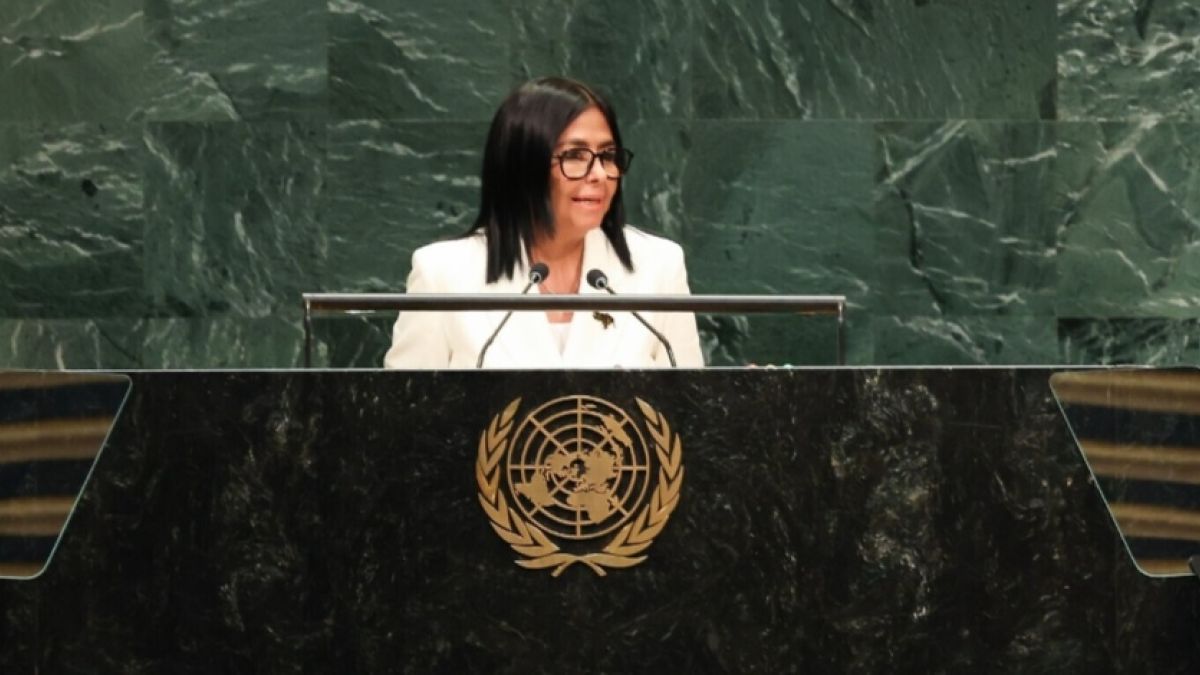
At the recent 81st General Assembly of the United Nations, the President in charge of Venezuela, Delcy Rodríguez, posed a question that resounded in the plenary and that, however, very few in the old continent were able to decode in all its dimensions: On which side is Venezuela?
For the traditional European left, used to interpreting the world through rigid Eurocentric manuals, the Venezuelan government's response is often an enigma.
They see pragmatic twists, uncomfortable alliances or discourses of economic openness, and they immediately assume that the Bolivarian Revolution has given up on its principles or that it lacks an ideological compass.
The fundamental error of the left is chronic: they don't study Simon Bolivar. By ignoring the Liberator's doctrinal roots, they are unable to understand that Venezuela's actions do not respond to the script of European Social Democracy or to Soviet dogma, but to an emancipatory root with more than two centuries of validity.
Social Equality: A Venezuelan Concept Before Marx
When Delcy Rodríguez pointed out at the UN that the country's inalienable goal is to “consolidate a system of justice and social equality as conceived by our Liberating Father Simon Bolivar,” she was not resorting to an empty slogan. He was invoking the core of Venezuelan political identity.
Let's make historical memory. At the Congress of Angostura in 1819, Simón Bolívar pronounced a categorical sentence:
“The foundation of our system depends immediately and exclusively on established and practiced equality... Nature renders men unequal in genius, temperament, strength and character. Laws correct this difference, because they place the individual in society so that education, industry, arts, services, virtues, give him equality, properly called political and social”.
This thought is 29 years older than the very Communist Manifesto of Karl Marx and Friedrich Engels (1848). If we use the famous definition of the Italian political philosopher Norberto Bobbio, who established that the unequivocal trait of the left is the relentless search for equality as a mechanism for correcting social oppressions, Bolívar's thinking is, by definition, original socialist.
It is a profoundly republican, ethical and anti-imperialist socialism born from the open veins of colonial America. The European left, ignoring this foundation, loses sight of the fact that the priority for social justice in Venezuela has indigenous and pre-Marxist roots.
High Diplomacy as a Shield: The Language of a Republic Under Siege
One of the most misunderstood points in the President's speech (E.) Rodriguez was his tone. Those who expected strident rhetoric or a linear dogmatic confrontation were baffled by an address characterized by extremely sophisticated and diplomatic language.
To understand this, we must assume the harsh geopolitical reality: Rodríguez spoke to the world as the statesman of a Republic that suffers from an iron economic blockade and that exists under the constant latent threat of military aggression.
In the Bolivarian tradition, language is not an ornament; it is a weapon of strategic defense. Bolívar himself was a master of epistolary balance and asymmetric negotiation when the Republic was in the making and surrounded by powerful enemies. The President-in-charge employed surgical diplomacy not out of weakness, but out of State responsibility:
Neutralizing the narrative of the use of force:
By expressing himself in the purest codes of international law, he disarmed the pretexts of those who seek to justify military interventions or the intensification of sanctions.
Protect the people from the rostrum:
Using a constructive and firm tone at the same time allowed him to open vital energy and political negotiations for the country, demonstrating that sovereignty is not defended in isolation, but with geopolitical audacity.
Own destiny, free trade and the challenge of Artificial Intelligence
The President (E.) Delcy Rodríguez was categorical in denouncing the failure of world free trade, a global corporate system that has commodified human rights and that uses financial flows and economic blockades as tools of collective punishment to prevent nations like Venezuela from “building their own destiny”.
But the discourse did not stop at the diagnosis of the 20th century. The President in charge warned that in current geopolitics, artificial intelligence (AI) will play a major role.
AI and data control are not neutral technologies; today they risk becoming the new instrument of neocolonial domination, automating global inequalities and concentrating power in a few corporations.
Back to Bolivar in the Age of Algorithms
The European left will remain mired in its own misunderstanding as long as it persists in applying colonial prescriptions and interpretations to the processes of the Global South. Studying Simon Bolivar in the 21st century is not an exercise in historical nostalgia, but rather an urgency for geopolitical survival.
Faced with a fragmented world order, threatened by the collapse of multilateralism and the rise of a technological architecture that seeks to subordinate peoples, the Liberator doctrine stands as a guide to resistance.
Only practiced equality, the shield of national sovereignty and diplomatic audacity in the face of siege, will allow nations of the Global South to navigate the era of artificial intelligence without masters or tutoring. It is time for Europe to turn on the lights of Angostura to begin to understand, at last, the nature of the Bolivarian Revolution.
FRANCISCO AMELIACH