Chávez, a leader who set the tone in the world
Internet photo
Published at: 28/07/2026 09:36 AM
The leader of the Bolivarian Revolution, Hugo Chávez Frías, made a mark on the international community through undisputed leadership, in search of the union of peoples, framed in Bolivarian thought.
Chávez made his debut as president at the Non-Aligned Summit in Jamaica. In October 1999, he embarked on his first tour of Asia, immediately implementing the strategic plan for the region.
The 2000 Summit of the Organization of Petroleum Exporting Countries (OPEC) was the most important international event of the second year of the Bolivarian leader's administration, which pushed him out of the border in the role he would play within the framework of the organization, with the main natural resource, oil, and to strengthen international strategy.
In October 2000, the first cooperation agreements were signed with Cuba, being the starting point for the privileged strategic relationship between the two nations.
In April 2001, Commander Hugo Chávez participated in the Summit of the Americas held in Quebec, Canada. During the same year, Venezuela hosted the Summit of the Andean Community of Nations.
In 2002, in the month of April, the opposition in Venezuela, together with the United States (USA) and other allied countries, sought to arrest Chávez as a national and international leader, however, the People did not allow it and it was on April 13 that they rescued the Commander together with the glorious Bolivarian National Armed Forces (FANB).
On August 31, 2002, Chávez attended the II World Summit for Sustainable Development held in Johannesburg, where he proposed contributing 10% of foreign debt to help the world's poor countries.
BBC Mundo, through its web portal, revealed details of a survey in which Hugo Chávez Frías was elected person of the year 2002.
In 2003, during the XIV Andean Presidential Summit, while the High-Level Meeting on Poverty, Equity and Social Exclusion was taking place, the Commander promoted his social agenda framed in the principles of equality, so he proposed the International Humanitarian Fund.
The leader of the Bolivarian Revolution reached very high levels of popularity that led the nation to host the Second Summit of Heads of State and Government of OPEC, during which he urged industrial powers to lower the costs of inputs and manufacturing, as a protection for hydrocarbon prices.
Since 2004, while at the head of the country, Commander Chávez has promoted the 10 major objectives of the government with a view to consolidating the revolutionary process in the new phase of Socialism in the 21st century.
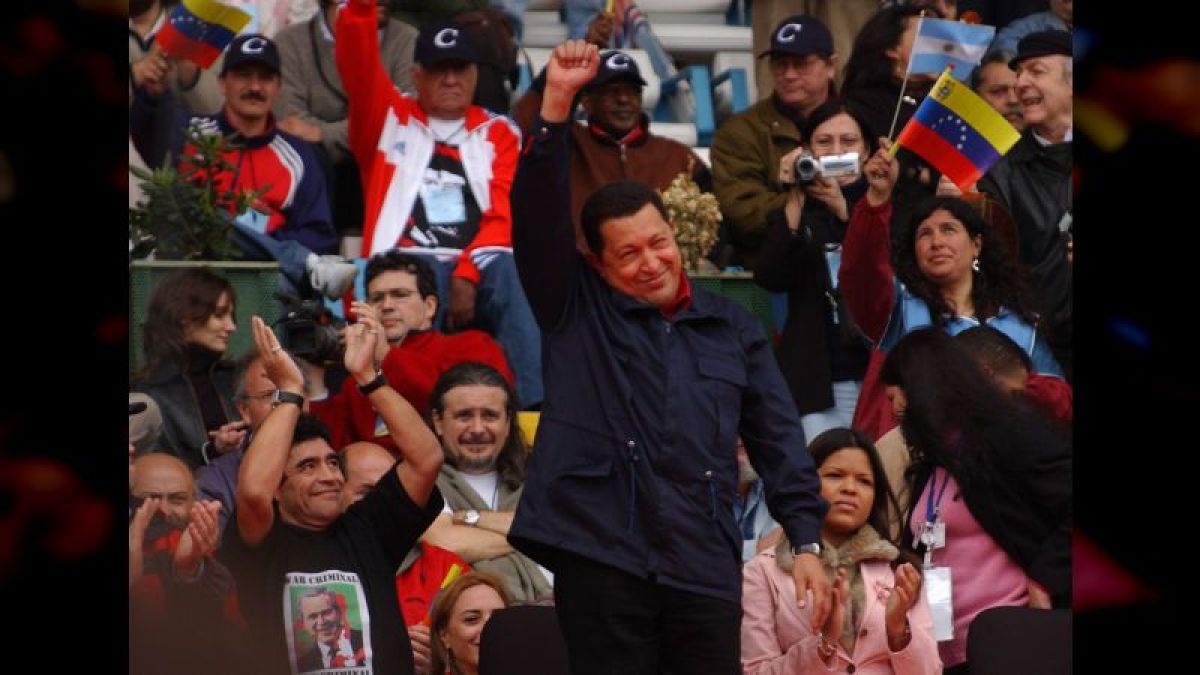
Hugo Chávez, during the Fourth Summit of the Americas, held on November 4 and 5, 2005, in Mar del Plata, Argentina, together with Ernesto Kirchner, Evo Morales, Luiz Ignacio Lula da Silva, and others, put an end to the attempt of the United States (USA) to impose its hegemony by burying the Free Trade Area for the Americas (ALCA).
“In Mar del Plata, today, each of us brought a shovel, a gravedigger shovel, because here in Mar del Plata is the tomb of the Alca,” said the Bolivarian leader in an unprecedented event, under persistent rain in a stadium.
On September 20, 2006, Chávez gave the famous speech at the sixty-first General Assembly of the United Nations (UN), where he denounced US imperialism and the “Devil” George Bush. “Yesterday the Devil came here, yesterday the Devil was here, in this very place. This table where I had to speak still smells of sulfur. Yesterday ladies, gentlemen, from this very rostrum the President of the United States, whom I call The Devil, came here speaking as master of the world,” he said.
In search of the consolidation of 21st century Socialism for the new alliance policy led by Hugo Chávez, he strategically sought, through Venezuela's foreign policy, the displacement of diplomacy as a fundamental instrument for the exercise of coexistence with nations.
Commander Chávez named Europe, Asia, Africa, North and South America the five poles of power in the world, highlighting the role of India and China in the new global context, driven by significant economic growth, which offered new investment opportunities at the political level.
Along with Chávez, Venezuela achieved important alliances with countries such as Russia, China, Belarus, Iran, Turkey, Syria, among others...
The work he carried out during his 20 years of government is impressive, these allowed the expansion of oil diplomacy, the consolidation of a society of equals through socialism and the promotion of energy and economic power as an engine, in order to achieve the recovery of the nation handed over by the governments of the Fourth Republic to imperial forces.
Mazo News Team