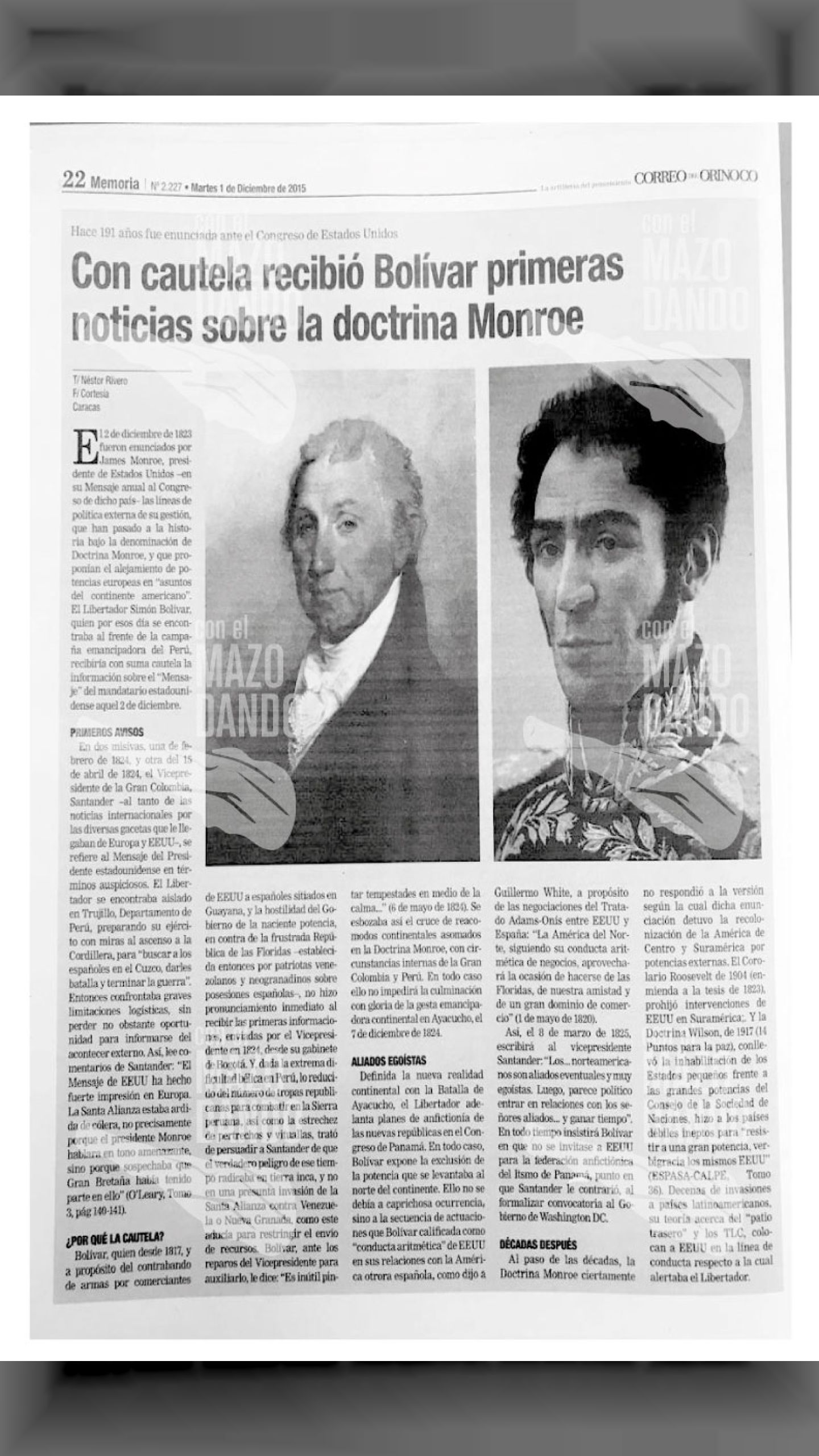
201 YEARS SINCE THE CALAMITIES OF THE MONROE DOCTRINE
Published at: 04/12/2024 10:00 PM
- The history of Latin American countries has always been marked by a constant struggle between the consolidation of their independence, autonomy and sovereign rights to free self-determination, versus the ambitions of imperialist powers to plunder them.
- After our independence, consolidated in the Carabobo Field on June 24, 1821, an American declaration appeared destined to plague the nascent nations of the South with all kinds of calamities: The Monroe Doctrine.
- The Monroe Doctrine, proclaimed on December 2, 1823, was presented as a new double-edged sword in American foreign policy, a symbol of its expansionist ambitions and a tool that was initially designed to protect the continent's independence, but which eventually became the foreign policy of the garrote or The Big Stick.
- Simon Bolivar received the news about the enactment of this new form of foreign policy with great caution.
- To date, El Libertador was in Trujillo, Peru, preparing the army to climb the mountain range and face the Spanish in a final battle to end the War of Independence for the nations of the South.
- Already in June 1817, following the confiscation of the American merchant schooners Tigre and Libertad, on the Orinoco River, both full of weapons, ammunition and equipment for the Spanish armies, he wrote a strong response to the emissary of the American government, J.B. Irving, warning about the hostile nature and the warlike nature of that country against the nascent Republic of Gran Colombia.
- Later, on August 5, 1828, Liberator Simon Bolivar was the first to warn, prophetically, about the dangers and threats that the United States would pose to the nations of Latin America and the world when he exclaimed: “The United States seems destined by Providence to plague America with misery in the name of freedom.”
- This was a clear testament to their distrust of the true intentions of the U.S. government. Bolívar understood that the struggle for independence did not end with the defeat of the European powers; the new challenge would be to resist the advance of the United States.
- Once continental freedom had been defined, achieved with the Great Battle of Ayacucho (December 9, 1824), Bolívar advanced the preparations for the holding of the Panamanian Amphictyonic Congress, for which he gave precise instructions so that the U.S. government would not be invited. An order that, for a change, Francisco de Paula Santander ignored, which meant a great displeasure for the immortal man from Caracas.
- In a letter addressed to Guillermo White, regarding the Adams-Onis Treaty between the United States and Spain, Bolívar predicted that “North America, following its arithmetic business conduct, will seize the opportunity to become Las Floridas, our friendship and a great domain of commerce” (May 1, 1820).
- The duality of the Monroe Doctrine today is reflected in sanctions, the blockade, the siege of hunger, interference in internal affairs and the constant threat of direct or mercenary military intervention.
- However, as early as 1630, the religious fanatics or “founding fathers” of the United States, who began the genocide of all the original ethnicities, had outlined the infamous “Manifest Destiny”, according to which they were the ones predestined by God to subdue whoever stood in their way and annexed the territories they believed to be their own.
- Therefore, Manifest Destiny, which came to fruition with the annexation of Mexican territories in 1848; the Monroe Doctrine and territorial appropriation are part of this most holy trilogy that justifies massacres, invasions, aggressions, interventions, and in our case coercive and unilateral sanctions.
- Thus, with a Bible in their hand and a Colt 45 in the other, American colonists executed millions of indigenous people throughout the 19th century.
- From the perspective of Hugo Chávez's Bolivarian Doctrine, the parallelism between the Monroe Doctrine, the Bolivarian vision of sovereignty and the current sanctions against Venezuela show the historical continuity of Yankee imperialist aggression against the continuous resistance of the Peoples in defense of their territorial integrity, their cultural identity and the dignity of their constituents.
- The Monroe Doctrine was nothing more than a rhetorical somersault of the Calvinist ideal or Manifest Destiny, which under the slogan “America for Americans”, was presented as an anti-colonial statement that rejected the interference of European monarchies in the affairs of the continent.
- However, this supposed defense of “American” autonomy was nothing more than a policy of expansion, surveillance, control, invasion and punishment by the United States. Instead of promoting the sovereignty of Peoples, it became a tool to consolidate their hegemony, leaving other nations relegated to the role of green areas in the imperial garden.
- Today, the aggression against Venezuela under the guise of “Bolivar Law”, “defense of democracy” or “protection of human rights” is nothing more than a continuation of the hypocrisy of the Monroe Doctrine, adapted to the conditions of the 21st century.
- The economic sanctions, promoted by the United States and its allies, represent an act of war whose objective is to subdue the Venezuelan people, destabilize their government and take control of their strategic resources, particularly oil, gold, coltan, water and forest resources.
- These sanctions, which violate all principles of international law, have caused serious consequences for the Venezuelan economy, especially affecting the most vulnerable sectors.
- However, instead of destroying the Bolivarian Revolution, they have strengthened the resistance of the People, just as Bolivar dreamed of when he fought against the Spanish Empire and the European Triple Alliance.
- The Bolivarian Response to unilateral and coercive measures is summarized in Hugo Chávez's last great message on December 8, 2012: “Unity, Struggle, Battle and Victory”. In other words, the unwavering resolve to resist the imperialist blows together, with the unwavering certainty that the unstoppable forces of history will give us the great total victory. As the title of Juan Germán Roscio's book goes: The Triumph of Freedom over Despotism.
- Venezuela, as a bastion of anti-imperialist resistance in the region, has become a strategic target of the United States. However, just as Bolívar fought against colonial forces in his time, the Venezuelan people are still fighting against modern aggressions today, defending their right to build their own social, economic and political model.
Mazo News Team