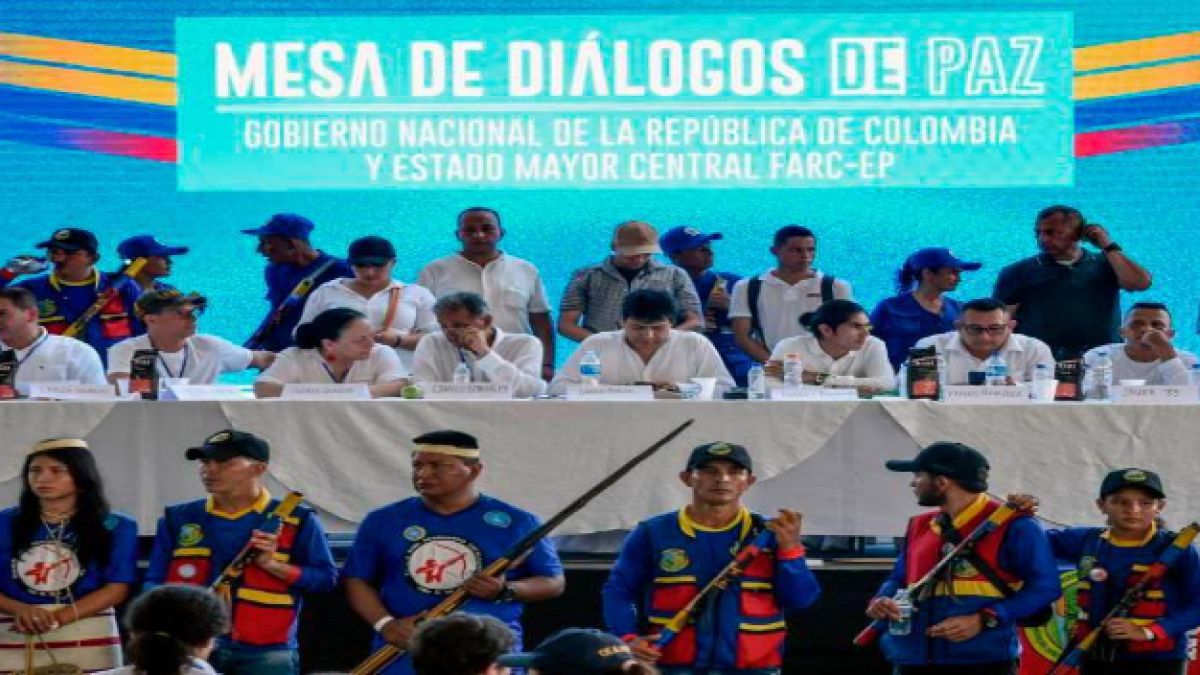
Government of Colombia and FARC dissidents will begin the third cycle of Peace Dialogues
Internet
Published at: 08/01/2024 10:20 PM
The Government of Colombia and the Central General Staff (EMC), one of the dissidents of the extinct Revolutionary Armed Forces of Colombia (FARC), will begin their third cycle of peace talks this Tuesday, January 9, according to the Russia Today website.
He reports that according to reports from El Espectador, the talks will take place in Bogotá and could last until January 20.
The initiative is launched after the completion of the second round, in mid-December, whose main achievement was the EMC's commitment to suspend kidnappings “for economic purposes”.
For its part, EFE notes that according to the office of the High Commissioner for Peace, today headed by Otty Patiño, the working sessions will be “closed” to third parties and “at the end of the cycle, if the Bureau so decides, there will be a public pronouncement”.
It indicates that the parties are expected to discuss the territorial transformation of places that depend on illegal economies, such as the Micay Canyon, an area located in the department of Cauca (southwest of the country), which constitutes one of the main centers of coca cultivation, where clashes have occurred between the Army and guerrilla members.
“We hope to advance important definitions, not only on the humanitarian issue and respect for the population, but also on territorial transformations and actions with an impact on regions,” Camilo González Posso, head of the Executive delegation in the exchanges, told El Espectador.
Another issue that will be on the table will be compliance with the bilateral ceasefire, as well as respect for the agreements signed to respect international humanitarian law in the areas under dispute, including, among other things, an end to forced displacement, not to attack civilians and not to prevent or hinder medical or humanitarian missions.
The dialogues between the Government of Petro and the EMC have come into crisis on several occasions for various reasons.
Last November, the dissidents announced their withdrawal from the format after months of clashes with the Army in Micay Canyon, in addition to a sectorized suspension of the agreed bilateral ceasefire.
On that occasion, Petro accused the insurgency of attacking soldiers deployed in the area with explosives to prevent the transformation of the local economy, currently based mainly on the cultivation of coca, to one based on legal activities.
In addition, in statements offered at an event with the National Police, the president said that the political negotiation initiated with the EMC had perhaps been “premature”, because they were directly proposed to leave the territory peacefully and give way to the authorities to “transform the entire Micay Canyon into a licit economy through the action of the Colombian State”, when the conditions were not right for it.
The mood became even more tense when the Minister of Defense, Iván Velásquez, questioned the appropriateness of maintaining the bilateral ceasefire, given that the guerrillas had decided to leave the table.
The EMC severely questioned Velásquez, who was accused of not following Petro's line of pacification and of not allowing the installation of the agreed oversight, monitoring and verification mechanisms, although they clarified that this did not mean that they were renouncing peace negotiations.
Tensions with the head of Defense and the rest of the Executive remain.
Mazo News Team