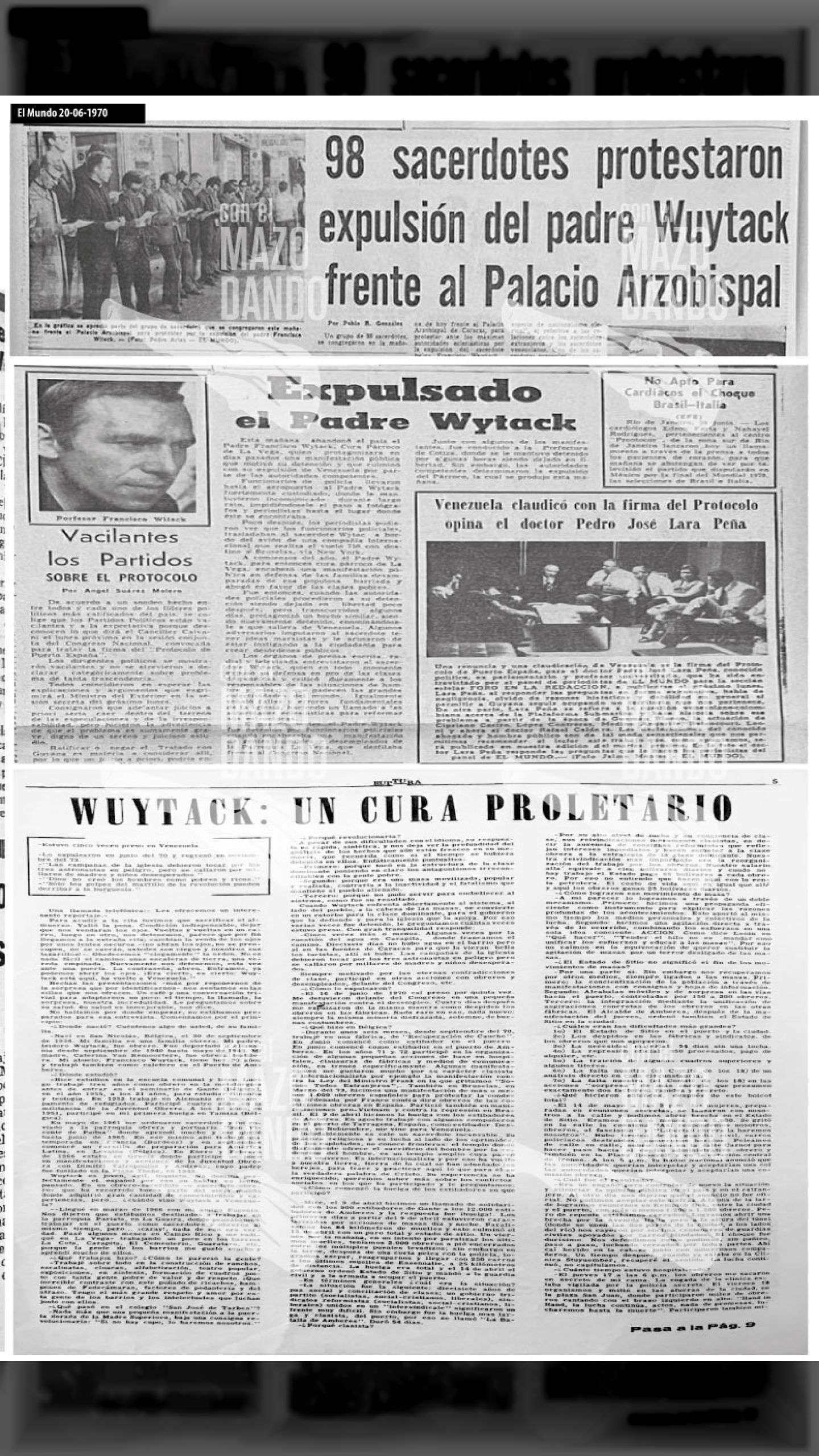
A PRIEST NAMED WUYTACK
Published at: 25/06/2025 09:00 PM
(Latest News, June 24, 1970)
- After his last demonstration, when Francisco Wuytack asked the National Congress to study the problem of unemployment and truly popular education, he released a sheet that read: “The Caracas Hilton Hotel costs 100 high schools.”
- He was then arrested and ill-treated by the police. That happened on Wednesday, June 17. They released him at 3 in the morning on Thursday... On June 19, at night, while at the neighborhood school, a judge and a priest went to pick him up.
- Witnesses claim that Father Wuytack told the priest who took the police: “I know you're going to hand me over.”
- And so it was, in effect, a Metropolitan Police patrol was waiting at the exit. On Saturday, June 20, he was taken to Maiquetía as if he were a thug, surrounded by police officers who prevented anyone from approaching him. He was expelled from the country wearing the same clothes he was wearing when he was arrested.
- Since 1966, the Belgian priest Francisco Wuytack worked in the neighborhoods of Caracas. He lived within the community, doing extraordinary social work all day and part of the night. In the El Carmen neighborhood, in La Vega Parish, he was at the center of his activity, but all of La Vega knew him.
- It was also moving to Carapita, Cota 905, Antímano and Los Aguacaticos de El Valle. This almost daily tour was done on foot or through “queues”. When he arrived in the country he had a car; then he sold it and bought a motorcycle. Then he had to get off the bike. Then I was walking through the hills and ravines to the west of the city.
- Father Wuytack always insisted on the need for the poor to become aware of their problems and to abandon the passivity in which they were engaged... It cannot be said that he held a position of violence, on the contrary, he recommended peaceful protest... He had a sensitivity that led him to directly exercise the priesthood without bureaucratic interference, to be in contact with the marginalized.
CONTEXT:
- Francisco Wuytack was born on September 30, 1934 in Saint Niklass (Belgium). As a young man, he actively participated as a metal worker in the organization of young Catholic workers.
- While in Venezuela, he managed to activate a plan for the social organization of the popular classes in La Vega. He was the victim of police persecution and the third priest expelled from the country by the Christian social regime of Rafael Caldera.
- The “Father of La Vega”, as he was known, always preached that the poor, who are the very essence of the People, will be the ones who will ultimately free the rich from their loneliness, individualism and social isolation. “I don't say a lot of things, I don't talk a lot of straw, I tell my people in the neighborhoods that the poor, the people, will liberate the rich,” he said.
- Their expulsion was due to a request made by the high church hierarchy who were uncomfortable with the continuous remarks made to them by Francisco Wuytack about the great flaws and fundamental errors of the Catholic Church.
- His opponents in the government and within the church charged him with the crime of professing Marxist ideas and fomenting popular protests.
- On several occasions, the residents of his community had to hide it in their homes to avoid mistreatment and arrests ordered by the government. This persecution tried to prevent his relentless work of transformation.
- After the first expulsion, in June 1970, he illegally entered Venezuela in 1973 to continue his fight in the neighborhoods of Caracas, but was violently arrested and expelled in 1974 by the government of Carlos Andrés Pérez.
- For this reason, hundreds of priests, nuns and liberation theologians were murdered in our continent. Others excommunicated or ostracized. However, thanks to their courageous work and despite the Vatican purges, they have left their memorable mark on Latin American history: Matías Camunas, Juan Vives Suriá, Leonardo Boff, Ernesto Cardenal; the four nuns of the Maryknoll Congregation, murdered in El Salvador; Hans Küng, Jon Sobrino, Gustavo Gutiérrez, Pedro Casaldáliga, San Arnulfo Romero, Camilo Torres and the six Jesuits murdered in El Salvador: Ignacio Ellacurina Beascoechea, Elba Julia, Celina Ramos, Ignacio Martín Baró, Segundo Montes, Armando Moreno, Juan Ramón Moreno and Joaquín López, testify to their faith that only the People save the People. Vox Populi, Vox Dei; the Voice of the People, is the Voice of God.
Mazo News Team