CENSORSHIP AT THE TIME OF THE FOURTH REPUBLIC - CLARÍN IS PERMANENTLY CLOSED
Published at: 05/02/2025 09:00 PM
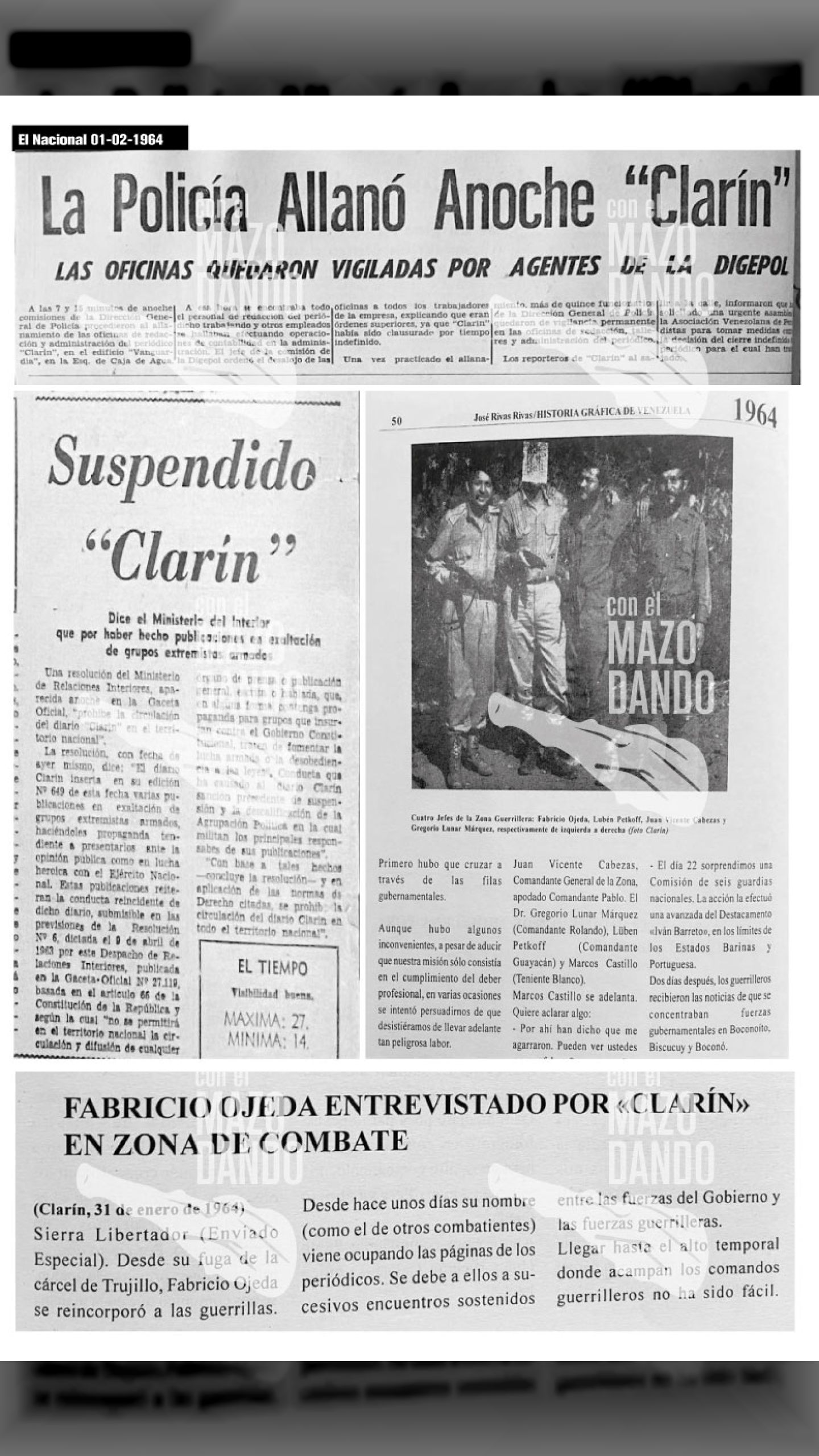
(El Nacional, February 1, 1964)
- Following an interview with Commander Fabricio Ojeda, in a combat zone, the Clarín newspaper was shut down on January 31, 1964, when it ceased to circulate permanently.
- During its almost three years of existence, Clarín was subject to several raids, destruction of its printing presses, and the arrest of its managers and employees. Its final closing was published in Official Gazette No. 27,119 of 31-1-64.
- These measures of police vandalism and official censorship were also systematically applied, at the same time, against the newspapers Tribuna Popular, Qué, La Hora and La Extra.
- On several occasions, Clarín published newspapers with blank spaces, referring to where information censored by the government should go.
- Clarín's voice was present in the allegations of the murder of Alberto Rudas Mesones, the murder of Livia Gourverneur, the massacre of the Sanz High School (Guerra y Millán), the lynchings carried out by armed AD gangs, in addition to the shootings ordered by the government against civilians and soldiers surrendered during the uprisings of El Barcelonazo, El Carupanazo and El Porteñazo, among the many covers he carried out.
- In the last edition of Clarín, No. 649, the office of the Ministry of Internal Relations stated in an official statement that: “The Clarín newspaper... exalted armed extremist groups, making them propaganda aimed at presenting them to public opinion as heroes confronted with the National Army.”
- The Clarín newspaper circulated for the first time on November 8, 1961, as a result of the need of the leftist sectors of the Democratic Republican Union (URD) party represented by José Vicente Rangel, Fabricio Ojeda, José Herrera Oropeza and others, to have a popular newspaper and to denounce the abuses of the Betancourt government.
- Later, he also became the spokesperson for some members of the Communist Party of Venezuela (PCV) and the Revolutionary Left Movement (MIR) who used him as an instrument of political struggle.
- His complaints in relation to the nefarious policies of the Betancourt Government earned him assaults on the drafting and workshops, suspensions, persecution of its workers and criers, as well as legal proceedings against its managers.
- Clarín did not give up in the face of such aggressions, on the contrary, he implemented different mechanisms to evade censorship that allowed him to always maintain his editorial line.
- Finally, the governmental animosity towards this tabloid was demonstrated on January 31, 1964, through a ministerial resolution that definitively banned its circulation (credit: Ysabel C. Meléndez - SABER UCV)
Mazo News Team