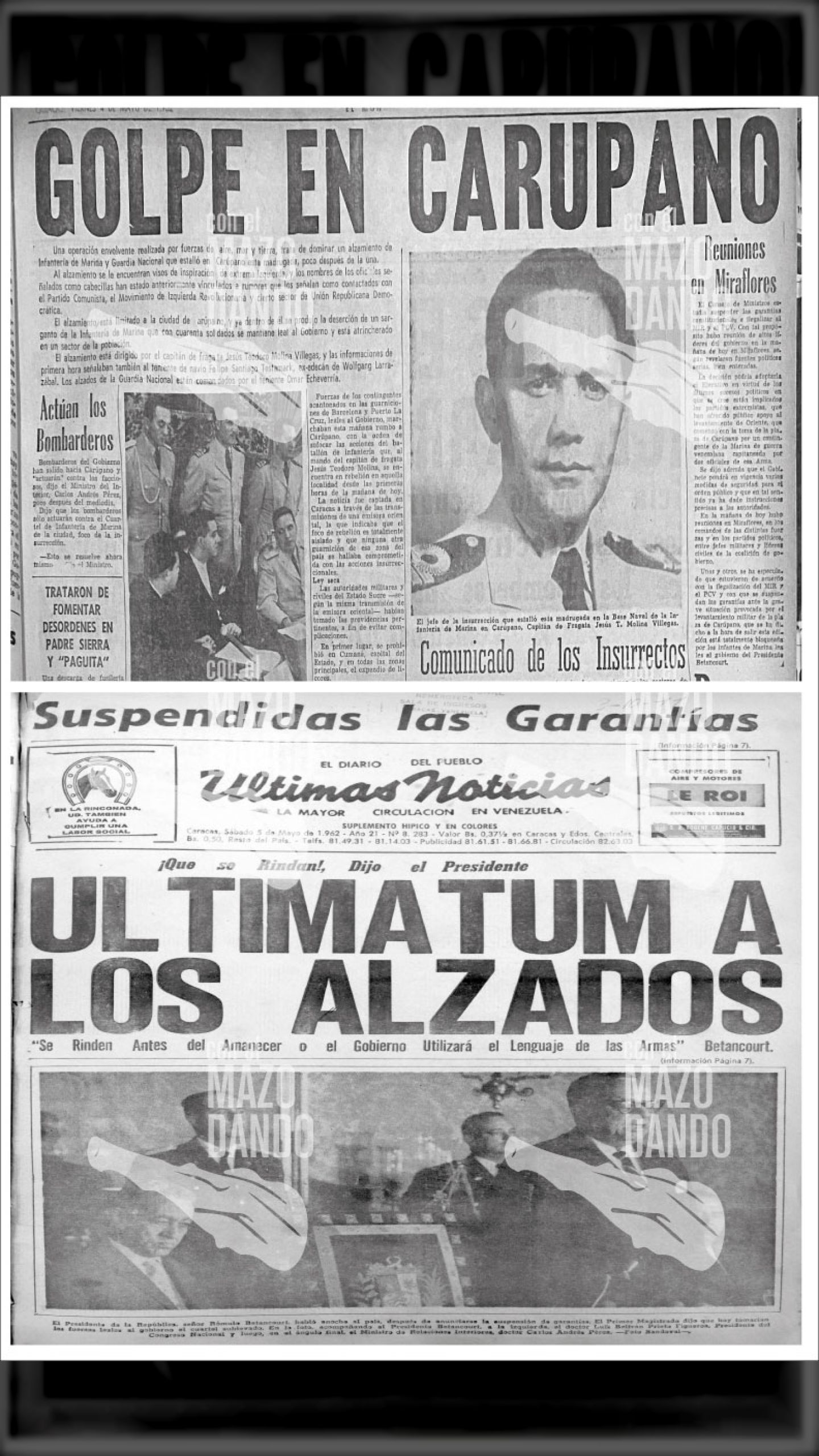
EL CARUPANAZO
Published at: 07/05/2025 09:00 PM
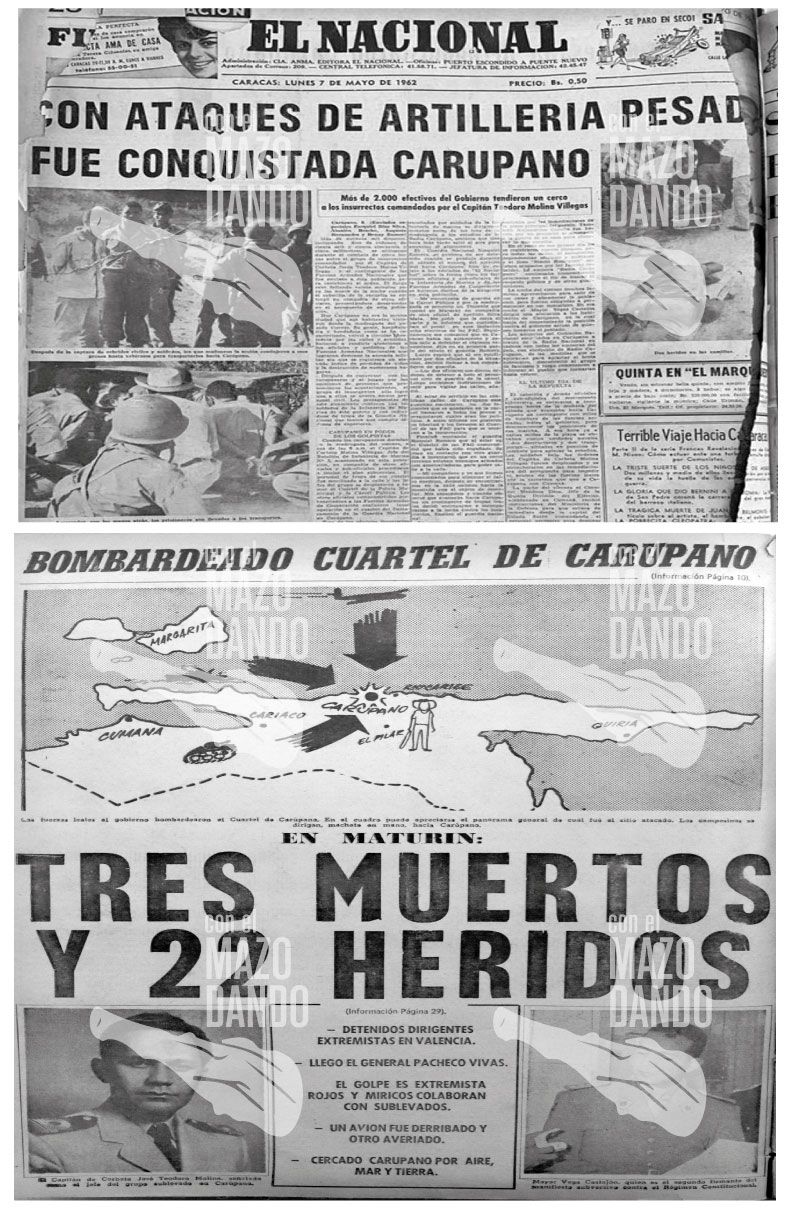
(EL NACIONAL and Latest News, May 5, 1962)
- The Carupanazo was an anti-imperialist insurrection, generated by young civilians and soldiers from the Navy and the National Guard, which included members of the 3rd Marine Infantry Battalion and Detachment No. 77, under the command of Corvette Captain Jesús Teodoro Molina Villegas and the Mayor Pedro Vegas Castejón, respectively, who led, together with the communist leader Simón Sáez Mérida, the uprising against the bloodthirsty regime of Rómulo Betancourt.
- The uprisings numbered around 350 soldiers and a hundred rebel civilians, who occupied the streets and buildings of the city of Carúpano, as well as the airport and the radio station Radio Carúpano, from which they broadcast the manifesto that started the uprising.
- The officers and civilians acted on behalf of the Democratic Recovery Movement, and in their radio statement they said:
“Because of the betrayal of the glorious 23rd of January*, the installation of a regime of terror by* Betancourt and his cabal, the repeated suspension of constitutional guarantees, and the farce of Agrarian Reform*, we seek the* Democratic Restoration and the reconstruction of the country.”
The statement noted: * “The Government of Romulo Betancourt has placed itself on the sidelines of principles and its unconditional minorities, despite the fact that they were the flag of the popular movement on January 23, 1958, and despite the fact that those principles were sworn in by the President. These principles have been trampled upon, the democratic regime has been usurped and the country's problems have been aggravated by this Government in the most irresponsible way, implementing irritating advantage and an increasingly aggressive and brutal repression against the people. We have rebelled against these deviations and those vices, because we know that there will be no constitutional continuity as long as this sectarian and ineffective regime, brutal on the other hand, endures, and that is why we believe that with Rómulo Betancourt and his current Cabinet there is no possibility of peace or progress” . *
- Manifests were broadcast on all radio stations, taken over by the insurgents, in the name of “Democratic Recovery”, calling on the civilian population to join the movement.
- The rebellion succeeded in dominating Carúpano, Rio Caribe and San José de Areocuar.
- The government, in response, sent 4,000 soldiers to the area. The uprisings were besieged by air, land and sea; and not receiving the expected support, from the eastern region and the rest of the country, they had no choice but to surrender.
Context:
- 1962 is the bloodiest period of the government of Rómulo Betancourt, which left a cemetery of 900 people murdered and more than 10,000 arrested in the concentration camps of Tacarigua (La Isla del Burro), Maracaibo and the mobile colonies of El Dorado.
- In January, there was the national transport strike, which began in San Cristóbal and the events in La Guaira, on January 29. This was an insurrectional attempt, known as “El Guairazo”.
- During Betancourt's five-year term, the rigor of torture was daily practice; applied in the cells of the White Palace, headquarters of DIGEPOL and SIFA.
- It was the year that the Theaters of Operations (TO) were installed, where horror stories and records abound:
- In July 1962, TO1 was created in Cabudare, edo. Falcón; who would be moved in August 1964 to Yumare, edo. Yaracuy, and it would be known as the TO5.
- The TO3, also known as the Urica Anti-Guerrilla Field, operated in the states of Lara, Portuguesa and Barinas, with a command post in El Tocuyo. It later expanded its operations to Trujillo and Apure.
- The TO4 operated in Cachipo, Monagas state and Cocollar, Sucre state. Its range of action covered Anzoátegui, Monagas, Sucre, Delta Amacuro Federal Territory, part of Guárico and even the south of Miranda.
- The TO6 was also installed, with a command post at Apamate Airport, in Altagracia de Orituco, which included Guárico, Miranda and Dtto. Federal.
- In these Theaters of Operations, the methods contained in the torture manuals prepared at the School of the Americas, in Panama, were applied, which combined repressive actions in vast peasant areas with the application of interrogations based on psychological terror to prisoners and torture.
- The application of these practices was carried out by a team called the Prisoners of War Interrogation Service (SIPG), composed of tormentors from the different military branches, police and informers from the guerrilla ranks incorporated into their commands.
- The TOs were torture camps that operated for the first time in the La Marqueseña ranch, in the Edo. Barinas, training site for members of the J.A. Páez detachment. This was the first unit of Army Hunters, formed to exterminate peasants and guerrilla fighters.
Mazo News Team