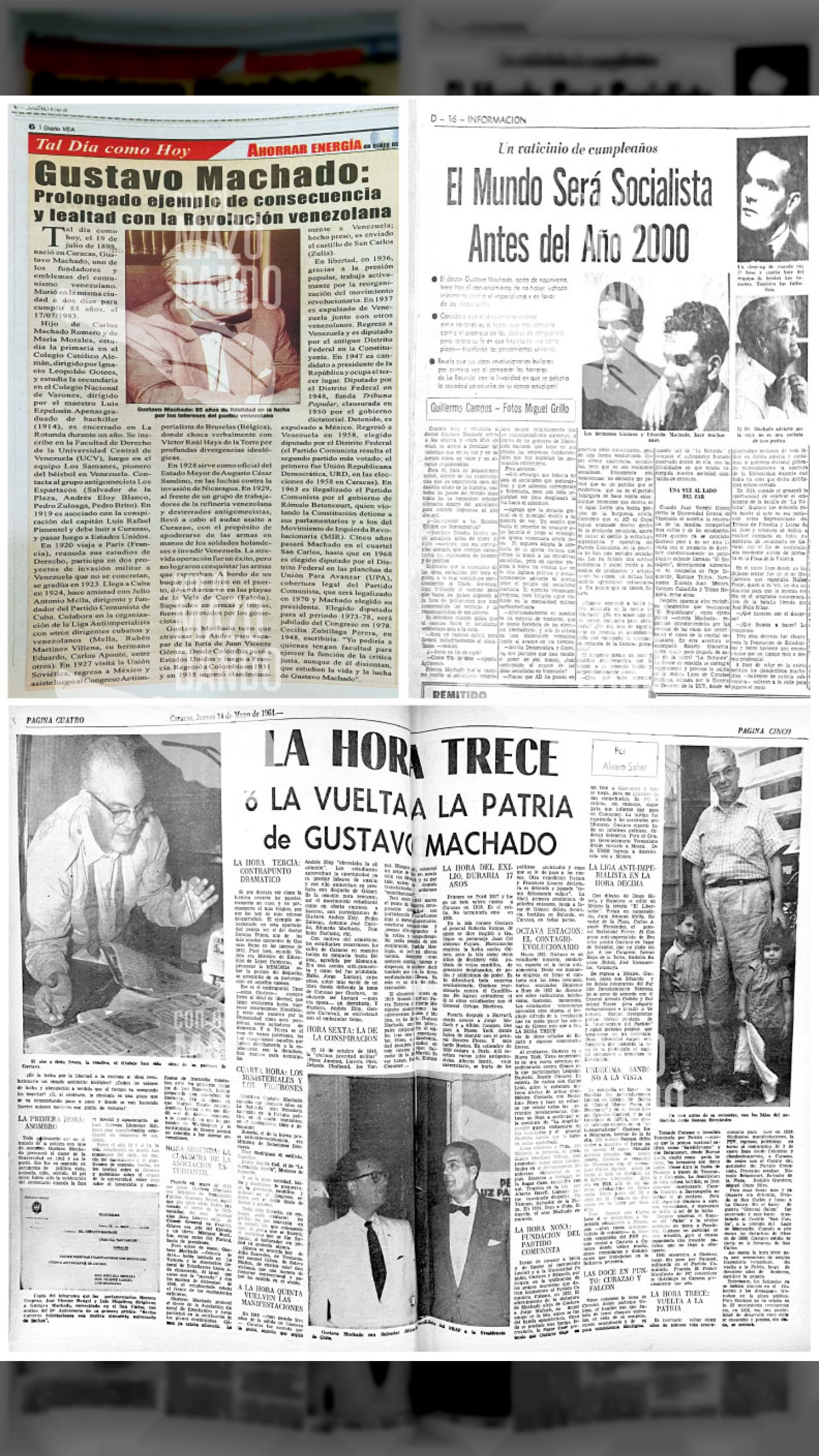
GUSTAVO MACHADO (1898-1983) EXAMPLE OF CONSEQUENCE AND LOYALTY TO THE VENEZUELAN REVOLUTION
Published at: 23/07/2025 09:00 PM
- Two days before celebrating his 85th birthday, Gustavo Machado Morales, a lawyer and communist leader who carried his flag of struggle beyond our borders, died in Caracas.
- Machado began his struggle as a revolutionary student in 1910, when he first witnessed the closure of the Central University of Venezuela.
- Two years later, on February 12, 1914, he intervened as a Youth Day speaker, protesting the closure of the Youth Association. This is why dictator Juan Vicente Gómez ordered his arrest in La Rotunda, carrying 30-pound crickets on each ankle for long months after his first imprisonment.
- He turned 16 years old while in detention in La Rotunda and because he was the youngest of all political prisoners in Venezuela, he was named El Benjamín of the Anti-Gomecist Revolution.
- After escaping spectacularly from this prison, he had to go abroad in 1919. That year he studied Philosophy at Harvard University.
- In 1920 he traveled to France where he obtained a law degree from the Sorbonne in Paris. In that city, he was linked to ideologically advanced groups, participating with Ho Chi Ming in the founding of the French Communist Party.
- Once he graduated, he returned to the United States and from there he went to Cuba, where he met Pío Tamayo and Salvador de la Plaza. Along with them and his brother Eduardo Machado, he participated in the founding of the Cuban Communist Party (PCC).
- As a result of his complaints against the dictatorship, he was expelled from Cuba. His colleagues from the Venezuelan Revolutionary Group (GRV) then sent him to the Soviet Union, from where he returned to Mexico as a representative of the French Communist Party to collaborate with the revolutionary government of General Lázaro Cárdenas.
- In Aztec territory, together with his brother Eduardo Machado, Salvador de la Plaza, Emilio Arévalo Cedeño and Julio Antonio Mella, he founded the Venezuelan Revolutionary Party (PRV), the origin of the Communist Party of Venezuela (PCV).
- On May 14, 1928, he joined the anti-imperialist struggle in Nicaragua, serving as an officer in the General Staff of Augusto César Sandino. There he founded the Hands Out of Nicaragua Movement (MAFUENIC).
- At the end of 1929, he was sent by the PRV to Curaçao where he carried out the assault on the island and then invaded Venezuela along the coast of Falcón state.
- After the defeat of the invasion, he returned to France, where he rejoined the French Communist Party until 1935.
- That year he secretly entered Venezuela, was arrested and taken to the Castle of San Carlos in the bar of Lake Maracaibo, from where he left on February 14 of that same year.
- In 1936, he participated in the definitive organization of the PCV and gave his famous speech at the National Theater where, among other things, he openly declared: “I am a Communist”.
- This meant a defiant provocation to the government of Eleazar López Contreras, for which he was expelled to Mexico in the company of 49 left-wing leaders.
- In 1947 he returned to Venezuela and was elected deputy to the National Constituent Assembly. That year he founded the newspaper Tribuna Popular, which he directed until his death on July 17, 1983.
- Between 1951-1958, he was banished to Mexico by the government of General Marcos Pérez Jiménez. In the capital, in 1956, he met Fidel Castro Ruz and Ernesto Guevara de la Serna, with whom he planned the voyage of the ship Granma to free Cuba from the dictatorship of Fulgencio Batista.
- He returned to Venezuela in 1958 to give his support to the authentic democratic process under way, which would later betray Romulo Betancourt and his sectarianism to deco.
- On September 30, 1962, Gustavo Machado was kidnapped by the repressive bodies of the government, violating parliamentary immunity and the legitimate jurisdiction with which he was vested.
- On May 14, 1964, Machado celebrated, imprisoned in the San Carlos Barracks, the 50th anniversary of his first prison during the Gómez dictatorship.
- Along with him were 12 other parliamentarians arbitrarily arrested, when Betancourt trampled on the National Constitution, imprisoning deputies and senators legitimately vested with popular representation.
- He was imprisoned in the San Carlos Barracks for more than four years. In 1964, a Sentence Commutation Act was introduced to release him in exchange for accepting voluntary exile, to which he replied: “I would rather die from the heart in the San Carlos Barracks than from the flu in Paris.”
- In 1974, he founded Unión Para Avanzar (UPA), a legalized version of the PCV, which brought him back to his seat as a deputy for the Federal District.
- From that moment, until his death, his incessant parliamentary activity in defense of the Human and Political Rights of the Venezuelan People flashed, up to the date of his trip of no return, from whose plane he remains an exemplary figure who guides new generations of revolutionaries and revolutionaries with his conduct.
Mazo News Team