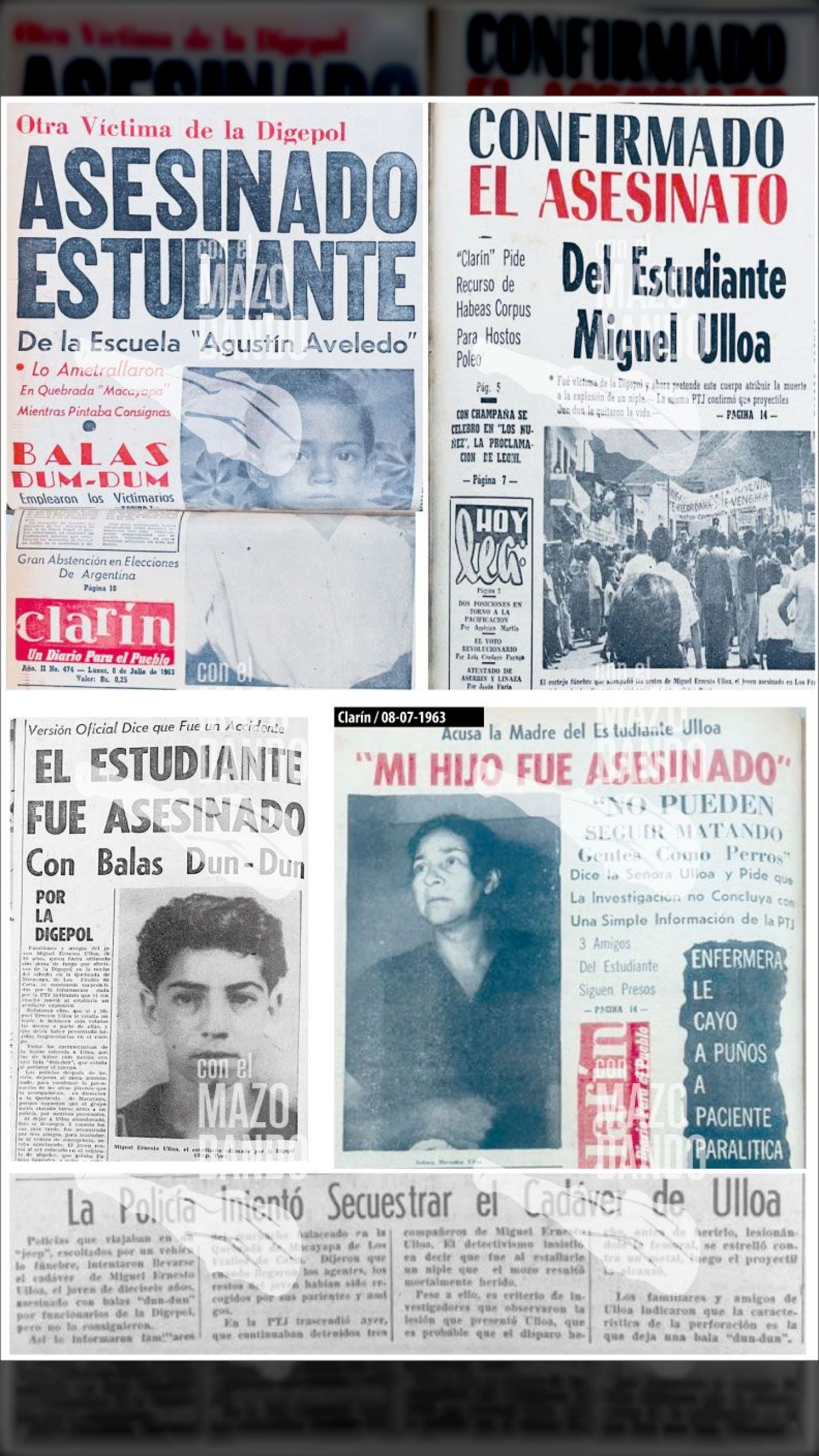
MIGUEL E. ULLOA, A STUDENT AT THE AGUSTÍN AVELEDO SCHOOL, MURDERED
Published at: 09/07/2025 09:00 PM
(Clarín, July 8, 1963)
- Miguel Ernesto Ulloa, a 16-year-old student, was strafed by agents of the General Directorate of Police (DIGEPOL) in the Quebrada Macayapa de los Frailes de Catia, when he was painting political slogans. During the wake, the officers who executed the child tried to kidnap the coffin.
- On the night of Saturday, July 6, 1963, Ulloa, a student at the Agustín Aveledo School, was killed by DIGEPOL agents, who killed him using Dun Dun explosive bullets.
- While painting slogans, Ulloa was surprised by a patrol and when he heard a loud voice, the unfortunate man raised his arms as a sign of surrender, and immediately the officers opened fire.
- In that sector, they left him bleeding to death, mortally wounded, without taking care of taking him to a healthcare position. Hours later, the body was found by his friends who tried to call for help, but he had already died.
- That night, 300 uniformed personnel from DIGEPOL, the Municipal Police and the National Guard raided Lomas de Urdaneta and Los Frailes de Catia, carrying out house-to-house searches in search of alleged escapees from the El Junquito checkpoint.
- In this police operation, the student Ulloa was killed and injured: Nélida Oliveros, 24, with a bullet in the face; Magaly Salcedo, 16, with a bullet punctured in the left leg; and Juan José Vásquez, 36, shot in the right shoulder blade. All of them were shot inside their homes.
- At the funeral of Miguel Ernesto Ulloa, thousands of people were outraged, becoming a true demonstration of popular mourning. There, the voices and slogans of protest against a criminal and immoral government were heard.
- That year, as a measure of intimidation, Rómulo Betancourt ordered that every night police forces fire shots into the air and machine gun bursts at “suspicious” young people in the popular areas of western Caracas. Some were seen as left-wing militants, others were not engaged in any political activity.
- The Clarín editorial denounced the complicit silence of most of the media, which did not publish the news, justifying with their indifference the criminality exercised by the repressive bodies of the State and the armed gangs of Democratic Action (AD): By then, “spiritual sclerosis, conformism, political supporters and the society of accomplices closed ranks to put a damper on impunity, applying the Law of Silence in the face of so many deaths”. From Miraflores, the president said: “Dead people don't talk.”
Mazo News Team