Venezuela demands lifting of sanctions during meeting on Human Mobility
Telegram Rander Peña
Published at: 17/01/2025 07:10 PM
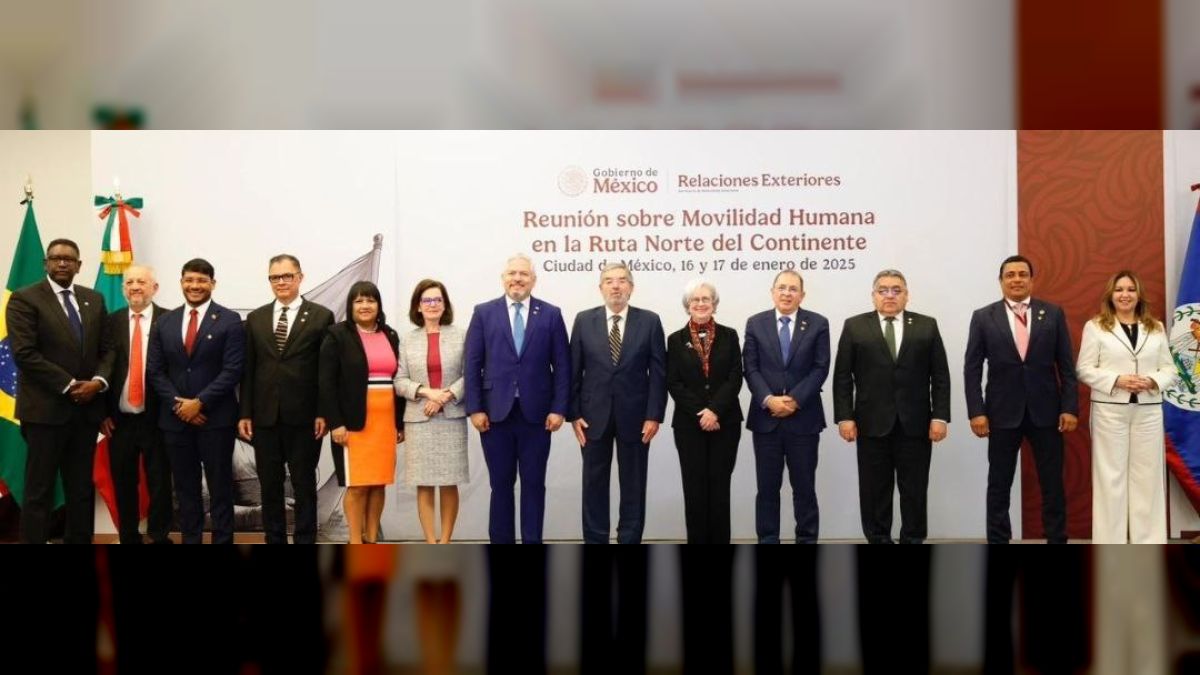
The Deputy Minister for Latin America, Rander Peña, on behalf of the Bolivarian Government and the Venezuelan People, demanded the cessation of the illegal imposition of unilateral coercive measures against Venezuela, a request that was included in the Meeting Declaration on Human Mobility on the Northern Route of the Continent, held in Mexico on January 16 and 17.
On his Telegram channel, Peña highlighted the support of ministers, vice-ministers and/or heads of delegation from Belize, Brazil, Colombia, Cuba, El Salvador, Guatemala, Haiti, Honduras and Mexico, in this issue, in addition to addressing migration challenges.
In his message, he emphasized that “we condemn unilateral coercive measures as a structural cause of Venezuelan migration, and countries urged the definitive and unconditional lifting of these criminal sanctions against our people. We also condemn all forms of criminalization against migrants and all types of unscrupulous businesses that seek to profit from migration.”
He highlighted the commitment of the President of the Republic, Nicolás Maduro, to advance the implementation of the Palenque agreements, while affirming that Venezuela is ready to receive every Venezuelan who was forced to migrate, as a result of economic sanctions illegally imposed by the United States and its satellite countries.
Peña published the declaration of the meeting on human mobility on the northern route of the continent.
Below is the full text:
MEETING STATEMENT ON HUMAN MOBILITY ON THE NORTHERN ROUTE OF THE CONTINENT
The ministers, vice-ministers of foreign affairs and heads of delegation of Belize, Brazil, Colombia, Cuba, El Salvador, Guatemala, Haiti, Honduras, Mexico and Venezuela:
We recognize the importance of constructive and respectful dialogue between countries for better management of migratory flows and their challenges.
We call on all countries in the hemisphere to behave in accordance with international law, human rights and their own domestic laws in managing human mobility with a humanistic approach, particularly in the face of the threat of mass deportation.
We stand in solidarity with people who are forced to leave their communities of origin, with the conviction that migration should be an option and not a necessity.
We reaffirm that all migrants, regardless of their migratory status, have fundamental and inalienable rights, and that all States are obliged to respect, protect them and to strive to adopt measures for their full realization.
We are committed to defending the human rights of all migrants, to rejecting their criminalization at all stages of the migration cycle, and to protecting them as a matter of priority from organized transnational crime that profits from migration, as well as from measures that place them in a situation of vulnerability and other risk factors. We will intensify intergovernmental cooperation and the exchange of information and good practices in consular matters, and the fight against trafficking and smuggling of migrants.
We reaffirm our interest in suggesting the reactivation of the meetings on migration of the Community of Latin American and Caribbean States (CELAC), with a view to having a wide space for the discussion of proposals from the different international organizations and mechanisms that deal with the issue of migration. This will facilitate the identification of synergies and complementarities between the different initiatives, in order to promote greater coherence and articulation between them, and to support the strengthening of their respective agendas.
Guided by the principle of shared responsibility, we will redouble national efforts and cooperation between governments, civil society, the private sector, destination countries, international organizations, international development banks and other partners, to address the structural causes of the migratory phenomenon in Latin America and the Caribbean. We understand that common efforts towards sustainable development, as well as the fight against poverty and hunger, and the reduction of social inequality gaps, promote social welfare.
We reaffirm our commitment to promote ways for safe, orderly and regular migration between our countries and other countries on the continent.
We stress that external factors, such as unilateral coercive measures, negatively affect entire populations and, to a greater extent, the most vulnerable individuals and communities. We urge their uprising, insofar as they are contrary to international law and have serious social repercussions beyond the countries on which they are imposed.
Announcements of mass deportation are a matter of serious concern, especially because of their incompatibility with fundamental human rights principles and because they do not effectively address the structural causes of migration.
We reiterate our intention to expand regular channels of labor mobility, and we call on other countries to do so. We are convinced that this contributes to the shared prosperity of our peoples and of the region as a whole, and that is why we are working towards the sustainable socio-economic integration of migrants, in the light of their important contributions to the countries and communities of destination.
We recognize the need to achieve humane and responsible management of irregular migratory flows. This management must include policies and measures to progressively strengthen migratory and international protection systems, where appropriate; provide basic assistance and services for people on the move; exchange information on the characteristics and routes of such flows; as! such as using voluntary and assisted return mechanisms in a dignified, orderly manner, respectful of human rights and with attention to reintegration that allows people to have opportunities for well-being in their communities of origin.
We reaffirm our strong support for the stability of the Republic of Haiti and to contribute decisively, in accordance with the capacities of each country, to supporting it in its efforts, together with the international community and the United Nations in particular, to restore an environment of human security for the normalization of the political, economic and social situation, with a sustainable development approach.
We will maintain close communication to evaluate progress towards these objectives and to address with priority the situations that deserve our greatest attention.
Mazo News Team