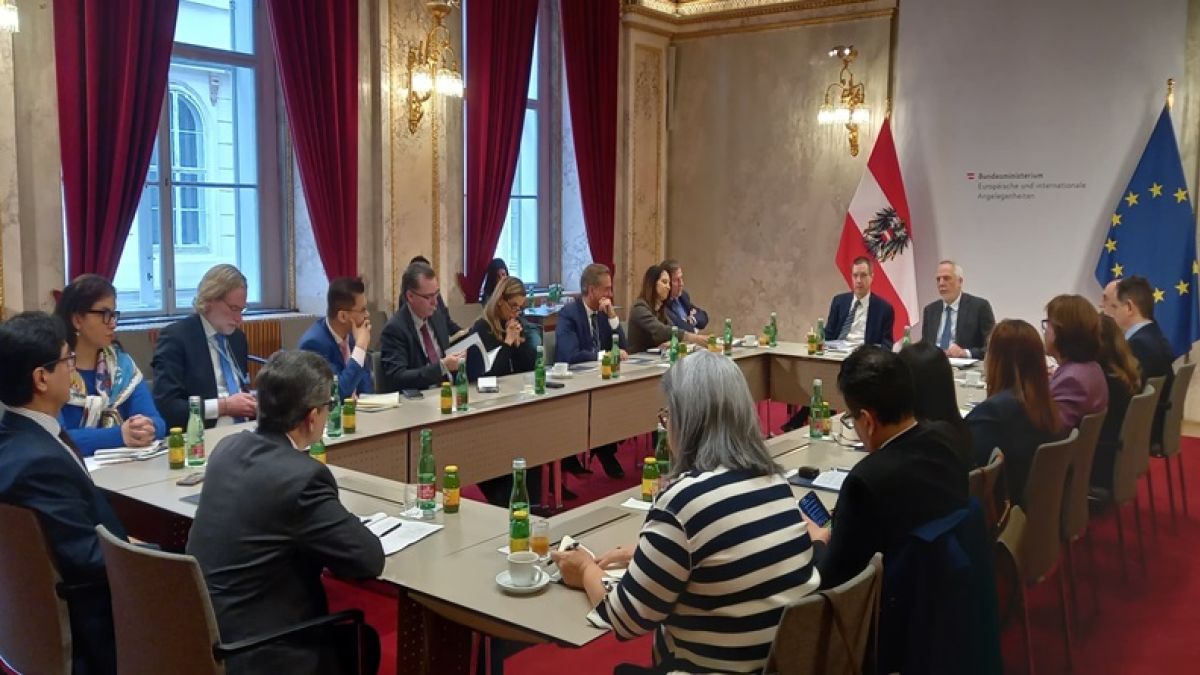
Venezuela participates in a meeting of the Austrian Ministry of International Affairs
Internet
Published at: 11/02/2025 05:38 PM
The ambassador of the Bolivarian Republic of Venezuela in Austria, concurrent to Slovenia, Slovakia and Croatia, Claudia Salerno Caldera, participated in a working meeting at the headquarters of the Federal Ministry of European and International Affairs of Austria, organized by the Embassy of Paraguay, in the exercise of the dean of the group of diplomatic representations of Latin American and Caribbean countries.
The first item on the agenda was called: “Disarmament and non-proliferation: Austria's current priorities”, by Ambassador Kmentt, who explained that his country's security policy encompasses all measures at the national, European and international levels, aimed at achieving, through cooperation, the objectives of working actively in configuring a situation favorable to the security of Austria, its population and the European Union (EU) as a whole; to prevent them from emerging or occurring effective threats; and protect yourself against threats.
Austria prioritizes support for multilateral organizations and international legal instruments on arms control that are based in Vienna. In addition to the International Atomic Energy Agency (IAEA) and the Comprehensive Nuclear-Test-Ban Treaty Organization (CTBTO), this city houses the Secretariats of the “Vienna Center for Disarmament and Non-Proliferation” (VCDNP); the Executive Secretariat of the Hague Code of Conduct against Ballistic Missile Proliferation (HCOC) and the Wassenaar Arrangement Secretariat (WA) on export control of conventional weapons and dual-use goods and technologies.
The Austrian diplomat recognized the role played by the countries of Latin America and the Caribbean in the adoption of international legal instruments in the field of disarmament and non-proliferation of weapons, both conventional and nuclear, as well as with regard to the cooperation that the regional group has had with the multilateral bodies that operate in Vienna, New York and Geneva in this area.
Before moving on to the second agenda item, brief interventions were made by the delegations present, highlighting their commitment to accompanying Austria's initiatives to support the disarmament and non-proliferation process worldwide, as well as research projects, conferences and training and training initiatives in this important area.
Ambassador Salerno Caldera thanked the presentation made by the Austrian Ambassador and emphasized that all countries advocate for security, peace and a world without nuclear weapons. In this regard, he stressed that “our diplomacy is aimed at avoiding double standards that allow multilateral bodies to make decisions based on pressure and political motivations to condemn only some States, being indifferent to the actions of others, such as what happened in the State of Palestine, where the prevalence of security of one of the parties to the conflict justified an unprecedented genocide against the civilian population, violating international humanitarian law and allowing the use of weapons not conventional”.
The second item on the agenda was called: “Cooperation in the cultural and scientific area”, with the intervention of Ambassador Alexander Wojda, who mentioned that one of the objectives of Austrian foreign policy is to cultivate his country's relations with the world and to represent the interests, concerns and points of view in the international and regional organizations of which Austria is a member, including UNESCO and EUNIC (National Institutes of Culture of the European Union).
He stressed that Austria's international cultural policy seeks to create new opportunities to promote bilateral cooperation, and indicated that that nation's global network of international cultural relations paves the way for international meetings and lays the foundations for cooperation projects.
This network consists of 30 Austrian Cultural Forums (Austrian Cultural Fora), 65 Austrian Libraries abroad (in 28 countries), 11 Austrian Institutes (in 11 European countries), two Science and Technology Offices, a Cooperation Office and 110 Austrian professors at universities abroad.
On the other hand, the head of the Cultural, Scientific and Technological Cooperation Agreements Unit, Ambassador Alexander Wojda, explained that Austrian international cultural policy focuses on the following 7 key areas, which are applied within the framework of priority programs: 1) Culture, Innovation and Ecology; 2) Digitalization and Digital Humanism; 3) Scientific Cooperation and Scientific Diplomacy; 4) Intercultural Dialogue; 5) Culture and Human Rights; 6) The EU and EUNIC; and 7) Women in Art, Culture and Science.
Mazo News Team