Venezuela promotes bioethics as a guide for training new professionals in the area of science
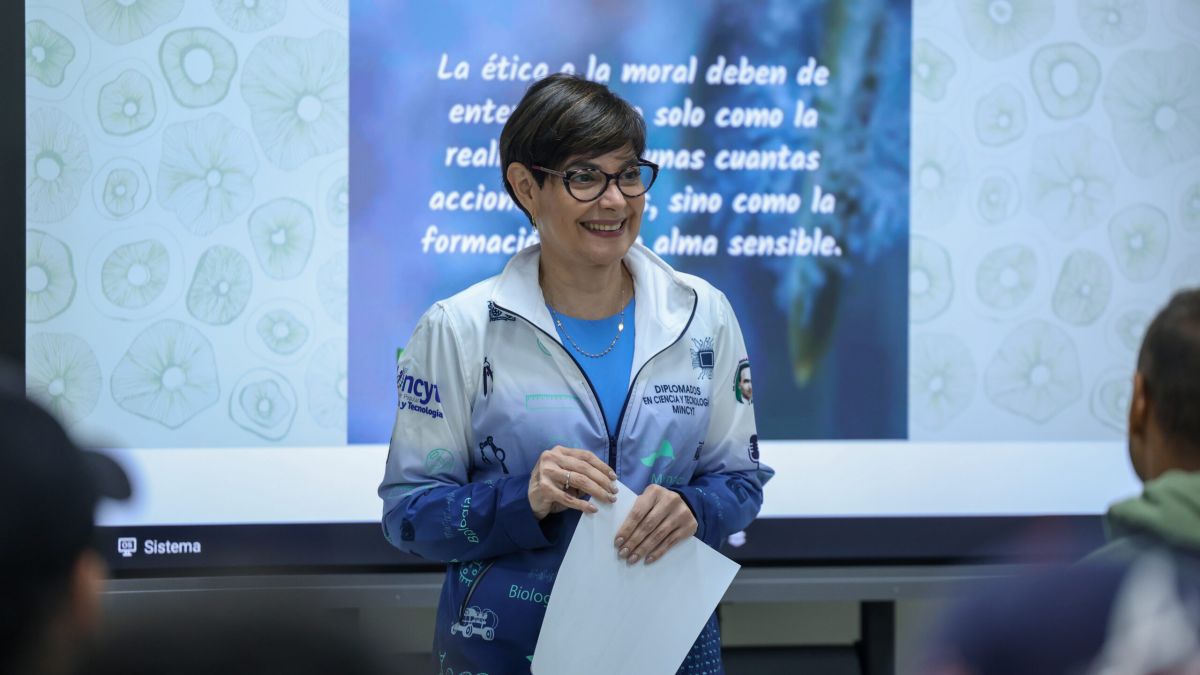
Photo: MINCYT
Published at: 26/11/2025 10:44 AM
With the incorporation of bioethics as a cross-cutting axis in the curriculum of the National University of Sciences Dr. Humberto Fernández-Morán, Venezuela consolidates its commitment to scientific education committed to life, social welfare and technological development with a humanistic sense.
These classes are provided by the rector of this house of study, Gabriela Jiménez Ramírez, who stressed that this approach responds to the contemporary needs and challenges of Venezuela.
“Each of the training programs has ethical and philosophical components that allow us to accompany the exercise of science and technology in Venezuela,” said the Minister of Science and Technology as well.
He explained that, in a context where the country promotes new technological platforms and a culture of innovation as productive engines, it is essential that future professionals understand their impact on daily life and their responsibility for collective well-being.
In addition, as highlighted by a press release from the Ministry of Science and Technology (MINCYT), he pointed out that bioethics must be understood as a profoundly collective process.
“We talk about the balance of altruism and selfishness, how it is possible to build dialogue from the point of view of bioethics because bioethics is not a monologue, it is the collective encounter, it is the promotion of the community, it is the encounter of the collective and the diversity of the people that we are, in our aesthetics and our truth,” said rector Gabriela Jiménez Ramírez, who, this Tuesday, evaluated the students of the Artificial Intelligence and Robotics course, which take place in this house of study.
For the Minister of Science and Technology, the discipline is a meeting point between diverse perspectives, sensitivities and knowledge and a tool for recognizing the plurality that makes up the country, its aesthetics, its truth and its identity.
He also stressed that this approach is essential to promote the social appropriation of technology, understood as the capacity of peoples to understand, participate, adapt and create technological and scientific solutions from their own realities.
“In the bioethics classes at UNC, we seek to sow in our students the conviction that all research and all new technology must be guided by a deep respect for human life,” he said.
Mazo News Team