April 11, 2002: When the Oligarchy Massacred a People Committed to a Revolution
Internet
Published at: 11/04/2025 09:10 AM
Since coming to the Presidency of the Republic at the behest of the people in 1999, Commander Hugo Chávez has been attacked by the country's elites supported by the North American empire and its allies, only for governing for the most vulnerable and leading a process of profound changes to vindicate Venezuelans.
One of the most criminal attacks perpetrated by the Creole oligarchy was 22 years ago, on April 11, 2002.
That day came with the characteristic violence of a fascist Venezuelan opposition, which through the media —which served as political parties of the right— radicalized a message of hate and under the slogans “All to Miraflores” and “Chávez go now”, would use all its tricks to generate chaos and death, attacking the Homeland of Peace for which the leader of the Bolivarian Revolution always fought.
Like sheep, at that time innocent Venezuelans embarked on a tragic path, planned by the diabolic brains of the right, who injected ideological poison into the consciousness of that sector of the people who believed in their speech, which only concealed an enormous interest in coming to power, through a coup d'etat that they had already been planning.
The afternoon of that April 11, became one of the most horrendous massacres that occurred in the country's political history, orchestrated by a sector of the business and commercial leadership that revealed itself to heat the country's streets, opposing a package of 49 laws enacted through an Enabling Law created by the then President Chávez, among which were the Land Law, which facilitated the fight against large estates, as well as the Hydrocarbons Act, which allowed the exercise of sovereignty in oil activity.
There, the resentment of the leaders in power of PDVSA was evident, who did not forgive Commander Chávez for the promotion of meritocracy in the state oil company, thus triggering a series of violent acts led by the Venezuelan Workers' Confederation (CTV) and the Federation of Chambers and Associations of Commerce and Production of Venezuela (FEDECÁMARAS), represented by Carlos Ortega and Pedro Carmona Estanga.
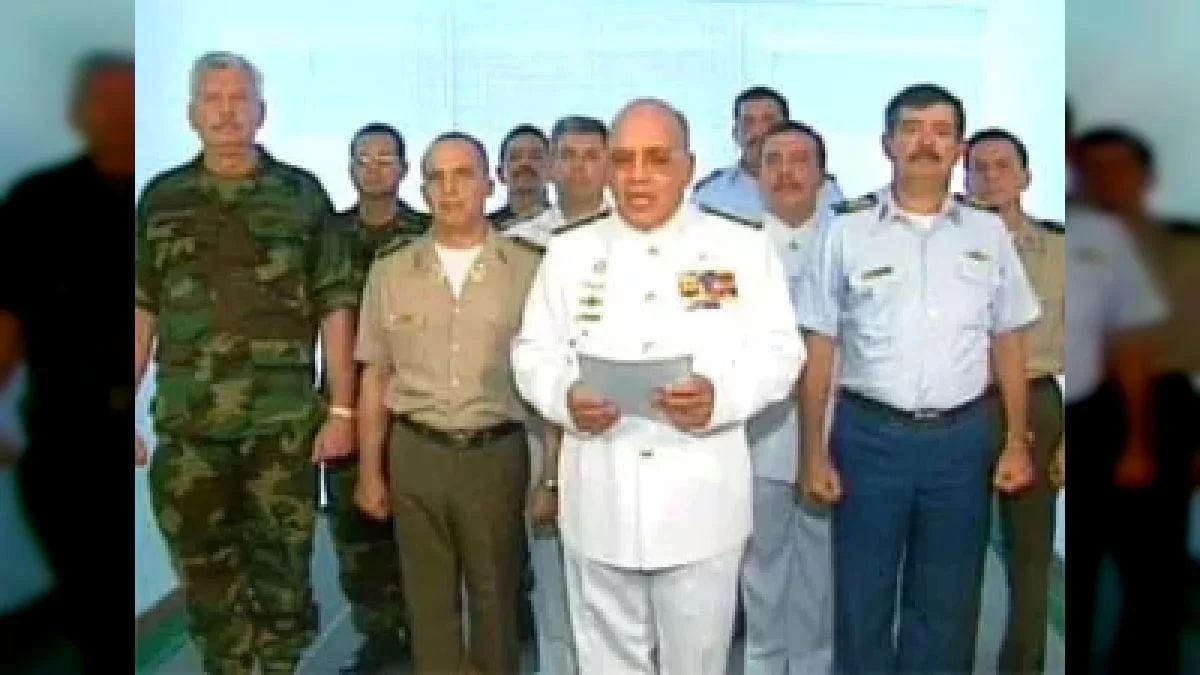
These figures, together with other representatives of the Venezuelan oligarchy such as Guaicaipura Lameda, Julio Borges, Henrique Capriles Radonski, Leopoldo López, María Corina Machado, and a group of dissident soldiers —all of them as part of the combo that appeared in Miraflores to install the Government of Carmona “the brief” —signed a document entitled “bases for a democratic agreement”, with the mediation of Luis Ugalde, rector of the Andrés Bello Catholic University; in which they demanded that the government to change his economic cabinet, and to abandon political sectarianism.
Faced with President Chávez's refusal to accept these demands, employers, unions and opposition parties created factual alliances to plan an indefinite strike on April 9 that would turn into a coup d'etat in which private media played a decisive role before, during and after the anti-constitutional action.
Unión Radio, RCR, El Nacional, El Universal, El Nuevo País, Venevisión, RCTV, Televén, Globovision, were some of the media that articulated actions of social persecution against the National Government; they were dedicated to transmitting information in which they referred to alleged attacks by the revolutionary people on the opposition march that was heading to Miraflores, without focusing on what was happening south of the Llaguno Bridge, on Baralt Avenue.
In the midst of media uncertainty, on April 11, 2002, President Hugo Chávez was kidnapped through a wave of violence that broke out in the center of Caracas, marked by unclear information that tried to make the population believe that the government had ordered the repression of the people and was inciting them to illegally usurp power.
Starting the violent plans, Rear Admiral Molina Tamayo called for a march to go to the vicinity of Miraflores, with the objective of meeting the popular demonstration that had been around the palace for three days in support of the process of change and in rejection of the civic strike led by the employers FEDECÁMARAS and the CTV, and thus the first acts of violence occurred, with the shooting of two demonstrators at point-blank range, and with the pretensions of keeping quiet about what had happened. among their demonstrators, private media omitted the events, which would end in more than 20 dead and dozens injured.
At 4:01 p.m., shooting began openly under the command of commissioner Iván Simonovis, Lázaro Forero and Henry Vivas towards Puente Llaguno, thus fracturing the hope of the Bolivarian people for several hours, during which they would be attacked by anachronistic groups (FEDECÁMARAS, CTV, private media, PDVSA workers, in coalition with the Democratic Coordinator, as well as the hierarchy of the Catholic Church) who conspired in an attempt to overthrow of President Chávez.
The 2002 coup d'etat is proof that the right wing, with its desire for power, has used all the methods of sabotage and conspiracy ever to overthrow the Bolivarian Revolution with excessive violence, on the premise that the end justifies the means. Action that left a long list of fatalities and injuries.
Mazo News Team