Egyptian social movements support Venezuela's sovereignty and reject US interference
MPPRE
Published at: 15/09/2025 08:16 PM
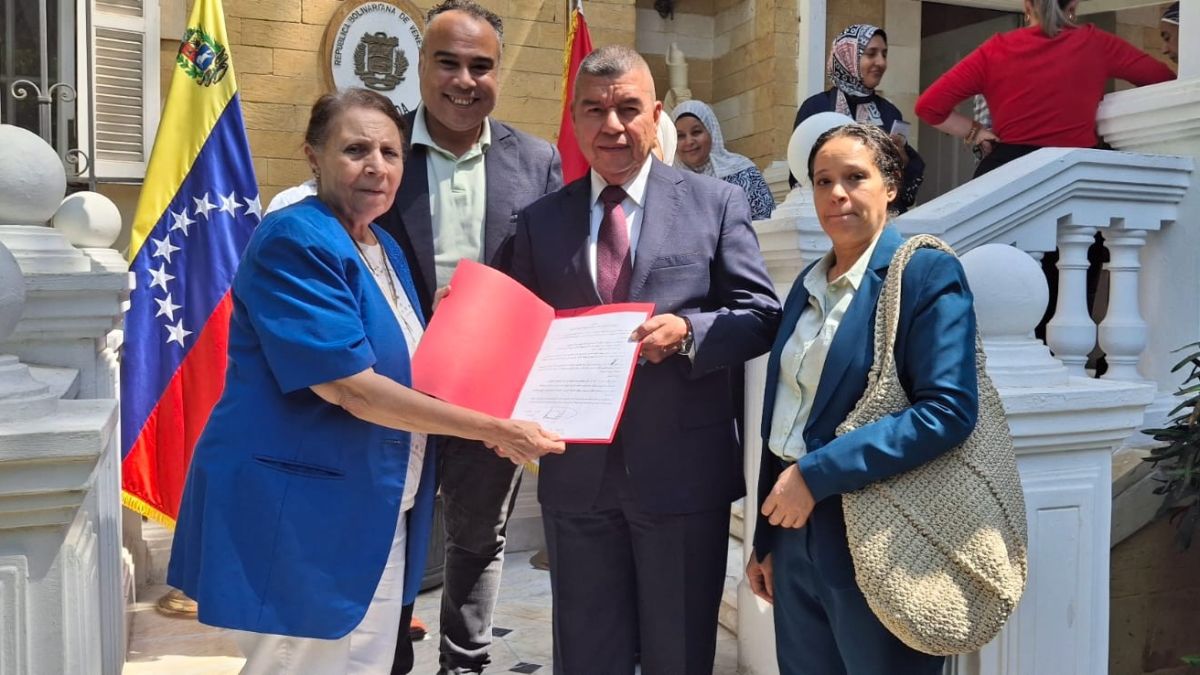
The Embassy of the Bolivarian Republic of Venezuela in Cairo received a statement of solidarity signed by various Egyptian social, political and cultural organizations and movements, in rejection of the United States military deployment in the Caribbean.
The document was given to Ambassador Wilmer Omar Barrientos by representatives of the Egyptian Women's Front; the Anti-Fascist International and the Communist Party of Egypt, the Ministry of People's Power for Foreign Affairs (MPPRE) reported on its website.
During the event, the president of the Anti-Fascist International chapter Cairo, Hayat Elshimi, together with journalists Amir Abu Rifae and Amena Abdelrahman, formalized the delivery of the text that denounces the U.S. military presence as a violation of the Treaty of Tlatelolco (1967), the Proclamation of Latin America and the Caribbean as a Zone of Peace (CELAC, 2014), and the fundamental principles of law international.
The statement highlights that reports from the United Nations (UN) deny Washington's narrative about drug trafficking in the region.
“Venezuela and the Caribbean are not significant routes for drug trafficking,” the text points out, dismantling the arguments used to justify armed actions in Latin American territory.
“The peace of Venezuela is the peace of Latin America and the Caribbean. The sovereignty of our Peoples is not negotiated”, concludes the document.
For his part, Ambassador Barrientos thanked him for the support received: “We thank every organization and every person who has supported this call for peace. Their support shows that truth prevails over false accusations,” he said.
He stressed that “the Bolivarian Revolution has historic allies who understand that the accusation of drug trafficking is just a pretext, just as was the pretext of weapons of mass destruction in Iraq.”
“Venezuela is a territory free of illicit crops, as certified by the UN, and only 5% of regional drug trafficking tries unsuccessfully to pass through our country,” he emphasized.