“EL PORTEÑAZO” YES, THERE WERE CRUELTY AND SHOOTINGS AGAINST WOUNDED SOLDIERS AND STUDENTS
Published at: 04/06/2025 08:00 PM
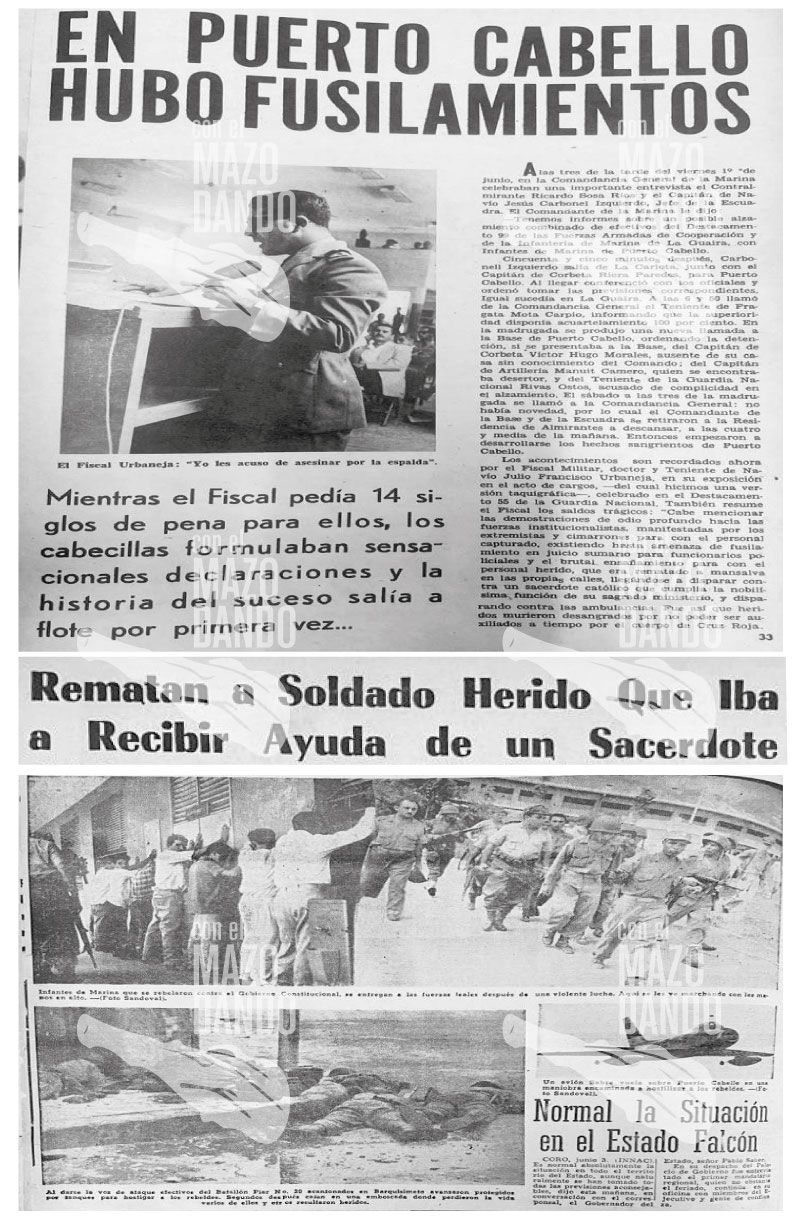
The Prosecutor called for 14 centuries of conviction for the rebels
(El Nacional, Latest News and Elite, June 1962)
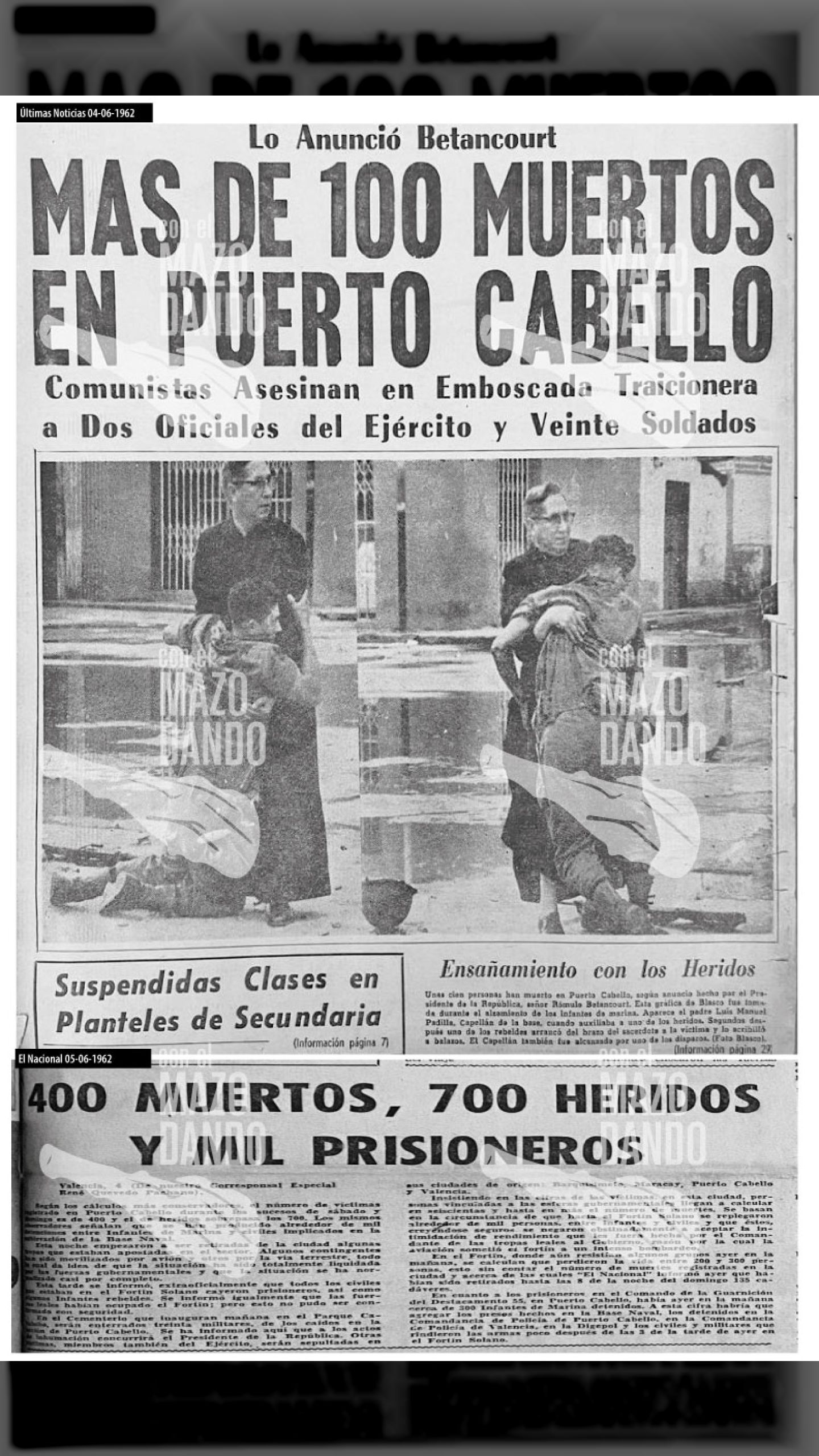
- On Saturday, June 2, 1962, the civic-military uprising known as “El Porteñazo” took place. According to the most conservative estimates, between Saturday and Sunday, the number of victims exceeded 400 dead and 700 injured. Many students and soldiers were shot, without a trial, according to the order given by Romulo Betancourt.
- Between Monday and Tuesday, 135 people were registered who lost their lives while resisting in the La Alcantarilla sector. In this place, the courage demonstrated by the students of the Miguel Peña High School was outstanding.
- The students, in solidarity with the rebellious soldiers, arrested four DIGEPOL agents, whom they tied up outside the high school to prevent the campus from being bombed.
- However, government troops, under the command of Colonel Alfredo Monch, entered the La Alcantarilla sector with 16 war tanks and, with cannon fire, they demolished the Miguel Peña High School, regardless of the people inside.
- This was a real massacre. Students and soldiers were shot on the spot or shot to death on the floor. All school facilities were bombed.
- At no time did the government accept the surrender of the rebel soldiers and students who had taken refuge there. The white flags that were waved, as a sign of surrender, were riddled.
- Inside the Miguel Peña High School, those who survived the first massacre were later put to arms.
- All the streets of Puerto Cabello were taken one by one and house by house. Families were violently evicted and suspects shot inside their homes.
- As a result of this carnage, the photo of Father Luis María Padilla, helping a mortally wounded rebel officer, grabbed all the headlines in the national and international press.
- The so-called “father's photo” was manipulated by the government as a propaganda ploy to cover up the true number of victims, trying to hide the atrocities committed against the unarmed civilian population that was shot to death and the wounded soldiers who were executed on the ground.
- In addition to all these, the Military Prosecutor in the case requested 14 centuries of conviction for Navy Captains Manuel Ponte Rodríguez, Pedro Medina Silva and Víctor Hugo Morales, together with the leaders of the Communist Party of Venezuela (PCV) and the Revolutionary Left Movement (MIR) who rose up in that heroic battle.
- In reality, it was a real four-day battle, with the unobjectionable advantage of the government that it had air and ground superiority. F-38 Le Sabre planes bombed the radio station and Fortín Solano, the last stronghold of the uprising, thus nullifying the firepower of the insurgents.
- For his part, Father Padilla, chaplain of the elevations, in the midst of the massacre, continued to work his way through bullets to treat others injured in the street, recommending that they be killed so that they would not be shot dead and thus help save their lives.
- Román Chalbaud, in his masterful film The Burning of Judas, made a staging very adjusted to the reality of the events, in which priest Padilla himself acts, giving credit to what actually happened.
- The author of the “photo of the father” was photojournalist Héctor Rondón, a native of Bruzual, edo. Hurry up. His risky work was widely awarded the Pulitzer and World Press Photo Prizes.
- In 2005, the Dutch Post Office (Netherlands) issued a special edition of stamps to commemorate the best photos in history, including that of Héctor Rondón from Apurea when he captured that historic event in 1962.
Mazo News Team