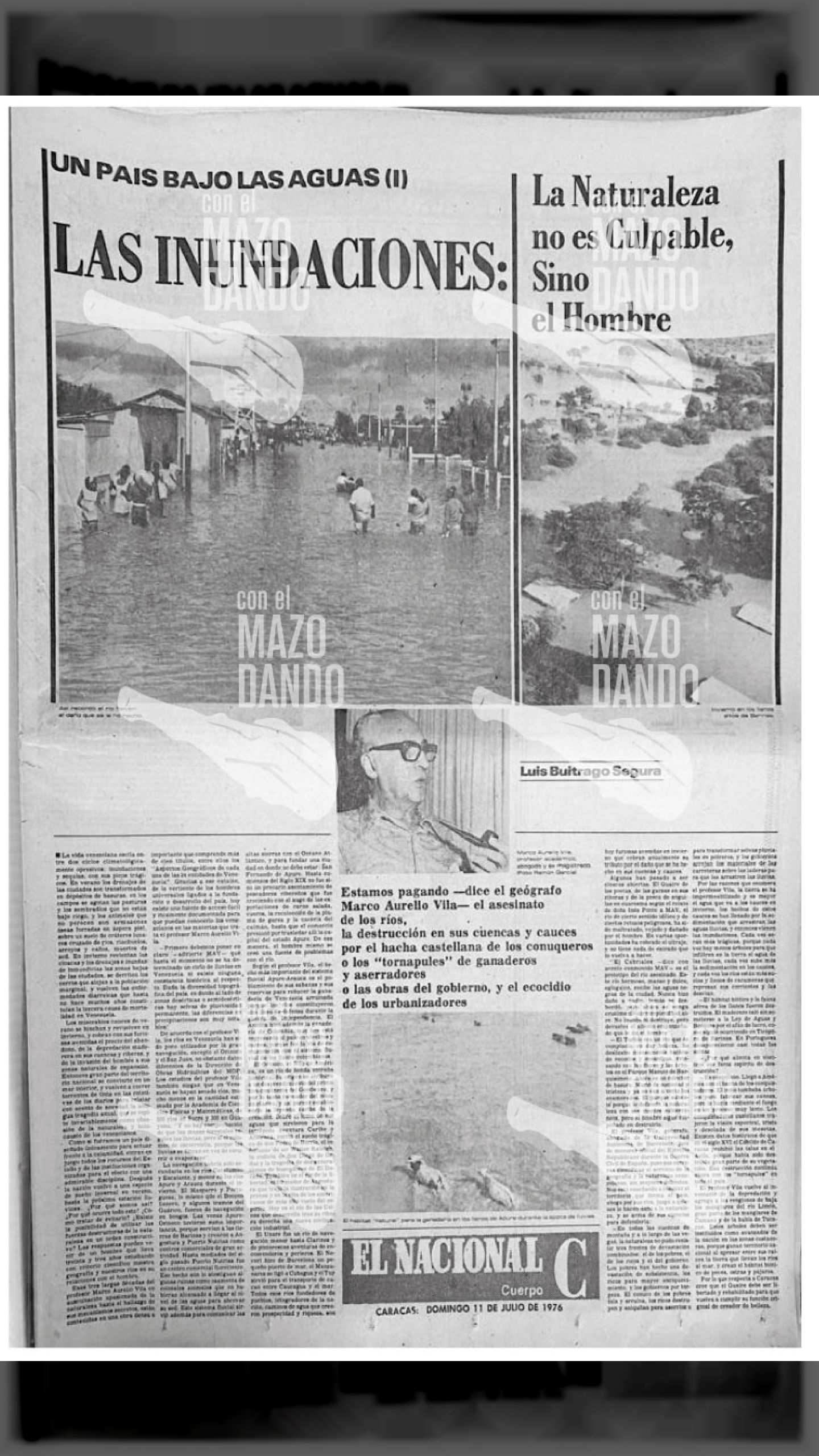
FLOODS: Nature is not to blame, but man
Published at: 16/07/2025 09:00 PM
(El Nacional, July 11, 1976)
- Regarding the historical importance of the conservation of our rivers, the Catalan geographer and lawyer, Marco Aurelio Vila, an officer of the Republican Army during the Spanish Civil War, with more than 30 years in the service of Venezuelan geography and more than 100 titles published in this regard in 1976, warned:
- “We are paying for the murder of rivers, the destruction of their basins and channels by the Castilian axe... and the 'tornapules' (tractors) of ranchers and sawmills.”
- “Castilian came to America with the axe of the conquerors to create a ghostly vision of its desolate Iberian plateaus.”
- “The miserable summer riverbeds swell and stir in winter, and with their furious waters they take the price of abandonment, of the depredation of timber in their basins and banks, and of the expansion of man in his natural areas.”
- “Then a large part of the national territory becomes an inland sea, and rivers of ink flow again in their newspapers to recount, with an accent of novelty, the old annual tragedy, which he invariably repeats as an obsession with nature and a holocaust of Venezuelans.”
- “The Orinoco , the Nile of America, is deeply rooted in history, it brought the first printing press and the birth of the Third Republic, with the formation of Angostura, today the Bolivar City.”
- “All the rivers in Venezuela have been creators of peoples, integrators of the nation and sources of prosperity and wealth, which every year take their toll for the damage that has been done to their basins and channels.” + Some have become open sewers:
El Guaire, harassed and mistreated, has been insulted on several occasions and there is nothing strange that, like him, many rivers do it again.
El Cabriales, in Valencia, is the prototype of the murdered river.
El Turbio, in Barquisimeto, once huge and crystalline, has died of dirt, like a simple garbage collector.
The inventory of Venezuelan rivers, subject to the maximum stress of the indiscriminate felling and pruning of surrounding forests, is extensive; more than 800 have ceased to exist.
Background:
- On December 19, 1825, El Libertador Simón Bolívar ordered the planting of one million trees, known as the Chuquisaca Decree: “That at all points where the land promises to make any species of major plant thrive, a regulated plantation be undertaken at the expense of the State, up to the number of one million trees, preferring the places where there is the greatest need.”
- This decree, issued during his triumphant tour of Bolivia, established measures to protect forests, rivers, soils and promote the sustainable use of water, showing Bolívar's vision of the importance of our rivers and jungles.
- However, the voracity of the European axe and its quest for plunder have left only traces on the American continent of predation, the death of rivers and the disappearance of the forests and jungles that surround them.
- The Venezuelan Indian eventually cut down trees to make canoes in a very slow and selective process that allowed Venezuela to be a true Earthly Paradise or “Land of Grace” for thousands of years, as Christopher Columbus called it.
- The latter, realizing the virginity of our jungles and the exceptional hospitality of our original ancestors, exclaimed: “Only fifty men will suffice to subdue them and do everything we want.”
- The first record of an ecocide in our territory was committed by the Spanish governor José Francisco de Cañas, who, between 1713 and 1714, ordered the felling of all the trees in Caracas, promoting for the first time the death of the natural tributaries of the Guaire River, whose flow is now a tiny part of what it was.
Mazo News Team