Published at: 25/06/2025 09:00 PM
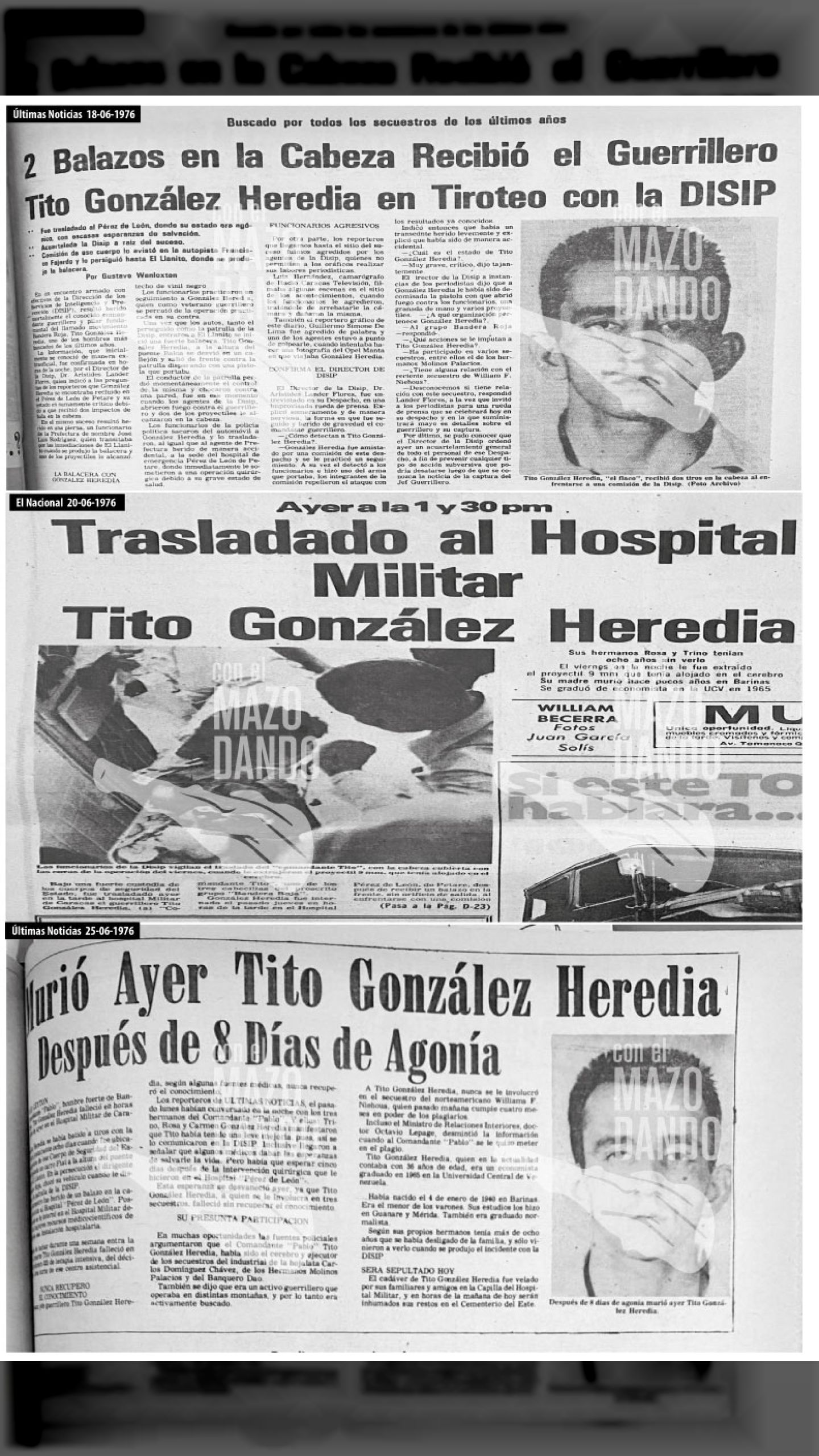
(El Nacional and Latest News, June 18, 20 and 25, 1976)
- During the first administration of Carlos Andrés Pérez, on Thursday, June 17, 1976 at 4.30 p.m., “Tito” González Heredia was seriously injured by two bullets to the head by officials of the General Sectorial Directorate of Intelligence and Prevention (DISIP).
- Eight days later, after a long agony, González Heredia died at the Military Hospital in Caracas.
- DISIP officials began their pursuit at the height of Rio de Janeiro Avenue in Chuao, until it was hit in El Llanito.
- Later, he was surrounded and shot down near the Baloa Bridge in Petare, as he tried to oppose the death squad that executed him.
- At the time of the execution, González Heredia was traveling in a vehicle he owned, the Opel Manta brand, blue, license plates 23 44 03, which became a strainer due to the multiple bullet wounds he received.
- The cameramen and reporters who tried to cover the news were brutally attacked by DISIP officials as they approached the scene of the events**, ** being shot with UZI sub-machine guns and backstabbed from the scene.
- Photojournalist Guillermo Simone de Lima, from Última Noticias, was savagely beaten while trying to take a picture of the vehicle where Commander Pablo was shot down. Cameraman Luis Hernández had his camera seized and destroyed while he was filming.
- Tito González Heredia was assassinated for being the planner and logistical genius behind the escape of 23 political prisoners from the San Carlos Barracks, which took place on January 18, 1975.
- Commander Pablo was born in Barinas, Edo. Barinas, January 4, 1940. From a very young age, he was a member of the Youth of Democratic Action (AD), until the late 1950s.
- In 1960, disappointed by the betrayal of the spirit of January 23, he definitively broke all ties with that party, joining the ranks of the Revolutionary Left Movement (MIR).
- At the beginning of the 70s, completely disagreeing with the submissive and kneeling attitude of some MIR leaders, genuflexed in the face of the “pacification policy” of the Rafael Caldera government, he broke away from this organization and became the second in command of the Red Flag.
Mazo News Team