The history of the CIA as a regulatory body for drug trafficking
Internet
Published at: 12/12/2025 05:00 PM
Despite the fact that the
US government declares almost daily that it fights against drug trafficking, the
Central Intelligence Agency (CIA) is the organization that for years has
coordinated the drug business in the world.
According to investigations
by American journalists, such as Daniel Finn, the CIA has been
involved in drug trafficking for a long time since the end of World
War II; even Dennis Dayle, former head of an
elite unit of the Drug Enforcement Administration (DEA), stated that “in
my 30 years of experience with the DEA and related agencies, the main
objectives of my investigations almost invariably turned out to be CIA
workers.”
In the same way, William Blum, writer on foreign policy and intelligence and author of the book Killing Hope: US Military and CIA Interventions since World War II , chronologically detailed how this organization is really a structure for overlapping illegal activities, and agrees with what was explained in the text Memorial of Atrocities of the CIA written by journalist Steve Kangas, in which the agency's operations on the subject of drug trafficking were revealed. Here's a summary of that:
France , between
1947 and 1951
CIA weapons, money and
disinformation allowed
Corsican criminal organizations in Marseille to wrest control of the unions from the Communist Party.
The Corsicans gained political influence and control over the
docks, ideal conditions for consolidating a long-term alliance with the drug
distributors of the mafia, making that city the
capital of post-war heroine in the West. The first heroin laboratories
opened in 1951, just a few months after the Corsicans took
over the port.
Southeast Asia
, 1950s
The Chinese Nationalist Army, organized by the CIA to wage war against
communist China, became the opium magnate of the Golden Triangle
(parts of Burma, Thailand and Laos), the world's largest source of this drug and heroin.
Air America, the main CIA-owned airline,
transported drugs across Southeast Asia.
Indochina , from
1950 to the early 1970s
The CIA, during the US military
intervention in Laos and other parts of Indochina,
known today as Cambodia, Vietnam, Burma and Thailand,
through Air America transported opium and heroin throughout the area.
Many soldiers in Vietnam became addicted. A laboratory
built at CIA headquarters in northern Laos was used
to refine heroin. After a decade of U.S. military intervention,
Southeast Asia had become the source of 70% of the world's
illicit opium and the main supplier of raw materials for the
booming U.S. heroin market.
Australia ,
1973 to 1980
The Nugan Hand Bank in Sydney
was a CIA bank. Its managers included a network of American
generals, admirals and agents, including the
agency's former director, William Colby, who was also one of its lawyers. From
its branches in Saudi Arabia, Europe, Southeast Asia,
South America and the United States, the Nugan Hand Bank financed
drug trafficking, promoted money laundering and international arms trafficking.
In 1980, in the midst of several mysterious deaths, this financial institution went bankrupt with a
debt of 50 million dollars.
Central America , 80s
In Costa Rica, there were
several CIA networks involved in drug trafficking. The Mercury
News reported that in addition to those who served the Meneses-Blandón narco operation
and the overthrow of Noriega, there was John
Hull's agent, whose farms along the border between Costa Rica and Nicaragua
were the main area of operations. Hull, along with the agency's pilots,
joined George Morales, a major Colombian drug trafficker
based in Miami, who later admitted giving 3 million dollars
in cash and several planes to business leaders. In 1989, after
the Costa Rican government accused Hull of drug trafficking, a
plane hired by the DEA flew him clandestinely and illegally to Miami via Haiti. Subsequently, the United States repeatedly
frustrated efforts to extradite Hull to that Central American country
to stand trial.
Another drug trafficking network
based in Costa Rica involved a group of Cuban-Americans
hired by the CIA as military trainers to destabilize
the government of that nation and for this purpose, they used a
Costa Rican shrimp company, which laundered money for the organization and to channel cocaine to the United States.
However, that was
not the only route. Guatemala, whose military intelligence service,
closely linked to the CIA, harbored numerous
drug traffickers, and according to the DEA, was another stop on the cocaine route.
In addition, the accountant of the Medellín Cartel in Miami, Ramón
Milián Rodríguez, testified that he channeled almost 10 million dollars to Nicaraguan
rebels through Félix Rodríguez, a veteran agent, who worked at the Ilopango Air Base
in El
Salvador.
Haiti , between
1980 and 1990
While working to keep key Haitian military and political leaders in power, the CIA turned a blind eye to the drug trade of its clients. In 1986, the agency added more names to its payroll when it created a new Haitian organization, the National Intelligence Service ( SIN). The SIN's mandate included combating cocaine trafficking, even though its own officers were involved in the trafficking, a business with the complicity of some Haitian military and political leaders.
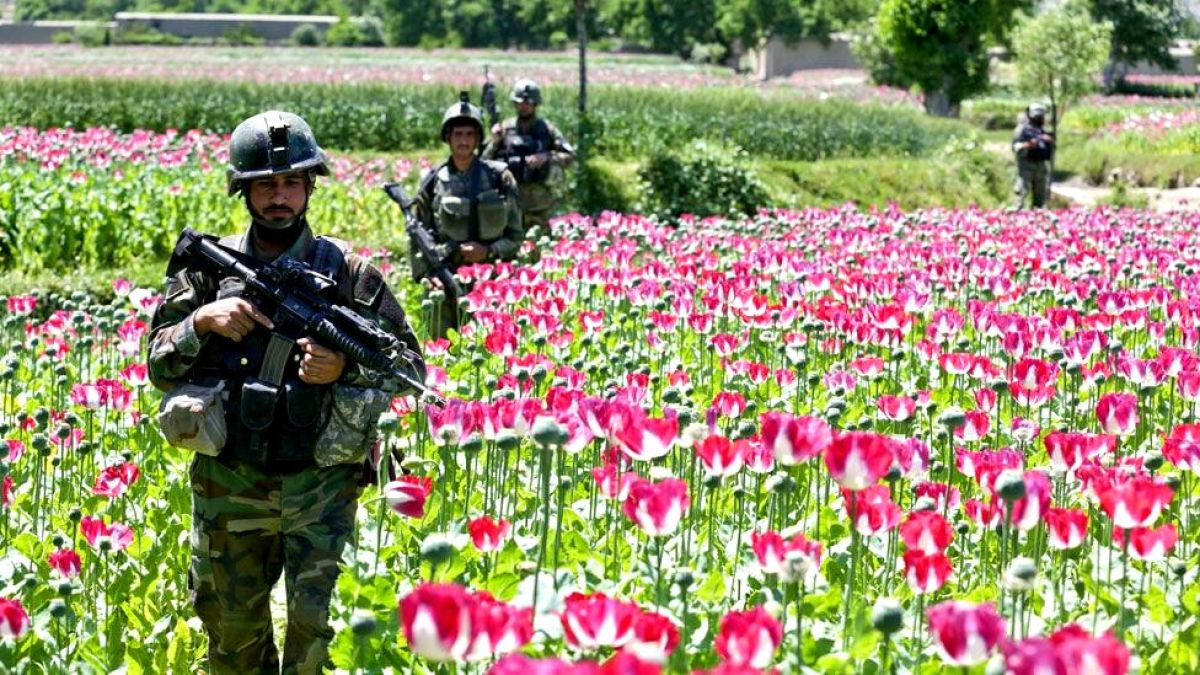
Afghanistan, between
1980 and the early 1990s
The Mujahideen rebels,
supported by the CIA, were actively involved in drug trafficking while fighting the government
. The agency's main client was Gulbuddin
Hekmatyar, a major drug lord, heroin refiner, and who
was also the biggest beneficiary of the agency's military support. Trucks and mules
supplied by the latter, which had transported weapons to Afghanistan,
were used to transport opium to laboratories along the border with Pakistan. This production provided almost 50% of
the heroin consumed annually in the United States and 3/4 of that
consumed in Western Europe. U.S. officials admitted
in 1990 that they had not investigated or taken action against the
drug trafficking operation so as not to offend their Pakistani and Afghan allies. As early as 1993,
Afghanistan was known as the new Colombia of the
drug world.
While Washington is lecturing the world about drug trafficking and security, its own record reveals decades of complicity, cover-up and clandestine operations that destroyed entire countries. This file makes it possible to identify the CIA as the agency responsible for being the guardian of illegal American activities, including the drug market, in order to protect both the consumption of the merchandise and the profits derived from that business.
AMELYREN BASABE/Mazo News Team