Published at: 02/07/2025 09:00 PM
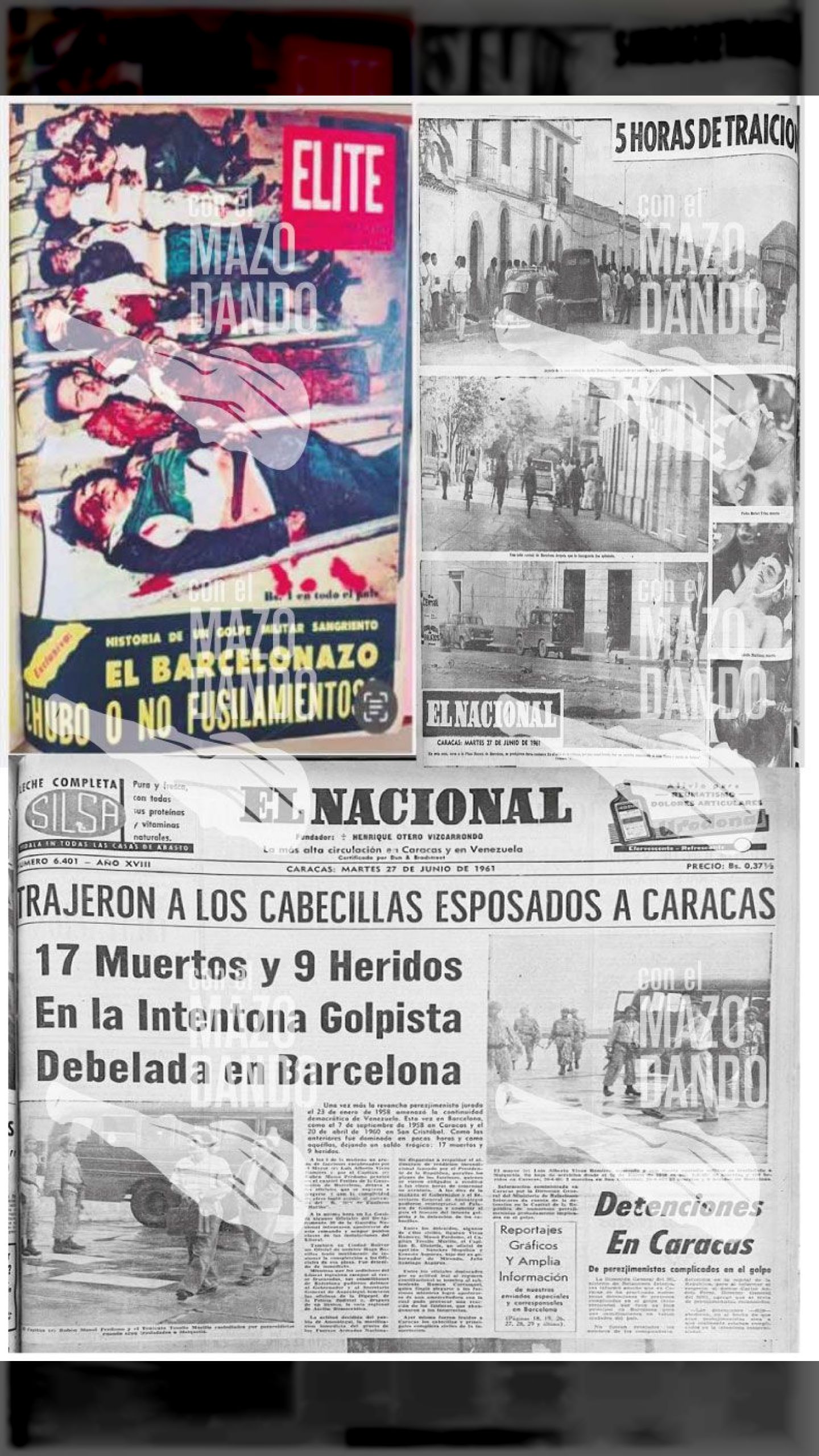
(ELITE, June 27, 1964)
- Three years after El Barcelonazo, which occurred on June 26, 1961, when none of the rebellious officers had yet received a sentence, the magazine ÉLITE exclusively illustrated a cover whose photo speaks more than a thousand words. It shows seven of the 21 unarmed civilians who were shot during that civic-military uprising. These were passed by arms, without a formula of judgment, in the central courtyard of the Pedro María Freítes Barracks.
- They are historical testimony to the discontent that existed throughout Venezuela and to the criminal practices imposed by the Democratic Action (AD) -Copei coalition, at the time of Rómulo Betancourt. These martyrs of that popular feat are:
- Tony Paez.
- Leonardo Chacín Beltran.
- Ramon Celestino Zapata.
- Michael Clavier.
- Pedro Rafael Trias.
- Angel Custodio Martinez.
- Adolfo Martinez.
- Narciso Rivas Mata.
- Marcos Urbina.
- Fernando Gino.
- Jose Rafael Alvarez.
- Jose Gregorio Sosa.
- Dionisio Olivo.
- Rosendo Rada Antonini.
- Jesus Zapata.
- Jose R. Reyes.
- Abelardo Djhami.
- Jose German Lander.
- Those shot were members of the 26th of July Movement, who came out that day to demonstrate against the Betancourt government, outside the Pedro María Freítes Barracks.
- All of them were brought into that military compound by government troops, before being tortured and shot. Their bodies had bayonet and bullet wounds, as well as organs and viscera that were backfired.
- The instructions to go through arms to all surrendered and unarmed civilians were given directly by Rómulo Betancourt and executed by Minister Carlos Andrés Pérez. They were in charge of the Secretary of Government of the edo. Anzoategui, Carlos Canache Mata.
- One day after the uprising, El Nacional and Última Noticias (27-6-1961) highlighted, on the front page, the textual statements of the regional president, Rafael Solórzano Bruce, in which he demonstrated his pride in the execution of the uprisings: “With blood and fire, Cuartel Freites was recaptured”.
- The governor continued: “... the situation tends to normalize due to the vigorous and effective behavior of both the Armed Forces and the People,” meaning AD para-police gangs.
- The governor of that entity himself reaffirmed that “the recapture of the Freites Barracks was an act brought to blood and fire, in an action led by Second Lieutenant Carrasquel, as well as by a contingent commanded by Major Sánchez of the National Guard...”. All of them acted on orders from their office.
- The procedural delay of the judges in the case in deciding the sentence was that none of the defendants committed any murder, and that all the evidence contained in the files pointed to the regional government authorities and their supporters as the intellectual and material authors of the massacre.
THE CONTEXT:
- Political and social tensions began to cool after the first massacre committed by Betancourt in Plaza La Concordia, Caracas (August 4, 1959), where four demonstrators protesting against the recently enacted hunger and unemployment measures were killed.
- This climate of indignation was also the result of the arbitrary arrests, the suspension of constitutional guarantees, the daily persecution and searches carried out by Digepol and the armed gangs (cabilleros) of AD, against university students, peasants, union leaders and members of the Venezuelan Agricultural Chamber, all disaffected by the government and its arbitrariness.
- Because of this and many bloody acts perpetrated by the government, in the early morning of June 26, the first major concentrated insubordination against the government of Rómulo Betancourt took place in Barcelona, in the state of Anzoátegui.
- This action echoed throughout the country and left 18 patriotic officers and soldiers who were shot in disproportionate retaliation from the government, once it had managed to control the situation. There were coordinated uprisings in Ciudad Bolivar and La Guaira.
- The Civic-Military Brotherhood was led by Major Luis Alberto Vivas Ramírez, Captain Rubén Massó Perdomo and Tesalio Murillo who managed to raise the José María Freites Barracks and the Marine Rifle Battalion.
Mazo News Team