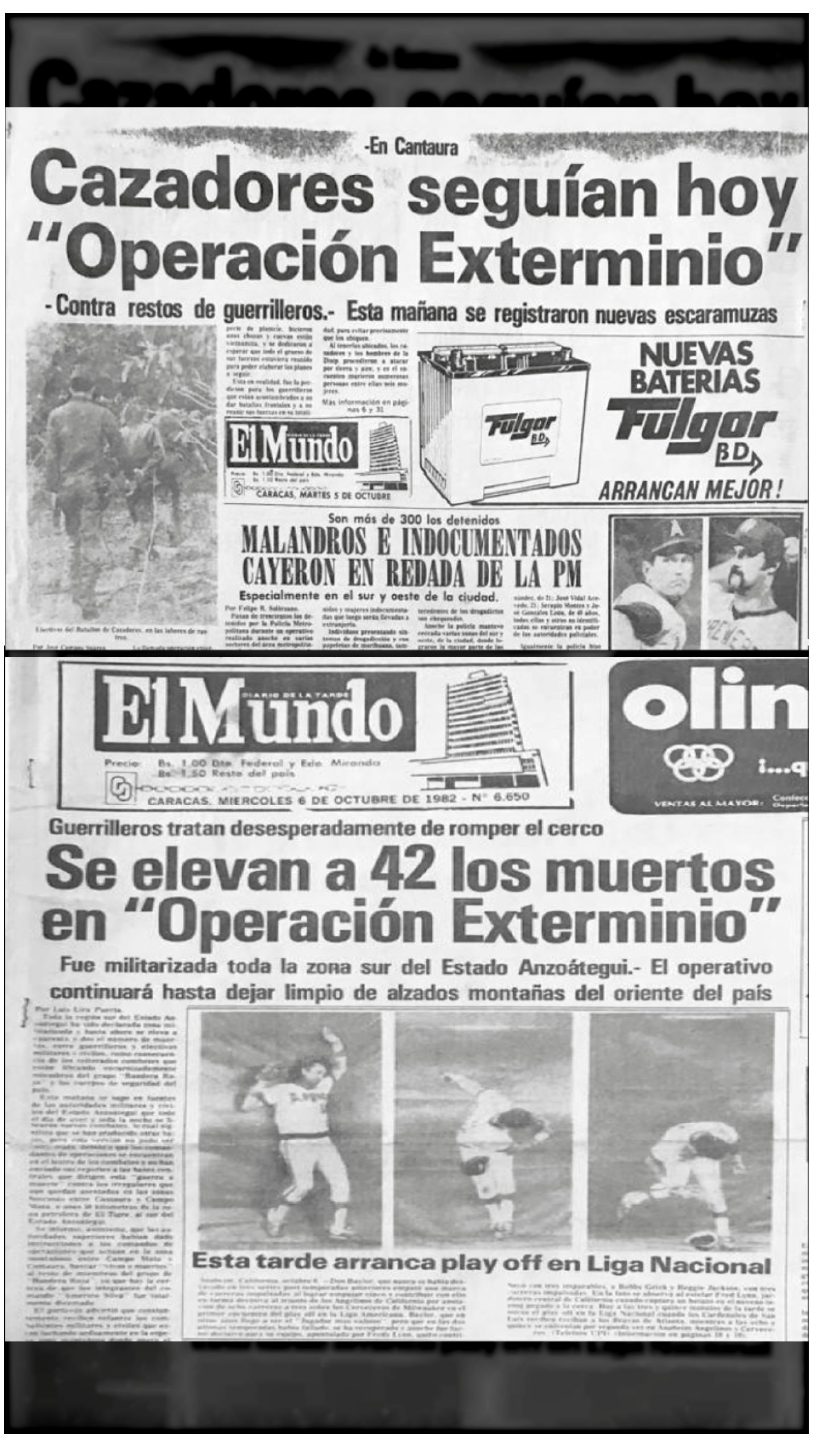
OPERATION EXTERMINATION
Published at: 08/10/2025 09:00 PM
(El Mundo, El Nacional and 2001, October 6, 1982)
- “Operation Extermination”, as it was called “The Cantaura Massacre”, carried out by Bronco, Canberra and armed helicopters of the Venezuelan Air Force (FAV), jointly members of the Army and the General Sectorial Directorate of Intelligence and Prevention (DISIP), led by Arpad Bango and Henry López Sisco .
- The alleged massacred guerrilla fighters were disfigured by the gunshots they received in the head. According to witnesses and forensic expertise, they were all brought to their knees, executed with gunshots in the back of the head and later grinded by machine gun bursts.
- Although the then President of the Republic, Luis Herrera Campins, wanted to show that it was a confrontation, it was demonstrated that the correlation of forces (four combat planes and 600 police personnel) was disproportionate to 23 precariously armed guerrilla fighters.
- The Canberras threw 27 50-pound bombs at the guerrillas, while the Broncos were responsible for strafing them.
- On the third day of the fighting, 55 deaths were reported. Today it is known that not only were the guerrilla fighters savagely tortured and annihilated, but that indigenous and peasant communities in the area were also executed by state security forces.
- Three ranches in the area, located near Cantaura, were also bombed and strafed by Canberra and Bronco planes, with a high death and injury toll.
- On the ground, more than 500 army soldiers and 100 DISIP agents were deployed to crush 23 guerrilla fighters.
- 23 urns for adults and some white ones for children were transferred to the Hospital de El Tigre, which, according to the graphics, shows that the massacre had minors among its victims.
- For three days, the combined forces “combed” a vast sector of the central region of Anzoátegui state.
- Sources in the area indicated that up to that day there were 55 dead, including not only men and women but also children. All this in contradiction to what was established in the official statement issued by the Ministry of Defense and Internal Relations.
- The Cariña indigenous population was also severely bombed by aircraft and there were several casualties among its inhabitants.
- The 2001 envoys, Ediccio Balestrini and Hilario Mujica, confirmed that the number of people killed rose to 55, including six women, three of them pregnant.
- “TWO GUERRILLAS BETRAYED THE CAMP.” El Nacional, October 8, 1982: “Due to a report by two guerrilla fighters, it was possible to discover the Red Flag camp near Cantaura. Two whistleblowers flew over the area in a private helicopter, where three State security agents were going.”
- That day, coincidentally, Gabriel Puerta Aponte, then head of the Red Flag, was taken to the Military Hospital. Thanks to him, the whistleblowers did their dirty work with the DISIP.
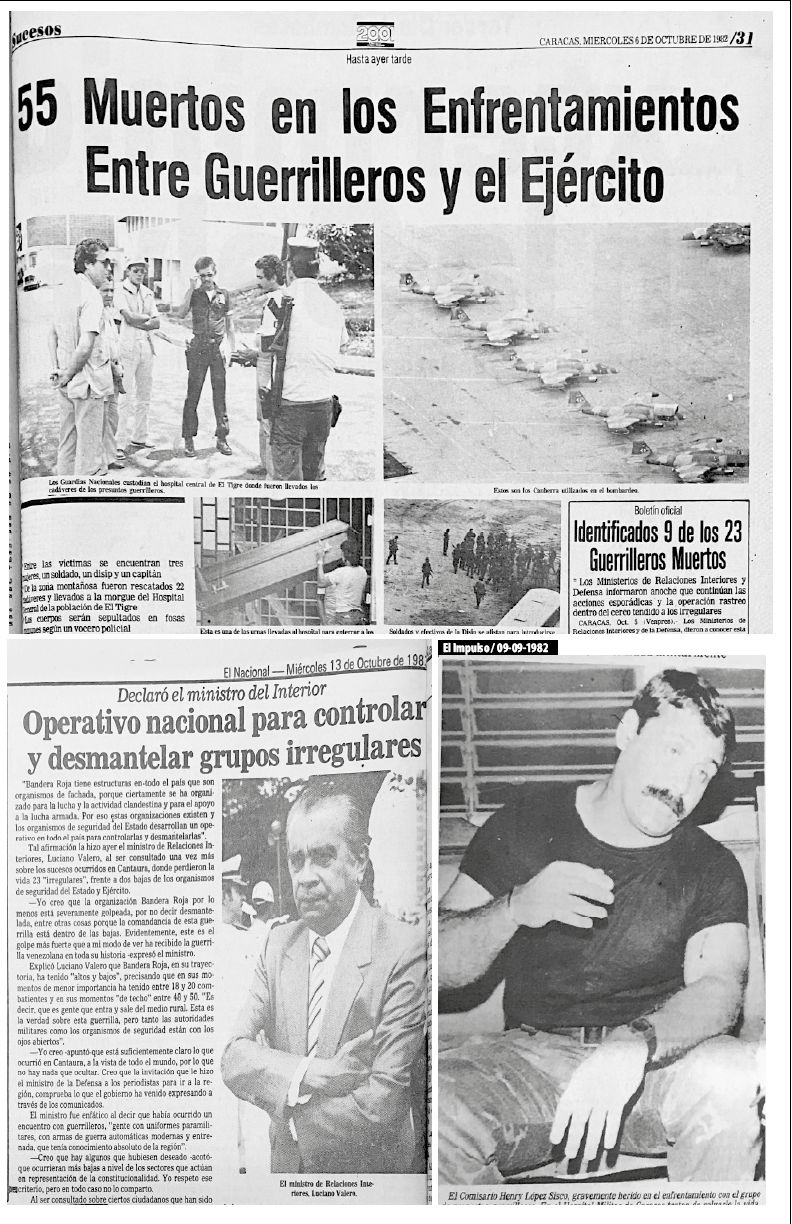
Before and after the Cantaura Massacre:
- At the Red Flag National Tactical Command (CTN) meeting held weeks earlier, Gabriel Puerta Aponte was told about the inconvenience of incorporating the Rabanales brothers into the Américo Silva Front.
- Ignoring this decision, Puerta Aponte planted them in those guerrilla columns where they acted as infiltrators of the DISIP.
- Nolberto and Alirio Rabanales arrived days earlier at the meeting site on orders from Puerta Aponte. While there, there were many complaints about the constant “going out” of the brothers Rabanales, who were constantly absent from the camp. One day before the massacre, they disappeared without asking Commander Rincón for authorization.
- On several occasions, the peasants alerted the guerrilla leaders about the movements of Army and DISIP troops in the vicinity of the camp. However, “El Catire” Roberto Rincón, commander of the Américo Silva Front, had orders from Puerta Aponte not to mobilize. He thus ignored these recommendations and kept his men immobilized for weeks.
- Four years later, on May 8, 1986, the Rabanales brothers were the same ones who led the DISIP to execute the Yumare Massacre.
Mazo News Team