American Interventions in Latin America: A Recurrent Practice
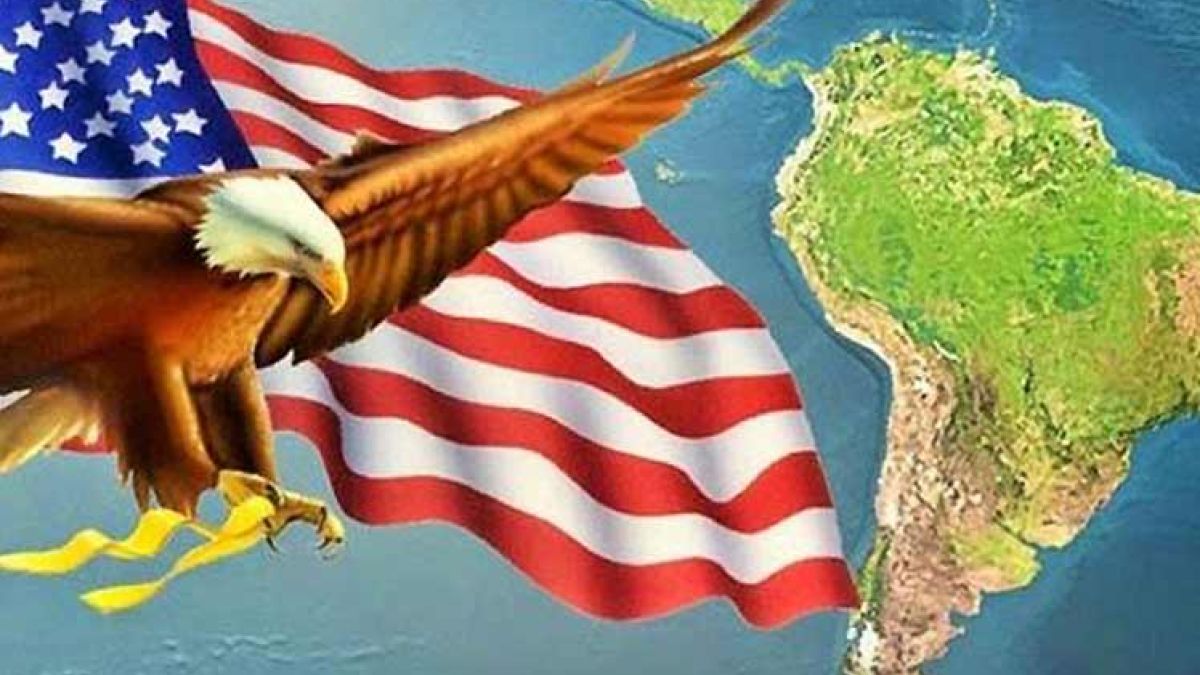
Internet
Published at: 23/05/2025 05:26 PM
American interventions have marked the history of
Latin America. Starting in 1823, with the establishment of the so-called Monroe Doctrine and his “America
for Americans” discourse used as an anti-colonial plea to prevent the
interventions of the European empire on American soil, after most of the colonies
of the old continent had become independent, it then
became a weapon of war to invade other countries.
In other words, Monroe
's message ended up mutating until it
became the right to have its own exclusive area of influence on
the continent, through the coercion of the nations that comprise it.
American interventionism in the American continent has been a common and
growing practice during the context of the
Cold War, between 1947 and 1991, underpinned by the excuse of the distortion of the Monroe Doctrine, the US empire carried out
military interventions or destabilizing actions through its secret services, in order to destabilize governments
aligned with the communist bloc or who
showed sympathy for them; and to demonstrate this, we bring some examples.
On December 20, 1989,
in Panama, philologist and analyst Guillermo Castro Herrera recalls that he woke up, like many other Panamanians,
“to the sound of bombing explosions in the neighborhood of El
Chorrillo, disorder of all kinds was allowed to occur for three days.
There was an enormous wave of looting that terrified the population even more...
When the troops finally came in, they were greeted as saviors.”
In the case of Panama, Castro Herrera indicated that the
ultimate goal was “the control of the country to maintain drug trafficking routes,
border control, and others, which are not specific to the fight against
communism.”
In the same vein, the professor
at the Simón Bolívar Andean University in Quito, Wolf Grabendorff, added that “the United States seized this opportunity to
regain control of the Canal, which was always geopolitically one of its main interests in the region.”
Covert operations
The motives of
US interventions, direct or covert, have been geostrategic,
political or economic, as the case may be, and have varied throughout history.
The Spanish politician José
Antonio Sánchez Román explained
that “the intervention
in Cuba, in the war against Spain at the end of the 19th century,
is not the same as the interventions during the Cold War. These are different geopolitical
and economic contexts,” he also pointed out that military interventions,
with the landing of marines, had been common, especially in the first
half of the 20th century, and cited as examples those of Haiti and Nicaragua.”
Sánchez
Román explained that “in the second half of the last century, the
strategy changed, using covert interventions as a tool,
through intelligence agencies, supporting opposition groups. The
Spanish politician gave as an example the attempt at Bay of
Pigs, which failed and highlighted in the same way the overthrow of Salvador Allende in Chile in 1973, commenting that “they didn't want to do
it directly, but US intelligence was conspiring
to bring about the coup d'etat,” he said.
Supporting the elites
Regarding this topic,
Professor Grabendorff stressed
that “a characteristic of American interventions is precisely
that they have not been carried out against the elites; on the contrary, these elites have
had the support of the United States
to stop some revolution or some important changes in the political system
such as agrarian reforms, mainly in the countries of the Caribbean basin”.
Grabendorff
insisted that “ideological aspects are not as important as they
say, they are always the strong ties that exist between the traditional elites
of those countries and their allies in the United States.
This is how they justify interventions by stating their ideological reasons,
when in reality they have to do with economic interests.”
Neither democracy nor
stability
“After an intervention, the country is worse off than before it,” Grabendorff explained, adding that “the
clearest effect of the interventions, with the exception of failed attempts in Cuba and Nicaragua, has been to strengthen sectors related to the United States.”
Regarding the effect of US
interventions, the politician Sánchez Román assured
that the impact has always been negative, arguing that “the war against Spain in Cuba, the occupation of Cuba
and Puerto Rico or the overthrow of
Allende in Chile, they did not bring more democracy or more freedom to those
nations. Neither in Nicaragua nor in
Haiti was there more democracy or more
stability and much less economic development.” In his opinion,
“military interventions or covert interventions have
generated, apart from immediate violence, more political and
civil polarization”.
Nowadays, there seems to be
broad consensus in the rejection of direct military interventions,
although other ways of exerting influence in the region remain, such as the
application of economic sanctions, for example.
Professor Grabendorff referred to the use of the Monroe doctrine, with which they justify interventions when the US considers its economic
stability threatened and noted that “it's a very long story and we are not going to
see a long-term change in that American thinking, now they change the
discourse with a new argument: they need to guarantee their backyard in their fight against
China, especially
since the Asian country behaves like a true commercial and
financial partner, which is seen by Washington
as a major threat.”
AMELYREN BASABE/Mazo News Team