
Betancourt Decreated Mass Dismissal of Workers and Reduction of 10% of Wages and Wages
Published at: 06/05/2026 09:00 PM
(El Nacional y La Sfera, May 5, 1961)
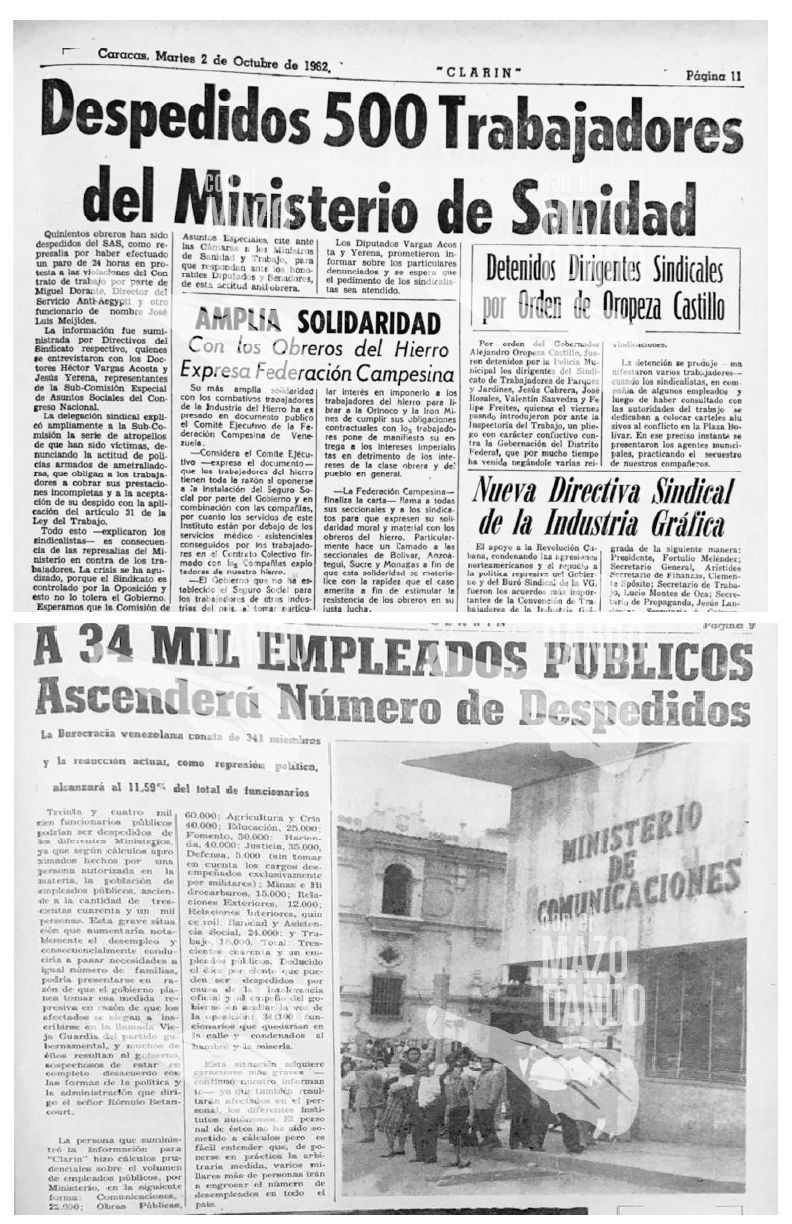
- With annual inflation of 1.6%, tax revenues equivalent to 17,770, or millions of U$D, an increase in Gross Domestic Product (GDP) of 3.2% in that year, being the third largest oil exporter in the world (3.5 million barrels per day) and the strongest economy in the region, President Rómulo Betancourt, in order to celebrate the International Workers' Day, decreed hunger measures for the working, working and peasant classes that brought it to power.
- In a country free of sanctions, with full freedom and access to the exercise of international trade, operating in the main oil fields, “The Seven Sisters (Chevron, Shell, BP, Creole, Texaco, Mobi and Standard Oil)”, he ordered the mass dismissal of public employees, construction workers, the reduction of 10% of salaries and the reduction of the State's payroll. This was the first package of the Punto Fijo Pact.
- With this, he intended to close an alleged gap in the fiscal deficit of Bs. 533 million and to transfer labor, in addition to layoffs, to the private sector. The latter never happened.
- In 1961, Venezuela had 8,453,106 inhabitants, 356 tons of gold in monetary reserve, and maintained a sustained production of 3,500,000 barrels of crude oil per day, at an average price of 5 U$D per barrel. The annual growth rate was 1.6%. In other words, that was looting.
- Not counting revenues from concessions granted to foreign companies for iron mining, the steel operation and the Reynolds aluminum processing plant, as well as other traditional exports from our formal economy.
- Betancourt's misleading and twisted rhetoric about an alleged economic crisis, the fiscal deficit and the payroll problems of the public administration were some of the many pretexts that served to mortgage our wealth.
- To this end, it resorted to the first large foreign loan, under unfavorable conditions, of 2 billion U$D (equivalent today to 10 billion U$D) and to the “austerity” measures mentioned above.
Mazo News Team