Child Abduction as a U.S. War Policy: Japanese Concentration Camps
Internet
Published at: 18/07/2025 08:50 PM
The separation of families is
a form of aggression and fascist propaganda used by the United States to
undermine the dignity of countries that do not submit to its politics,
also using a narrative supported by the media so that the
people who are the object of these acts are considered inferior to the rest of the world.
Child abduction has been
a recurring war policy used by the United States. To support this
statement, we consider the case that occurred with Japanese citizens, when in
December 1941, the imperial army of Japan attacked the naval base that the United States
had in Pearl Harbor as part of a strategy to protect its
expansion in Asia, neutralize US interference and ensure access to key natural resources in
Southeast Asia.
In an investigation carried out
by journalist J. M. Sadurní, a specialist in current historical events on
the Second World War, he explained that “after the attack, everything
related to Japan profoundly impacted American society.
Given this, for racial reasons, all
North American citizens of Japanese origin were arrested and deported to
internment camps throughout the entire geography of the United States
between 1942 and 1948.”
In the investigation, Sadurní
explained that “on December 8, 1941, the day after the attack, and
coinciding with the declaration of hostilities pronounced by
then-President Franklin Delano Roosevelt, the authorities decreed the
first measures against Japanese citizens: A
Presidential Edict was issued whose content segregated citizens of Japanese, German or Italian origin from the rest of the population
autochthonous. The
president's words left no room for doubt: All citizens, residents or
subjects of Japan, Germany and Italy over 14 years of age who are in the
United States and do not have nationality, may be arrested, detained, locked up
or expelled as enemy aliens. That decree triggered an
outpouring of racial hatred that affected citizens who were heavily impacted by the
Japanese attack on the Pearl Harbor naval base. An example of this are the
statements of the governor of Idaho for the time, Chase Clark:
The 'Japs' live like rats, are raised like rats and act like rats.
We don't want them here.”
Added to these expressions of hate were concrete
acts, beyond the decree; Sadurní commented on the recall
of products manufactured in Japan and the felling of 3,000 sakura cherries that the
citizens of Tokyo had donated to the city of Washington
in 1912, members of the Federal Police and the
The U.S. military forced all Japanese citizens to
register following racial segregation, and the authorities accepted
these actions for reasons of “national security”.
Order 9066
Two months after the
Japanese attack, on February 12, 1942, the US Government approved Order
9066, according to which all Japanese immigrants and the first generation
of them born in North America would be deported to
internment camps that would be divided into three categories:
- Assembly camps under the
responsibility of the US military, where
prisoners would be temporarily grouped together and then transferred to another destination.
- Relocation camps under the
control of the War Relocation Authority, where the deported would live.
- Detention centers under the
direction of the Immigration Service where it would detain
non-nationalized Japanese people, including some Germans and Italians.
Regarding this order, Sadurní commented
that “it only affected residents of California, Arizona, Oregon,
Washington and Alaska, but not those of other states such as the Hawaiian
Islands; because the Japanese community was the engine economic
of the region and stopping this group would have meant collapsing the financial
machinery of the entire archipelago”.
After a few years, it became known,
through some revealed documents, that, for the implementation of Order 9066, there were a total of ten relocation
camps for American-Japanese: Manzanar, Tule Lake, Poston, Gila River ,
Topaz , Minidoka,
Granada, Heart Mountain , Rohwer and Jerome.
Prisoners considered potentially dangerous were transferred to other
camps located in Arizona and Moab, in the state of Utah.
Approximately 113,605 Japanese citizens were deported during
the Pacific War.
The photos of shame
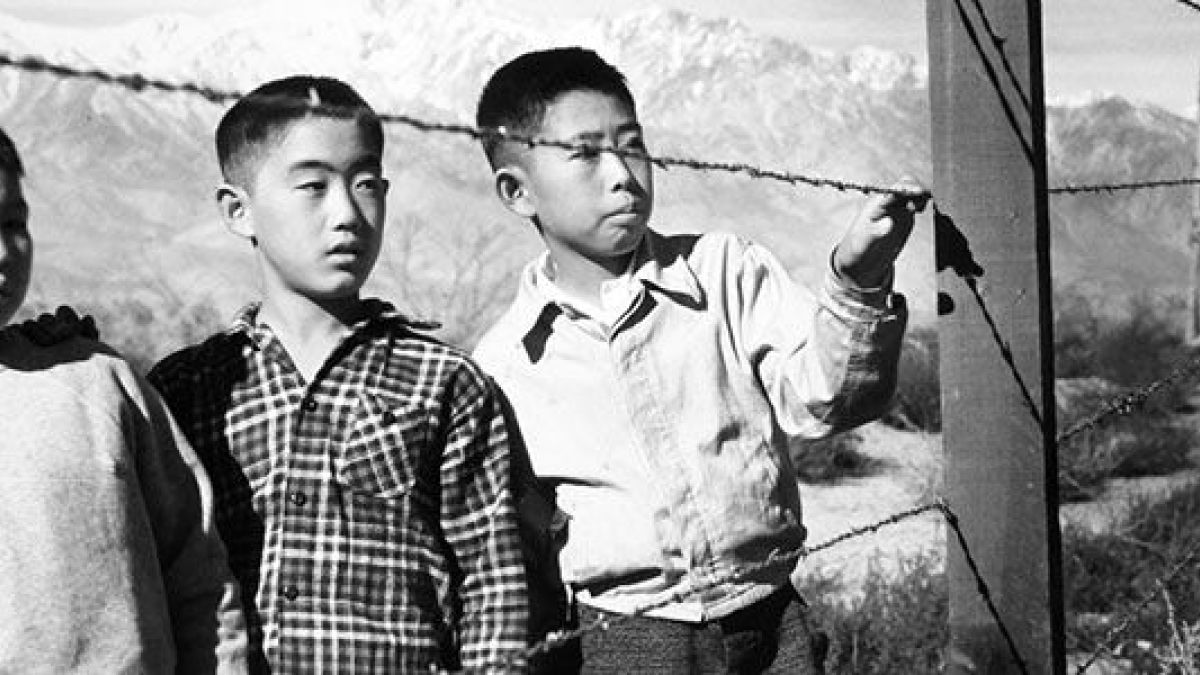
Manzanar was
one of the best-known fields. This one, unlike others built on swampy
terrain, was located on land in the Sierra Nevada
of California. It was a terribly harsh place, with
extreme temperatures all year round, in winter the thermometer didn't rise above zero degrees and
in summer it didn't go below fifty. Half of the population held there
were women, a quarter consisted of school-age children, and there were also
babies and the elderly who could barely fend for themselves.
Jeanne Wakatsuki Houston , a
woman who lived in the Manzanar camp as a child, says that
“interns with professional training found work in the fields
through the War Relocation Agency (WRA), and earned a minimum
fraction of the salary earned by an employed white civilian.
As a mutation of the
concept of slavery, inmates were allowed to work outside the
field, especially as an agricultural labor force. Some of them did so under armed
surveillance, while others had some autonomy. However,
everyone had to carry cards that identified them as prisoners of the camp.”
Also, the
professional photographer, named Toyo Miyatake, secretly documented Manzanar,
managing to insert a lens and support inside and
then, with the help of a carpenter, to build the rest of the camera.
Miyatake was discovered and his camera confiscated, but the camp
director allowed him to continue taking photos. Thanks to this, the
photographer was able to take about 1,500 snapshots, which documented life in the
countryside, during his more than three years in prison.
Family Separation
“Shoot anyone who
tries to flee.” That was the order the soldiers received when
they recorded some incidents in the camps due to the prevailing poor
living conditions. There, tension, suspicion and despair were the norm
. The most serious case was a riot that took place in the Manzanar camp,
where American troops opened fire on the inmates, killing 135 people.
Despite this, and as the war progressed, the
Government allowed some of the inmates to join the army after
signing a loyalty document. In the Manzanar camp, 174 men were enlisted.
At the end of the Second World
War, on September 2, 1945, when the inmates were
released, there were only broken families left in economic ruin due to the
loss of numerous businesses and land; that was the price that these people had
to pay for their three years of confinement.
As compensation for the
losses, the authorities only handed the inmates $25 and a train
ticket. Many were unable to resume their previous lives: without means to
survive and without employment, they had to stay in shelters, shelters or official
housing in cities far from home, where
they continued to face racist attitudes for years. It was until 1988, during
the presidency of Ronald Reagan, that the White House issued an official
statement of apology to Japanese Americans.
“They marked our lives
forever out of revenge and, 40 years later, we received an apology,”
summarized Rick Noguchi, head of operations at the
Japanese-American National Museum, located in the Little Tokyo neighborhood in Los Angeles
Ángeles, which houses a detailed permanent exhibition on the forced
internment of families of Japanese blood during the 1940s; that
is the story of American wars, which in addition to bombs, missiles and
bullets, destroy the families that work and move their economy. Shamefully, this fascist policy is not history, it has not been left behind.
AMELYREN BASABE/Mazo News Team