Deputy Escarrà: Supreme Court ruling on electoral results marks an historic day for the country
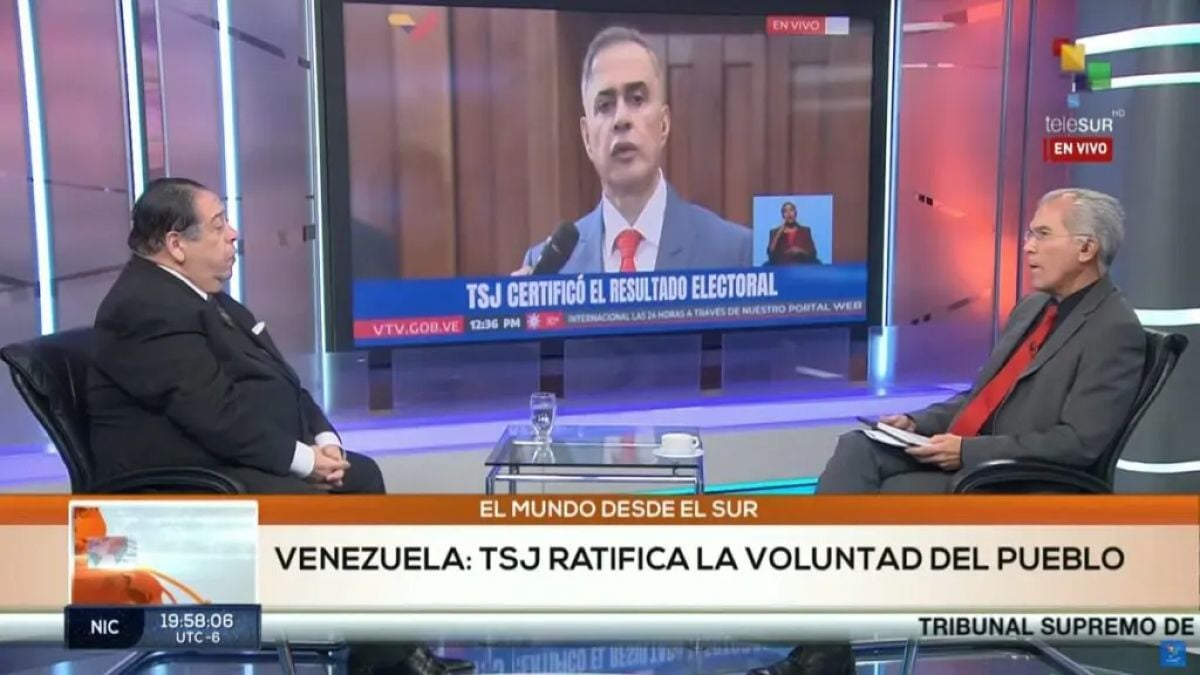
Screenshot
Published at: 23/08/2024 08:03 PM
The deputy to the National Assembly (AN), Hermann Escarrà, stressed that Venezuela experienced a historic day after the ruling issued by the Supreme Court of Justice (TSJ), on the contentious appeal filed by the President of the Republic, Nicolás Maduro, on the Presidential Election of 28J, which certified the electoral results issued by the National Electoral Council (CNE) and ratified the victory at the polls of the head of state.
During an interview on the program The World from the South, broadcast by teleSUR, he said that “this is a historic day, the process is unprecedented. For the first time, contentious electoral recourse is being exercised.”
Faced with an extreme situation of conflict and violence, Escarrà said, President Nicolás Maduro filed the contentious appeal.
“The president had three options: to declare a state of emergency, the second option to establish extraordinary protection or constitutional amparo for violation of law, and the third to file a contentious electoral appeal,” he confirmed.
Also explaining the legal action of the Supreme Court in the face of the appeal presented, he explained that the Electoral Chamber made the admissibility decision and informed the candidates of the process to be carried out.
Regarding the people who shouted fraud and did not attend after the summons of the Supreme Court, he added that they tried to disrupt public order and destabilize Venezuelan institutions. “When this happens, we are in the presence of a factual rupture of the constitutional order,” he stressed.
The Executive Branch manages to counter the coup d'etat, he insisted, while the Electoral Chamber of the Supreme Court makes the second decision.
All the organizations for political purposes and former candidates submitted these files, but the parties that supported Edmundo González Urrutia said that they had no records, nor the list of witnesses, that they had nothing to do with the mobility of information in the electoral process.
“The third decision is res judicata. The decision I'm going to make is final and firm and there's no appeal,” he said.
Recalling that the sentence is not reversed, Escarrà pointed out that the only thing that exists in the constitutional order is an extraordinary remedy for review, to see if there is such a serious unconstitutional act.
“It's not an appeal, nor a procedural challenge, nor is it another instance,” he insisted.
In this regard, he specified that the sentence is attached to the Constitution, to the Organic Law of the Supreme Court, to the Organic Law of Electoral Power and of Electoral Processes.
“Nobody has the right to alter the peace of the Venezuelan family,” he said, pointing out the need to follow the rules of the Criminal Code and the Constitution.
“We cannot continue with the issue of impunity, in a context of respect within the framework of law and guarantees,” he remarked.
In this regard, he stressed that Edmundo González Urrutia signed a statement as electoral president, and that procedure (trying to supplant a State Power) has become a constitutional process.
“This is what is now beginning to accumulate as a guarantee state,” he said, referring to González Urrutia's research process.
“By behaving in contempt, in rebellion, not having a narrative, Mr. Urrutia will be sanctioned for not attending the trial and for the issue of the coup d'etat, Escarrà said.
He explained that in criminal matters “sanctions have to do with freedoms. Here, the serious issue where González Urrutia participated is that of the coup d'etat, that of cyber-aggression, and positioning lies to alter the stability of Venezuelan institutions and families. These are crimes: he has to go to jail. In Venezuela we follow a procedure, we respect some guarantees. There must be a trial, brought before a judge, there must be a prosecutor, and a defense.”
“Democracy imposes limits on us. That we must be subject to what the rule of law is, regardless of whether the antagonist, the adversary knows it: but we cannot ignore it,” he said while pointing out that there is no way to prove that Venezuela is a country that violates human rights.
Escarrà emphasized that “we are in a good moment, a bright moment for the rule of law and democracy.”
Mazo News Team