Deputy Minister Molina holds bilateral meetings during a working visit to Vienna
MPPRE
Published at: 04/03/2025 01:48 PM
The Deputy Minister for Multilateral Affairs of the Ministry of People's Power for Foreign Affairs, Rubén Darío Molina, paid a working visit to Austria, where he held important bilateral meetings at UN headquarters in Vienna on February 27 and 28, with senior officials from the United Nations Industrial Development Organization (UNIDO) and the United Nations Office on Drugs and Crime (UNODC).
In the company of the Permanent Representative to International Organizations based in Vienna, Ambassador Claudia Salerno Caldera, and Minister Counselor Gustavo Villarroel Valdez, Deputy Minister Molina spoke with Ciyong Zou, managing director of the Directorate of Technical Cooperation and Sustainable Industrial Development of UNIDO, with whom he analyzed the benefits for Venezuela of the Technical Cooperation Program (Country Program), signed with that multilateral body in May 2018, initially designed for the period 2018-2022, but which was later extended to 2024, which was based on the national agricultural sector.
Both authorities shared Venezuela's interest in extending for a period of 5 or 6 months during 2025, the Country Program in its current phase, called the “Industrial Update and Modernization Program”, which began in December 2020; and then, through joint work, to design and plan our projects, adapting its structure to the new modality promoted by UNIDO, called “Program for Country Partnership” (PCP), which is more appropriate for obtain funding and potential donor countries.
To advance bilateral technical cooperation, both parties agreed to do what was necessary to coordinate a visit to Venezuela by the UNIDO Representative for Colombia and the Andean Region, in order to jointly identify national priorities, through multisectoral meetings with local authorities and communities, allowing the design of a PCP oriented to other projects beyond the agri-food sector, based on the Seven Transformations 2025-2031 (7T) and the 13 productive engines of the Bolivarian Economic Agenda.
Deputy Minister Molina also held bilateral meetings at UN headquarters in Vienna with the Permanent Representatives of Qatar, China and Russia to UNIDO, with a view to defining a road map that will allow them to serve in the future as donor countries of the Plan signed by Venezuela, thus guaranteeing solidarity and complementary cooperation with nations of the Global South, committed to the sustainable and inclusive development of peoples.
During his stay in Vienna, Molina also had an outstanding working meeting with Bo Mathiasen, director of the Operations Division of UNODC, a multilateral body responsible for dealing with drug problems, crime prevention and criminal justice, transnational organized crime, including its multiple activities and manifestations, corruption and the prevention of terrorism.
The senior Venezuelan official stressed that trust, unconditional dialogue and mutual respect are key to any efficient relationship.
He stressed that Venezuela is not a country that produces illicit drugs, but because it borders with producing nations, it is directly affected by this scourge.
He also noted that the absence of senior authorities of the Venezuelan Government at international events of UNODC or its commissions and specialized agencies is mainly due to the administrative sanctions imposed on their representatives by the European Union, Canada and the United States.
The Deputy Minister highlighted the importance for Venezuela of the approval granted by UNODC for the country to become part of the portfolio of the Regional Office for the Andean Region and the Southern Cone (ROCOL), based in Bogotá, as well as the interest of the Regional Representative of that multilateral body to visit Venezuela to meet with her counterparts and explore concrete opportunities for cooperation.
Mathiasen, who knows the South American reality in this important area after being the UNODC Representative in Colombia, stressed the importance of deepening technical assistance between both parties.
In this regard, he attached special importance to defining an exploratory visit to Venezuela by ROCOL representatives during 2025, to identify sectors of mutual interest in two-way technical cooperation.
He also mentioned the need to include Venezuela in more regional training activities, to train human talent in the area of synthetic drugs and forensic research, for which, as part of bilateral cooperation, internships and training exchanges could be organized.
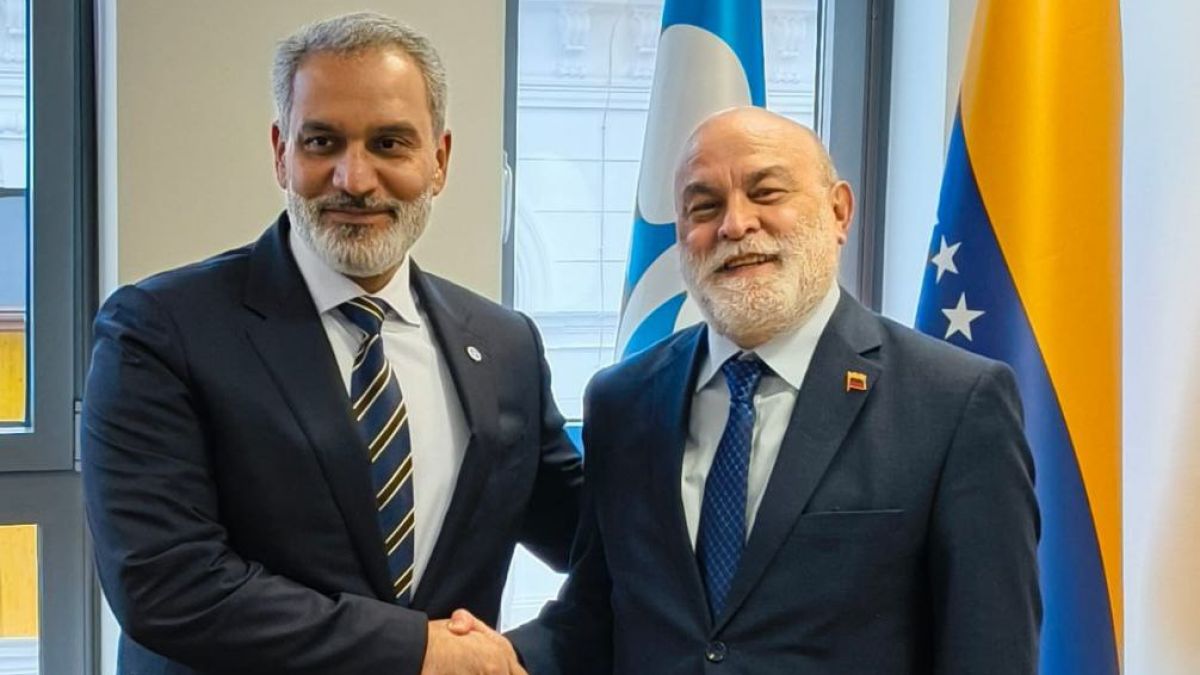
Deputy Minister Molina's stay in the capital of Austria concluded with a courtesy visit to the Secretary General of the Organization of Petroleum Exporting Countries (OPEC), Haitham Al Ghais, whom he personally thanked for his participation in the formal inauguration ceremony of the President of the Republic, Nicolás Maduro Moros, on January 10.
The highest authority of OPEC indicated that Venezuela is very important to the Organization, since it has been able to resist the illegal imposition of unilateral coercive measures that have affected its development, but that it still stands in solidarity with others and works for energy security and world peace.
Haitham Al Ghais, accompanied by part of his management team, offered Deputy Minister Molina an interesting presentation on the history of OPEC, its functional organic structure, current financial situation, current behavior and future scenarios of the global energy market.
The meeting ended with proposals from both parties to encourage training and knowledge exchange, through programs that could be designed with the support of the Venezuelan Hydrocarbons University and the “Pedro Gual” Institute for Higher Diplomatic Studies.
MPPRE