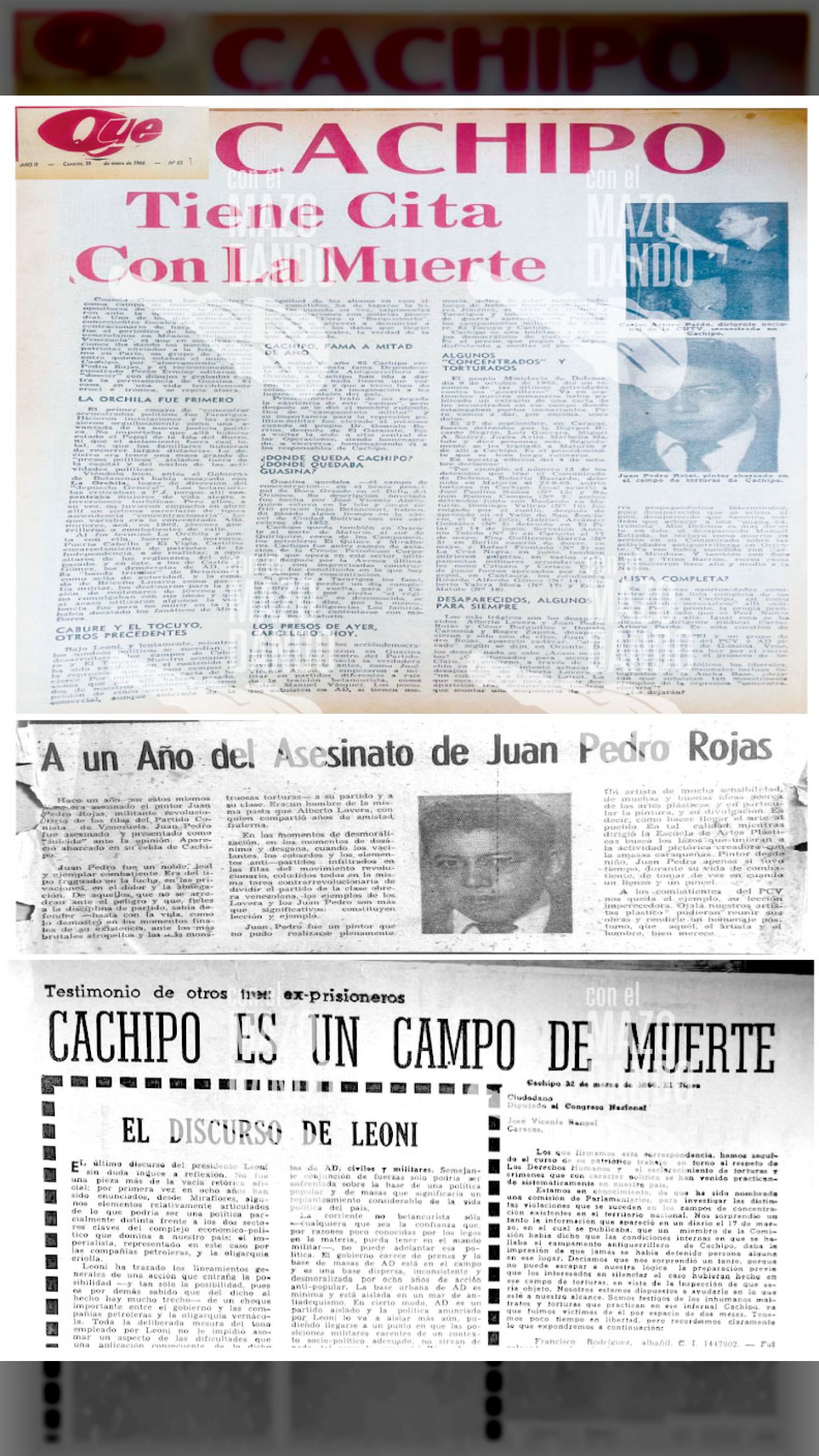
JUAN PEDRO ROJAS - 50 YEARS SINCE HIS ARREST AND HANGING
Published at: 15/01/2025 09:00 PM
(WHAT, happens in Venezuela January 25, 1966)
- 50 years ago, Juan Pedro Rojas Mollejas was hanged in the Tent of Truth, the torture site of the Theater of Operations No. 4 (TO 4), located in Cachipo, Monagas state, from which no one left alive. Within it, Donato Carmona, César Burguillos and Alberto Lovera were savagely tortured and later disappeared.
- In those first days of January 1965, the government of Raúl Leoni made the event look like a “suicide”. However, the investigation showed that Juan Pedro Rojas suffered severe torture and was then simulated hanging.
- Juan Pedro Rojas was a visual artist who served as director of the Museum of Fine Arts in Caracas in 1956. Merit for which he was awarded a scholarship by the government of General Pérez Jiménez, to study at the School of Beaux Arts in Paris.
- From that capital, together with the painters Mateo Manaure and Perán Erminy, they carried out a campaign against the abuses committed in the Guasina concentration camp, Delta Amacuro state, through the exhibition of a series of drawings, engravings and protest posters.
- Once back in Venezuela, he joined the Communist Party of Venezuela (PCV) and in his art workshop he continued to denounce the atrocities of the successive governments of Betancourt and Leoni.
- For these reasons, he was arrested in Caracas and transferred by DIGEPOL to the guerrilla camp of Cachipo or Theater of Operations No. 4 (TO4), located north of Maturín, south of Quiriquire, right next to the oil fields of El Quince and Miraflores. The esplanade of this camp had served as an airbase for Creole Petroleum Corporation aircraft.
- On July 7, 1965, in that same tent, which operated as a makeshift torture room in the open, Domingo Vallejo was hanged, who hours earlier had been arrested in the valleys of San Bonifacio, edo. Sucre.
- The instructions of the US Military Mission in Venezuela were precise: “The function of the anti-guerrilla units is not to take prisoners, but to shoot any guerrilla fighter that falls into their hands, wherever they find him”, which is why Rómulo Betancourt once said: “I don't charge a prisoner tied up.”
- At the beginning of Raúl Leoni's administration, there were more than 10,000 political prisoners, many of whom were minors. This is an important percentage, considering that the 1965 demographic census showed 8,875 billion inhabitants according to data from the Central Bank of Venezuela.
- For this purpose, in addition to providing spaces not suitable for detention and new concentration camps, in situ shooting or torture and subsequent disappearance of the detainee were carried out.
- In June 1963, the Chamber of Deputies dismissed, through a vote of censure, the Minister of Internal Relations, Carlos Andrés Pérez, for the flagrant and repeated violation of the civil and political rights established in the Constitution, in the exercise of his office. This was perpetuated with Gonzalo Barrios in the same position between 1964-1965.
- The five known anti-guerrilla camps and their branches, as well as the methods of disappearance and torture applied in them, obeyed the extermination manuals and instructions given by The Pentagon to military and police officials of the Leoni government.
Mazo News Team