Maduro podcast: Prosecutor revealed that Canserbero's death scene was staged
Presidential Press
Published at: 08/12/2023 06:19 PM
New leads are being handled by the Public Prosecutor's Office in the case of the death of Venezuelan singer-songwriter, Tirone José González Orama, better known as Canserbero, as revealed by the Attorney General of the Republic, Tarek William Saab.
“In a matter of days, impressive things were seen. As soon as we reconstruct the events at the scene of the event, we ask ourselves: How does a schizophrenic person pull out eight windows in an attack and then launch himself? We found inconsistencies in the way he appears in the photographs when he falls, it's as if he were sleeping, and that's impossible when someone falls from a tenth floor. We saw fractures on the right side, but we noticed that there were four penetrating puncture wounds on the left side prior to the fall. In addition, we did a psychiatric autopsy, the whole environment was interviewed again, his family members, his friends, no one gave an indication that he might have an illness or a mental disorder,” said the head of the Public Ministry.
After going even deeper into the investigations, the organs of the Venezuelan State have found evidence that counteracts the official version, said the Attorney General.
“Researchers relied on the fingerprints that looked out onto the window. The investigation also determines that these were not Tirone González's fingerprints and that what is there was superimposed, they changed the scenario of the events, but there is something more serious in the reconstruction of freefall, it's a lie that he stands up on his toes, rides in place and jumps, because when a simulation is done the body doesn't fall, as he fell,” he explained during the second episode of Maduro Podcast.
In this context, the President of the Republic, Nicolás Maduro, called for the prompt clarification of the facts and the application of justice.
“A scenario is taking shape that all seems to indicate that this boy was murdered. Surely it will be clarified by the Public Prosecutor's Office. Justice is the basis of peace, of coexistence. Things can be done better and that is the challenge we have as men, as women, as a generation,” he said.
MADURO POST CAST
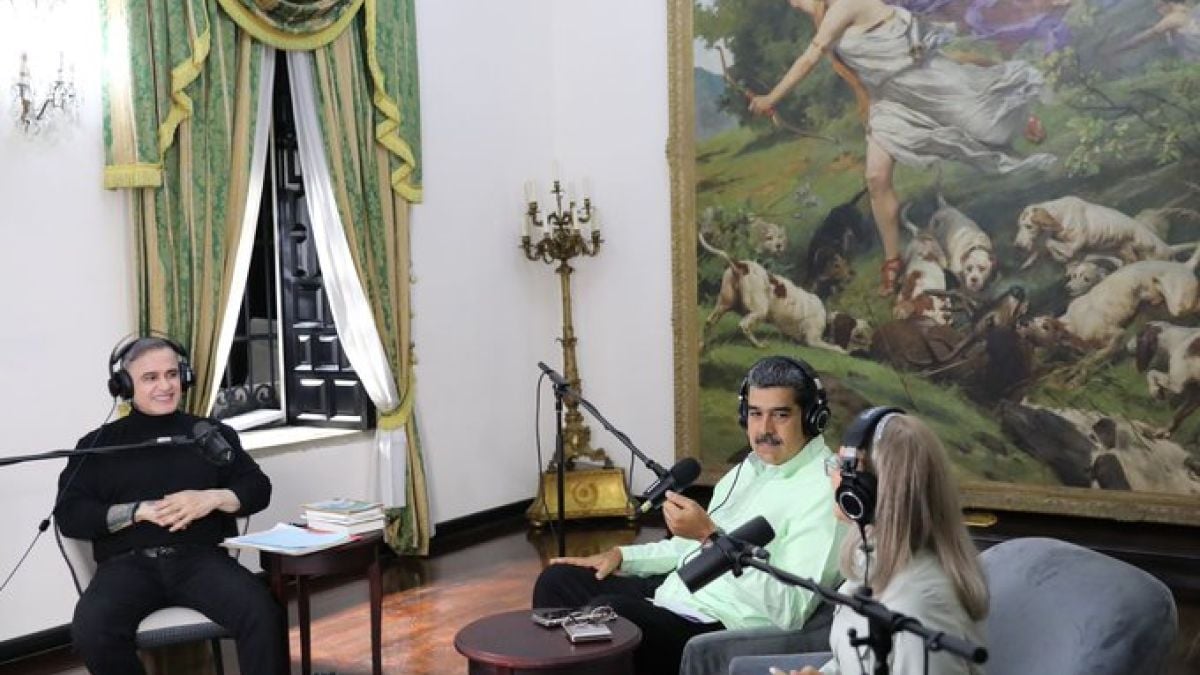
The President of the Bolivarian Republic of Venezuela, Nicolás Maduro, shared experiences, anecdotes and current issues with the Attorney General of the Republic, Tareck William Saab, during the second episode of the Maduro Podcast, a space that is broadcast on the social network YouTube.
The first fighter, Cilia Flores, also a guest on the Head of State's program, highlighted Saab's efforts to defend just causes for more than three decades.
“There we saw Tarek because then he was like a light” (...) “I said well someone is there, it's a light, a hope if because Tarek was an urban legend, there is a poet who defends human rights,” he said.
The president asked about his family origin and anecdotes about his life as a militant and his encounter with poetry.
Saab is a lawyer and poet, of Lebanese parents, who was born in Mesa de Guanipa. “I come from a land that sometimes seems to have been erased on the map, but where I was always surrounded by a homely womb, well, family values,” he said.
Prosecutor Saab emphasized that his father and uncle arrived from Lebanon to Curaçao, where they learned the skills of commerce and then the destination led them to Mesa de Guanipa, in the state of Anzoátegui, in the early 1950s, where they settled. Later, his father returns to Lebanon and brings his mother with him to Venezuelan territory.
Regarding his studies, the current Attorney General of the Republic emphasized that his education took place in “a famous school of the time, the Simon Bolivar school”.
In this regard, he recalled his younger years with nostalgia. “I would sometimes escape from the living room to go to Plaza Bolivar, which was nearby, a block away. But it was a very beautiful time that involved childhood friendship, it was a brotherhood, I at least remember that I was a close friend of a Greek”.
Saab also refers to the warmth of Venezuela, which stands out for welcoming all nationalities with open arms.
“The beauty of that school was that there were children of Greek, children of Chinese in El Tigre. From Italian, from Portuguese” (...) “Venezuela is always, still today, a recipient of immigration from Europe, from the Arab world, now from China, from Colombia, from Peru, from Ecuador, from the whole world,” he said.
The Prosecutor also spoke of his first steps as a student leader.
“I was a student delegate in the first year, second year, third year, at the age of fourteen” (...) “When I went to the Briceño Méndez High School, which was basic and diversified, I was elected president of the student center, so my struggles in the beginning are similar to yours in the sense that they were the product of the struggle of the student movement,” he said.
President Maduro agreed with the way in which Saab perceived the future of the country.
“To be able to dream in perspective with the faith and certainty that we always had in a time of despair. That everything is going to happen. And that all this was going to be on track,” he said.
Higher education was another area in which William Saab excelled when he began his career in Literature, at the University of Los Andes, where he would later be president of the Committee for High School Students without a quota (ULA).
In this regard, President Maduro emphasized that the current generation is unaware of the impediments that -years ago- young people who wanted to access university education had, as a result of the capitalist policies applied by right-wing governments.
“Because that's over with the Baccalaureate Committees without a quota. 20% of the then 30% of the youth population graduated and also only 20% of the graduates had access to universities,” he said.
Faced with the revealing question posed to him by the head of state about his first steps in poetry, he replied: “One day I was in the classroom, I remember that it was in the chemistry laboratory, the fourth year of high school, I was fifteen years old and suddenly there was a window here in that classroom” (...) “It started to rain in the window and that was facing some trees and all of a sudden that gave me a kind of magic and I wrote a poem called rain”.
Mazo News Team