Operation Babylift: When the US Abducted 3,000 Vietnamese Children
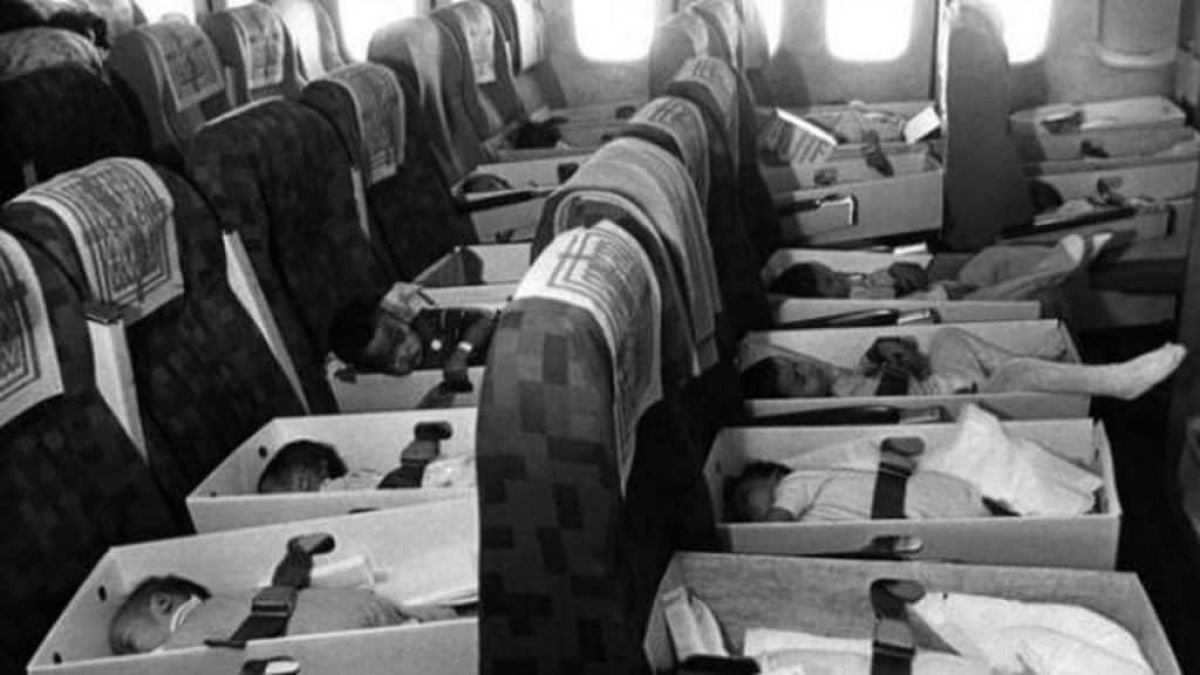
Internet
Published at: 01/08/2025 03:54 PM
Fifty years ago, when
the Vietnam War ended in April 1975, the United States carried out
Operation BabyLift, in which it kidnapped more than 3,000 native and mixed race children
(children who were the result of the rape of Vietnamese women by American soldiers) in a controversial action about
which questions remain unanswered.
At a press conference
in San Diego on April 3, 1975, U.S. President Gerald
R. Ford, after being defeated, declared: “We are witnessing
a tremendous humanitarian tragedy with the flight of countless Vietnamese people from the North Vietnamese offensive.
I have asked U.S. officials in Saigon to act urgently to reduce the red tape
that hinders the transfer of these children to
the United States,” according to the archive of the Gerald R. Ford
Presidential Library, the US president announced the
mobilization of 2 billion dollars in foreign aid funds to
“bring thousands of children to a safe place in the United States and other
countries”.
As they did in Cuba
in 1960 with Operation Peter Pan, the announcement came
weeks before the city was taken over by the communists, following a series
of rumors (the same strategy used on the island) that circulated in Saigon that children
born to Vietnamese mothers and American parents
would be “massacred” and “raped” by communists.
According to
research by the journalist of the portal Radio
France International (RFI), Chi Phuong, “the rumors
further fueled the fear of reprisals against any sympathizer of the
US military and the Vietnam regime, whose first
objective would be mixed race people, considered children of enemy. It
was also rumored that Catholic orphanages, supported by
American and international organizations, would be attacked, and that
communist forces would recruit orphans as human shields or as soldiers.”
This
provoked social tension led to the start of Operation Babylift, less than 48 hours after Ford's statements and
with the support of the US Embassy in Saigon, as well as
numerous humanitarian and volunteer organizations, the first flight took off on the 4th of
April 1975 from Tan Son Nhat Airport, an American military
aircraft, with more than 300 people on board, mostly
children and crew.
At the time, the atmosphere
was chaotic in Saigon. That disorder and confusion are still
very present in the mind of Phillip R. Wise, then a
23-year-old military nurse in charge of the aviation medical section of the
US Air Force at a base in the Philippines, assigned to Saigon:
“I remember hearing gunshots in the back and being able to feel fear in the voices and the cries.
We place children, from newborns to 3
years old, in the troop compartment, two per seat, with a pillow between
them and seat belts. There were 80 seats. And the older kids and
volunteers were down in the cellar, with us.”
Wise explained
that “just 10 minutes after takeoff, due to a technical failure, the plane's rear
door detached from the fuselage in mid-flight, more than
7,500 meters above sea level. Given the rapid decompression, we had no oxygen left to breathe in the
lower part, but upstairs, we did. The
crew was able to use oxygen tanks to care for themselves and then to
the children. We fasten ourselves with the children to the cargo boxes. The pilot tried to
return to the airport, but the hydraulic system failed and the plane crashed
into a rice field.”
In this tragedy, more
than 130 people died, including 44 women volunteers and 78 children. After this, other
airlines such as Pan Am, World Airways, United or Flying Tiger
Line continued with the mission. Operation BabyLift ended
on April 26, 1975, evacuating more than 3,000 children. Around 2,000
were adopted in the United States and 1,300 were sent to countries such as France, Canada,
Australia , Germany or Belgium.
That plane crash was the
first official Babylift flight, and immediately,
thousands of potential parents in the United States and other countries signed up to
receive their children for adoption, and young war orphans, other
abandoned children of American soldiers and others abandoned by families who
feared for their well-being and safety, were scattered to new homes in distant lands.
Soon after, the operation was questioned
when it was discovered that some of the adoptees had parents or living
relatives who had not given their consent for their transfer, now,
after 50 years, something is undeniable: it transformed the identities and families
of those affected for life.
Almost immediately, 3
weeks after the kidnapping of children began, there were reports of Vietnamese mothers and
family members protesting that they had given their children to their
care without realizing that they would be evacuated from the country. Most of these
adoptees wouldn't be reunited with their families for decades, if they
ever did.
Operation Babylift ,
a mission to expel children considered
orphans from Vietnam, was described as a humanitarian mission implemented by the United States, as a direct
reaction to the imminent fall of Saigon. The controversy
surrounding it spread as questions arose about the real
motivation of U.S. efforts to evacuate children from Vietnam:
Was the United States really concerned about the fate of these babies, or was it
more interested in generating the only positive image possible after a disastrous war
? The complex nature of these operations invites us to explore
the motivations and consequences of so-called humanitarian politics in
North America.
The professor at the University
of Kentucky, Bethany Sharpe, wrote a book called “
Wrong Intentions: Operation Babylift and the Consequences of Humanitarian Action”,
in which she described the situation that
Vietnamese families went through: “They understood orphanages as places of refuge for their children in times of extreme distress caused by
ravages of the war.
They took their children to these homes temporarily with the intention of
recovering them. Faced with these different interpretations of the adoption process,
many of the abducted children were not orphans.”
Professor Sharpe
explained that “soon after arriving in the United States and settling down with new
families, the parents of Vietnamese children found their children and
began the process to claim them, only to discover that their legal parental rights
had been canceled. A Vietnamese mother struggling to
get her children back explained her understanding of adoption: To understand
my story... think that you are trapped in a burning house. To save the
lives of their babies, they leave them in the hands of people outside to pick
them up. They are good people who would pick them up, but then they find a way to escape
the fire as well, and they thank people for getting
their babies back, and they try to take them away. But people say: Oh, no! These babies
are already ours, they can't get them back.”
As part of the U.S. policy
of abducting children under the guise of humanitarian aid, some courts
in California, Michigan and Iowa ordered the repatriation
of some Vietnamese children to their biological parents, but many others
ordered that they remain with their adoptive parents.
In a class action
brought against Henry Kissinger, claiming the right to
repatriate children to their parents, the courts ruled that the lawsuit had
no collective basis and therefore could not move forward. By relinquishing
the responsibility to repatriate parents and children, the lawsuits erased the
presence of the biological mother, reinforced the image of Vietnamese culture
as a culture that does not care for its children in the same way as American mothers and
families, and silenced questions about the nature of American humanity.
It seems then that the
American government has whitewashed the crime of kidnapping children as a
war policy and with the excuse that they are not safe in their country. Above all, because the United States does not offer a safe environment for anyone, since there is a social deterioration expressed in the indiscriminate use of
weapons, cases of pedophilia, naturalization of drug use, among other realities that call into question the
premise that seeks to justify such a crime.
AMELYREN BASABE /Mazo News Team