Operation Peter Pan: The Time the U.S. Abducted 14,000 Cuban Children
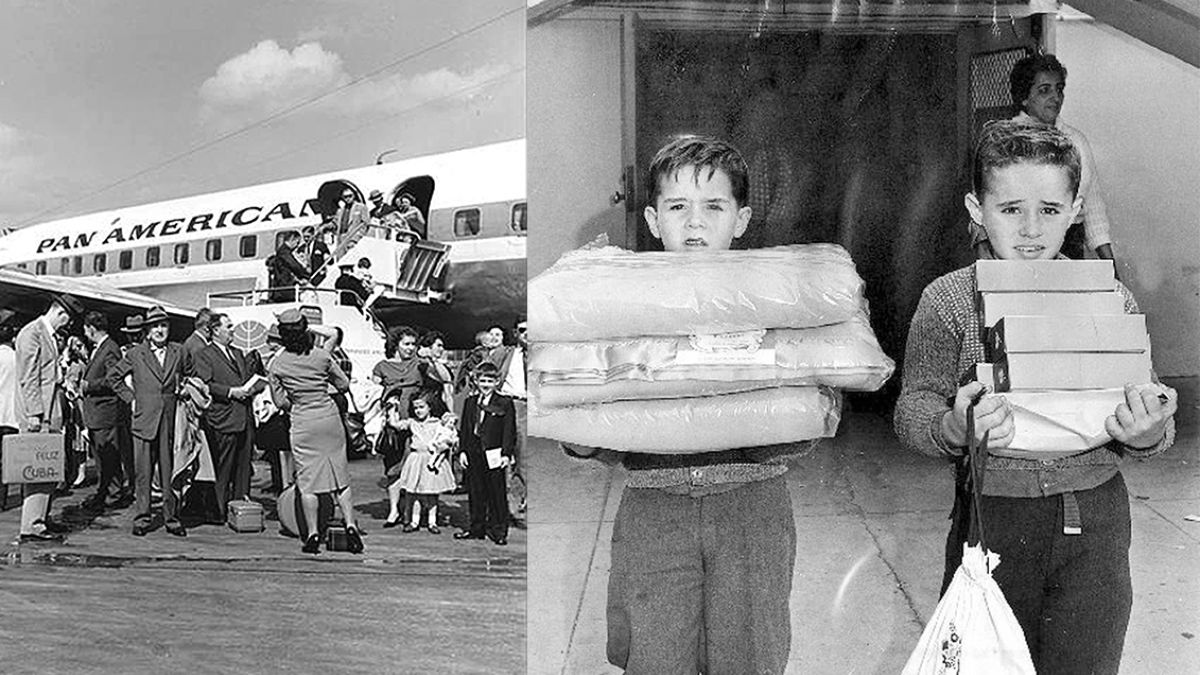
Internet
Published at: 25/07/2025 05:32 PM
Operation Peter
Pan, or Pedro Pan in Spanish, was another
open-air crime: the kidnapping of foreign children by the United States, this time,
against Cuban children. This disastrous event occurred in 1960, after Fidel
Castro assumed power of the Cuban Revolution the previous year and was moving towards a socialist system.
This led to clashes with those
who opposed it, especially with the Catholic Church. In this tense atmosphere, there
was a rumor that the new government would enact a law that would eliminate parental
rights (parental authority) and that children would be separated
and sent to camps or even to the Soviet Union.
In the book called Operation
Peter Pan: Closing the Circle in Cuba, written by Olga
Rosa Cortés Gómez and based on the documentary by the writer Estela Bravo, it
was detailed that “copies of an alleged law circulated, which were later proven to be false and we asked ourselves: Who was responsible for those rumors
that led to Operation Peter
Bread? It was the International
Intelligence Agency (CIA), whose clandestine radio station Radio Swan ,
was one of the main sources.”
In that book, the
victims' experiences were compiled. One of the interviewees, Álvaro Fernández
Pagliery, recounted how his father, Ángel Fernández Varela, who was a key CIA
agent shortly before his death, regretted his role in
the initiation and development of an operation that affected some 15,000 Cuban children and young people.
U.S. official
Wayne S. Smith, head of the U.S. Interests Section in Cuba
from 1979 to 1982, stated in an interview years later that “the objective behind
the CIA plan was to cause disturbances and confusion in
Cuban society. The Catholic Church was also involved, Father Bryan
Walsh, from Miami, was the main director of the operation.” Smith
claimed to have received a call from the State Department in Washington
in December 1960, requesting the Church's assistance, because there were
about two hundred Cuban children at his embassy in Havana, whose
parents had to send them to the United States.
Smith
further said that “because of the State Department's decision not to take
responsibility for it. Visas could only be granted if the
Church took responsibility and Father Walsh agreed.
On January 3, 1961, the U.S. government broke diplomatic relations with Cuba.
From then on, its embassy was managed by Swiss diplomats. The State
Department issued visa waivers only for children
through the Catholic Church, and Father Walsh signed them.”
“This was the pattern for more than
two years,” Smith said in the same interview, adding that “during those
more than two years, about 14,000 Cuban children and adolescents arrived in the United States
alone, without the company of their parents. Why didn't the parents travel too? Because they
didn't give them visa waivers. The expectation seemed to be that the United States would
soon end Fidel Castro's government and that everything
would return to normal life, with his children returning to Cuba. But these
illusions were dashed by the failed invasion of the Bay of Pigs
in 1961 and then with the Missile Crisis of 1962, which meant the
suspension of all flights between the two countries. In the meantime, what
happened to those thousands of Cuban children? Well, the children were placed in
orphanages, camps or offices of the Catholic Church, some were
lucky and treated well, but for others it was not like that, some were abused by priests.
With the breakdown of relations between the two countries,
most of them were separated from their parents, whom, in some cases, they did not see for
years and in others, never. I know a lot of these victims, to know them is to
feel their pain.”
Testimonials
More than 50 years have
passed since an event that had enormous repercussions for many
Cuban families: Operation Peter Pan. Between 1960 and 1962, more than fourteen thousand Cuban children and
adolescents left alone, without their parents, to the United States, as a result of a clandestine
operation.
In 1979, when the couple Estela and Ernesto Bravo were filming their documentary, they had their first approach to the history of the Pedro Pan family through Cuban émigrés. That same year, in New York, they interviewed several people who were victims of these decisions.
Elly Vilano Chovel, an activist based in Miami, firmly stated in an
interview in 1999 about her foundation for the Peter Pan children's location:
“We were the ones who participated in that story, no one could tell us a story about it.
We were the ones who had to recapture the
story to leave it to those who came behind, in the hope that they would
learn from the pain, from the courage we had, from everything we went through.”
“I was a 14-year-old girl when they separated me from my parents and sent my sister and me to the United States, and I was
immediately responsible for the care of my sister, who was two years younger
. We came alone, a completely unusual situation for
Cuban children or for any child in the world, to leave their family and their land,
and to grow up separated from all the things that were familiar to us.”
Vilano says that “when we
arrived, they sent us to a camp where the girls and those who were
under 12 years old were there, we stayed there for about three and a half months. It was a place where it was
very hot. We were twelve girls in one room, we slept in bunk beds,
it was like a dream or a nightmare, because we had never separated from our parents.
The Cuban family is very united, the parents are very
protective, they cut the navel when the child turns eighty-eight years old. I think that
parents separated from their children is an incredible, unreal thing, I
still don't know how it happened.”
“I think we should talk
about Operation Peter Pan or Pedro Pan in Spanish,
even if it's painful. Families should never be divided, we have to do
something to protect children, to protect families. We have the experience
and we know how it feels. My heart bleeds when I see what happens to the
children of Kosovo, I can't bear it. And when I see the rafters and
other children who lose their parents, my heart bleeds for these children.”
“There has to be an
understanding between people. There may be conflicts between governments,
but it is not necessary between Peoples.” Elly Vilano
Chovel worked actively to locate children. She was the founder of Pedro Pan Group,
Inc. , an organization created in Miami. He died in 2007.
Ed Canler, businessman, left Cuba on September 20, 1961. He was placed in an orphanage in
Lansing, Michigan. He traveled with his brother. His parents arrived
a year later. He visited Cuba for the first time in 1994.
“They uprooted me from Cuba,
I think it's like uprooting a young tree from the ground. One can hear how the
root breaks and that's how it was. You leave your family, your friends, your school, your
country, your language, your roots are broken, stretched and broken. You leave
what you have known, culture, friends, customs, everything you leave behind.”
It was not a
pleasant experience, but it was bearable, because, for example, I was proud that I
was not an orphan. The other little American boys were or their parents
had abandoned them, but I had parents and they loved me. For that reason I
considered myself special and that's why I refused to go to a foster home, because
I wasn't an orphan. On one occasion, a friend and I refused, that Easter
weekend, to spend the holidays in those foster homes, and we were the only
ones left in the orphanage, we were the only two of us in the orphanage.
I'll never forget that.
Alex López, living
in Washington, left Cuba on June 4,
1962, when he was twelve years old. He works in the tourism sector.
“We were children,
young children, that was the first violation, violating the children's minds and then
violating everything, the separation, the outcome, the children who never saw their parents again.”
On June 4, 1962, when I was twelve years old, I left Cuba.
I was in several camps in Miami, then I was transferred to Ohio
to an orphanage in the city of Cincinnati, and then I lived with an American
family until my parents' arrival in 1966. I currently run
a travel agency.
“I left during the time when there was talk in Cuba that parental authority would be taken away from
parents, and my parents were completely convinced that they were going to take their
children away from everyone and that the salvation was to send them to the United States .
It
was done through contact in our town, Matanzas, with the parish of
the Catholic Church”.
“I definitely think that
all of this was organized by the CIA, that's how it was. At the time, I
had no idea, but I have come to be sure that it was something created to
destabilize the Cuban government and we were the instrument, and
from what I have read it is the CIA and the State Department. How is it
possible to pick up a visa to enter the United States in the Catholic Church
's Matanzas parish? , where was the connection? I think it's very clear, it's
obvious. Someday the truth will come out. No, I don't think anyone will give up their arm
and tell the truth, but we Cubans are aware of
what the truth is, even those who today hide and deny it know inside
themselves what the truth is.”
Until now, the United States
has not taken responsibility for this dark episode in history,
tearing apart Cuban families, breaking them up forever and leaving the saddest memories
of their childhood.
AMELYREN BASABE/Mazo News Team