
President Betancourt said: “THERE WILL BE NO AMNESTY LAW”
Published at: 11/02/2026 08:34 PM
Raúl Leoni in his inauguration speech: “THERE WILL BE NO TRUCE OR GENERAL FORGIVENESS”
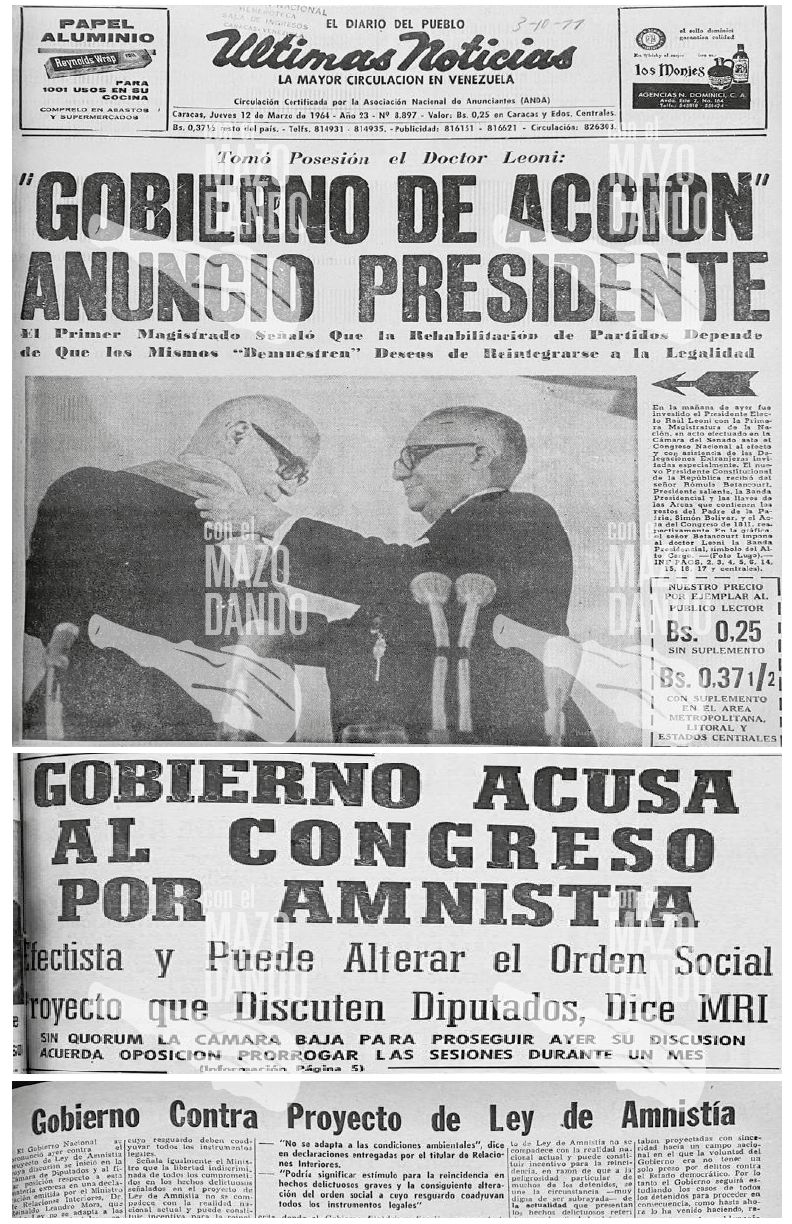
General Ramón Florencio Gómez, Minister of Defense: “There are 95 Detainees that no one takes them out; neither with Law nor without Law (of Amnesty)”
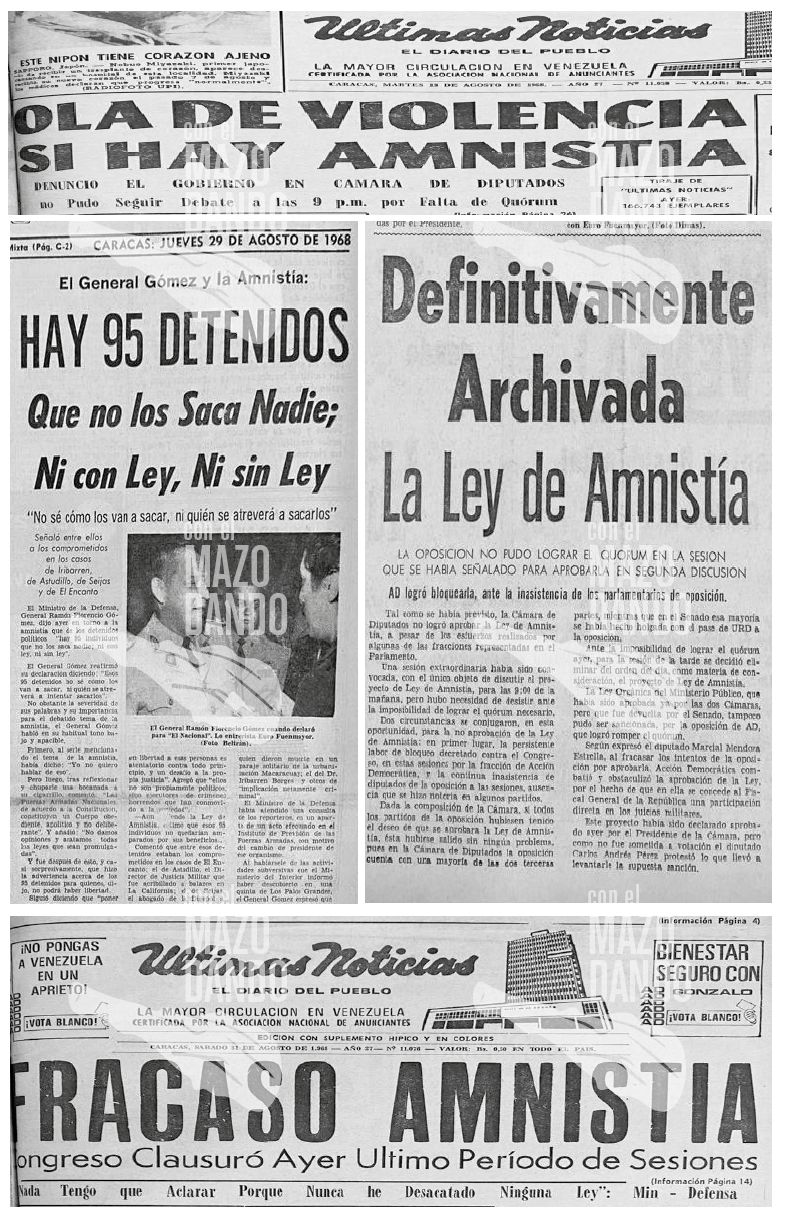
(EL NACIONAL and LATEST NEWS, January 1963 and March 1964)
- The statements made by Rómulo Betancourt, during his presidential address for the New Year in 1963 and by Raúl Leoni, in his opening speech on March 11, 1964, were almost identical: “There will be no Amnesty Law or General Pardon for outlawed parties and insurgent groups of the Communist Party of Venezuela (PCV), the Revolutionary Left Movement (MIR) and the Armed Forces of National Liberation (FALN)”.
- To which, to close the passage to the approval of any Amnesty Law that was being discussed in the National Congress, General Ramón Florencio Gómez, Minister of Defense added: “There are 95 detainees that no one takes them out; neither with law nor without law. I don't know how they're going to get them out or who will dare to get them out.”
- The door was closed to the request of General Amnesty requested by the factions of the Democratic Republican Union (URD), the Popular Democratic Force (FDP) and the Revolutionary Party for Nationalist Integration (PRIN), the floodgates of selective assassinations and the deployment of public force in all anti-government demonstrations were opened.
- Thus, history recalls how the government of Raúl Leoni applied Betancourt's “hard line” by executively declaring a bloodbath that continued from 1958 to 1998. Forty years of systematic violation of human rights in Venezuela.
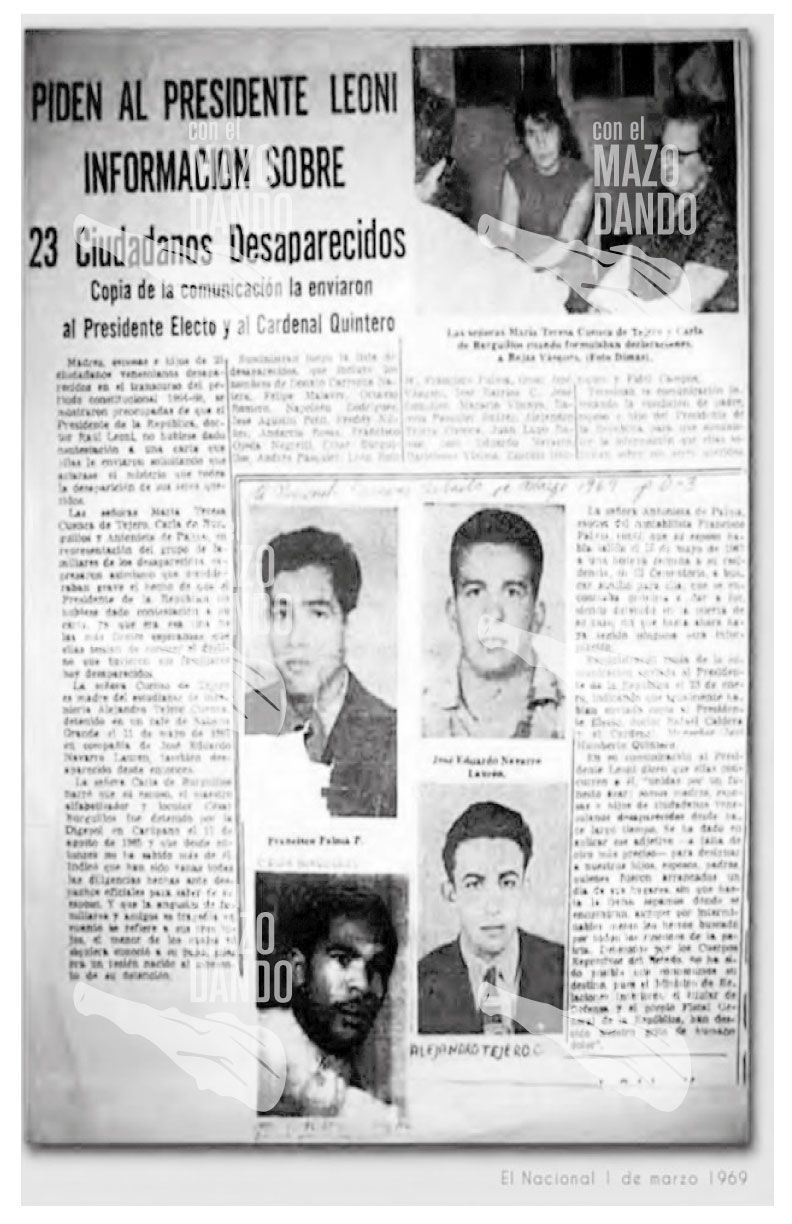
- The request of Amnesty General was raised on several occasions on behalf of the more than 2,000 political prisoners held in subhuman conditions in the concentration camps of Laguna de Los Tacarigua, known as “La Isla del Burro”, the political prisoners of the San Carlos Barracks, the Mobile Colonies of El Dorado, known as “El Dorado” Hampoducto” and the “La Pica” Prison in Maturín, Monagas state. Among the political prisoners were the “reds”: Gustavo Machado, Guillermo García Ponce, Clodobaldo Russián, Ali Rodríguez Araque, Jesús Farías, Captain Manuel Ponte Rodríguez, Víctor Hugo Morales, Máximo Canales, Teodoro Petkoff, Pompeyo Márquez, Nery Carrillo and Alejandro Mariño Suzzarini. Some of whom died in prison as victims of ill-treatment and torture or lack of timely medical care, such as the case of Captain Ponte Rodríguez. Others, at the time of their arrest, make up the long list of the more than 3,000 who were disappeared.
- To each request for General Amnesty, the governments of Democratic Action (AD) and Copei responded with greater brutality in political persecution, torture, shootings and enforced disappearances.
- A few days before the 1963 New Year's presidential address, President Betancourt ended the joyous and welcoming demonstrations expressed by the people of Caracas who came out en masse to receive Rear Admiral Wolfgang Larrazábal. As a result, an 11-year-old boy, Alejo Celis, who was holding the Venezuelan flag in his hands, was struck down by government bullets.
- A few days later, on February 3, 1963, Betancourt ordered the bombing of mountainous areas in the states of Falcón, Lara and Portuguesa, adding to the long list of 900 dead under that government hundreds of peasant families terrorized under the devastating effect of air attacks (Elite No. 1950, February 9, 1963).
- Raúl Leoni did the same at that historic moment, when all the living forces in the country and especially the political forces represented in parliament promoted the discussion of a General Amnesty Law, to which the president responded with the institutionalization of forced disappearance as a State policy and the installation of five Theaters of Operations ( extermination) anti-guerrilla (TO).
- Since then, the binomial Directorate General of Police (DIGEPOL), as an agent of arbitrary arrests, and the TOs, as secret isolation centers for torture, shooting and forced disappearances, operated uninterruptedly throughout the national territory from 1964 to the 80s.
- The refusal of the governments of (AD) and Copei to approve any General or Partial Amnesty Law, to the general pardon, to the clean slate to establish a climate of peace, always complied with the criteria of the Betancourt Doctrine: “Shoot first... find out later”, implementing de facto the death penalty.
Mazo News Team