The American Prison Business and Private Company Slaves
Internet
Published at: 25/04/2025 06:18 PM
US prison
policy is a key mechanism within its economic
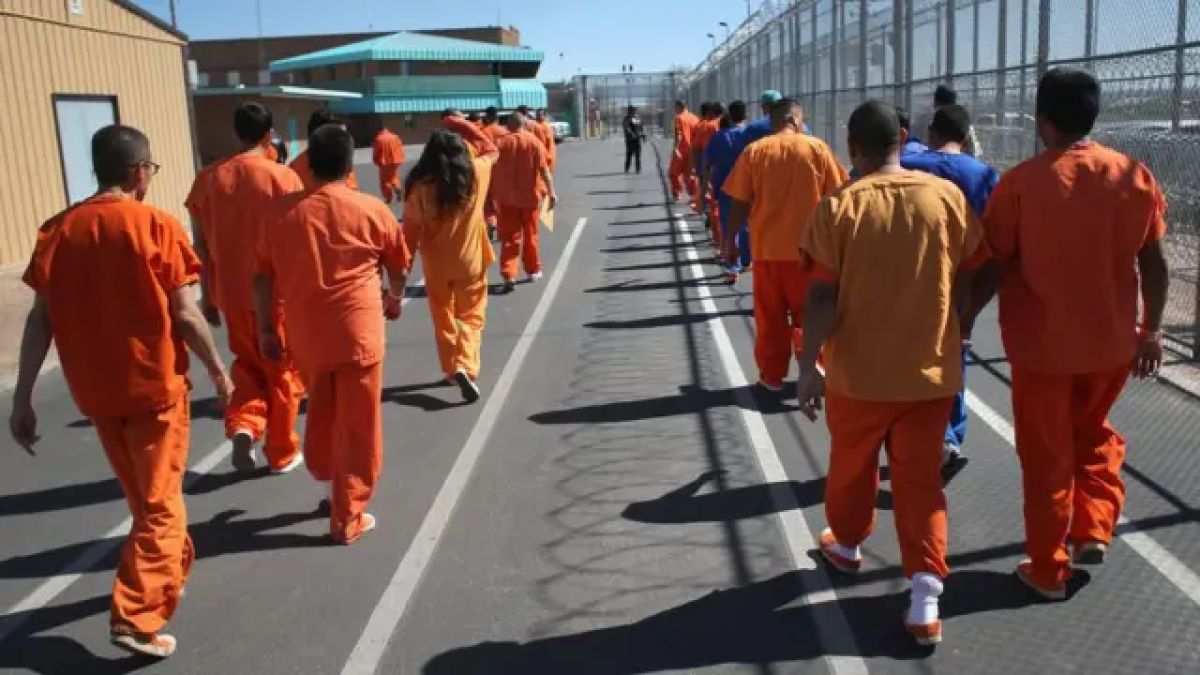
system and in it, detainees work for corporations that
bill millions of dollars. Prisons are in third place as labor
providers. They are second only to General
Motors and Wall Mart.
Analysts of these
statistics speak of slavery in the 21st century or at least exploitation,
according to the research portal Global Research, the pay is
0.23 cents an hour; this explains how the United States houses 25% of the world's prisoners when the population
of that country barely reaches 5% of the world total.
On this same topic, BBC
Mundo
published an article in which it described “what was happening in the Ohio penal system, where there were inmates who owed
between 20 and 35 thousand dollars to enter and leave prison after committing
minor crimes”.
Of course, there is a company, which was created in 1983, called Corrections Corporation of America (CCA), now known as CORECIVIC, which is the first of the companies created to manage prisons in the United States. According to an article published by Cuban writer Miguel Angel García Alzugaray, this company has 66 prisons, 91,000 detainees and annual profits of 1.7 billion dollars. The GEO Group, the other corporation that stands out next to CCA, has 65 convicts, 65,700 detainees and earns 1.6 billion dollars per year. Both companies increased their revenues by 46% between 2014 and 2019.
According to the Global Research portal , “CCA and GEO Group are not the
only ones doing business at the expense of prisoners. Other companies are
guaranteed that inmates work full time, cannot be late
or be absent due to family problems. If the pay is insufficient and they
refuse to do their job, they lock them up in isolation cells. It is
obvious that they lack union protection, do not receive overtime or
holidays, health or social security benefits. IBM, Motorola, Microsoft, Telecom and even the British oil company BP are using enslaved labor. Thanks to it, they manufacture
different industrial implements in a wide range of activities”.
In addition, the annual
report released by Human Rights Watch in 2017,
“there are 2.3 million detainees in the United States,
of which 211 thousand are in federal prisons and the rest in state
prisons. The number of prisoners in that country far exceeds
those in China, Russia and Brazil, which are
still in order and are between 600 and 700 thousand each. Comparing incarceration
rates, they show that for every white there are five black prisoners or
two Latinos in that same proportion. At the expense of that prison population,
a group of well-known corporations are doing businesses that are still far
from reaching their roof.”
Also, a study by the U.S. Progressive Labor Party
argues that “privately hiring prisoners for work encourages
incentives to imprison people. Prisons depend on this income, and
corporate shareholders who profit
from prisoners' labor lobby for longer sentences in order
to expand their workforce. The system feeds itself. More than
a hundred private jails are spread across the United States.
In several, prisoners are charged for their daily stay as if
they were living in a hotel.”
Also on this business,
journalist Justin Rohrlich published
a very illustrative work in World in Review
in which he detailed that “one of the big winners of this
policy is UNICOR (the former Federal Prison Industries
), this corporation hires work in prisons and has 110 factories in 79
prisons; prisoners produce, in exchange for
cents an hour, components for McDonnell
Douglas/Boeing F-15 warplanes, General Dynamics/Lockheed Martin F-16s and Bell/Textron Cobra helicopters.
They also manufacture night vision goggles,
bulletproof vests, camouflage uniforms, radio and communication equipment,
lighting systems and components for 30 mm to 300 mm anti-aircraft guns, landmine
trackers, and electro-optical equipment for the Bradley combat vehicle's laser rangefinder.”
Rohrlich added that the aeronautical transnational BAE Systems, “the second largest military contractor in the world, is
one of UNICOR's main customers.
Of British origin, but with large businesses in the US, one of its main products has been Patriot missiles. American
prisons make about 30 billion
dollars a year in profits for this type of company.”
“The perverse thing about the system is
that these commercial operations are guaranteed with the prison population that
each state assures companies. In the case of private prisons,
they must reach between 95% and 100% occupancy. If that doesn't happen, state
governments must compensate them,” Rohrlich stressed,
and further explained that “the quotas of detainees also reach
undocumented immigrants. By a congressional regulation,
the Department of Homeland Security has been
obliged since 2009 to guarantee 34,000 people per night in detention centers for foreigners.”
Regarding this, politician and businessman Conrad Black also denounced
that “in the last two
decades, the money that states spend on prisons has increased six
times more than the rate of spending on higher education. Our country is, from north
to south, a prison state.”
Reaffirming this argument,
Mexican researcher Raúl Guillermo
Benítez explained in an interview given in 2022, that “
private prisons in the United States are “big
business” that thrives on violations of the human rights of migrants and
minorities, while explaining why that country has the largest prison population in the world.”
Benítez
said that U.S. prison privatization “corrupts the essence of the prison
system because it turns it into a business whose profitability lies in the number of prisoners.
The government pays prison owners or
managers for each inmate, which means that, for companies
linked to the activity, having more prisoners means more income.”
Benítez ,
from his position as an academic at the North American Research Center
of the National Autonomous University of
Mexico (UNAM), explained that this economic logic is supported by
what he referred to as the heavy-handed
policy of the United States, because for at least 30 years the
police officers have incentives to send more people to prison
for minor crimes, in complicity with prosecutors and judges. This enriches private
entrepreneurs, who are the ones who rent prisons or those who own
prisons, and then it becomes a big business,” he said.
The most recent edition of
the Criminal and Judicial Policy
Research Institute (ICPR) database reaffirms the United States as the country with the largest prison population in
absolute
terms and in numerical proportion, with more than two million
inmates and 629 per 100,000 inhabitants, respectively.
According to complaints
from organizations and activists, the high number of people behind bars
contributes to the criminalization of migration, which causes many migrants to
be detained in detention centers operated by private companies, where their human rights are
violated or limited.
Benítez also
considered that “the growth of irregular immigration to the United States benefits the owners of private
prisons, because they receive money to hold migrants and use them as
an extremely cheap labor force.”
GEO
Group and CORECIVIC
are the two U.S. corporations with the
most investments in private prisons. Its combined revenues in 2024
exceeded $4 billion. Both are recognized donors to political
campaigns, such as that of President Donald Trump, and they hire lobbying firms to protect their
interests in the upper echelons of American power.
“The law allows local
governments to rent prisons to private individuals and hire them to be
administrators. This is a vicious circle, because many
leaders contact the owners of these companies and have agreed
interests,” said Benítez.
This is why there is no different scenario in sight
for private prisons in the United States and the human rights violations they promote.
Even this prison model has been expanding to other countries such as El Salvador, where people are kidnapped and dehumanized to convert them
into tradable currency, without any shame.
AMELYREN BASABE/Mazo News Team