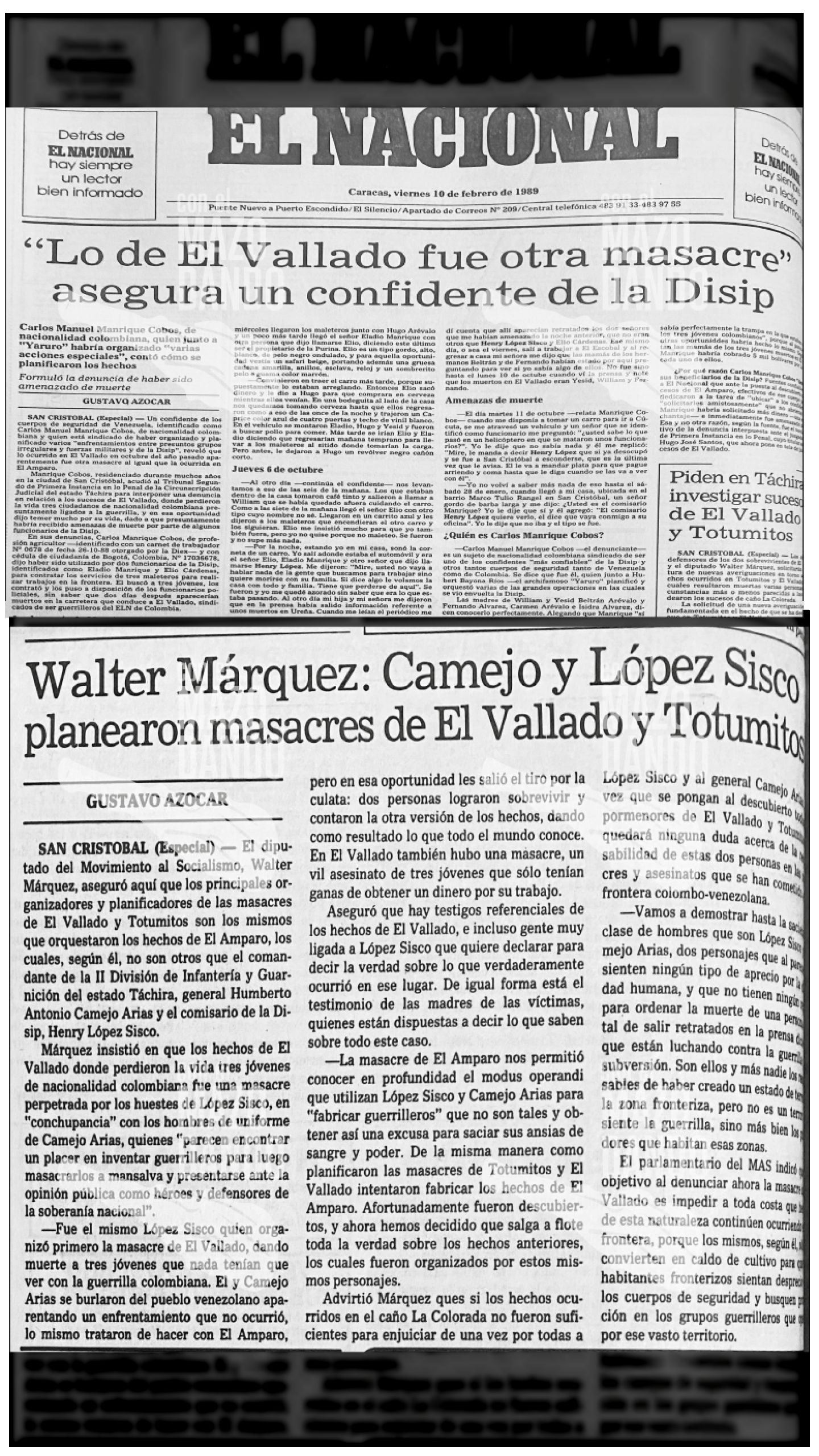
THIS IS HOW AGENT DISIP CONFESSED: HENRY LÓPEZ SISCO PLANNED THE MASSACRES OF EL VALLADO AND THE TOTUMITOS
Published at: 12/02/2025 09:00 PM
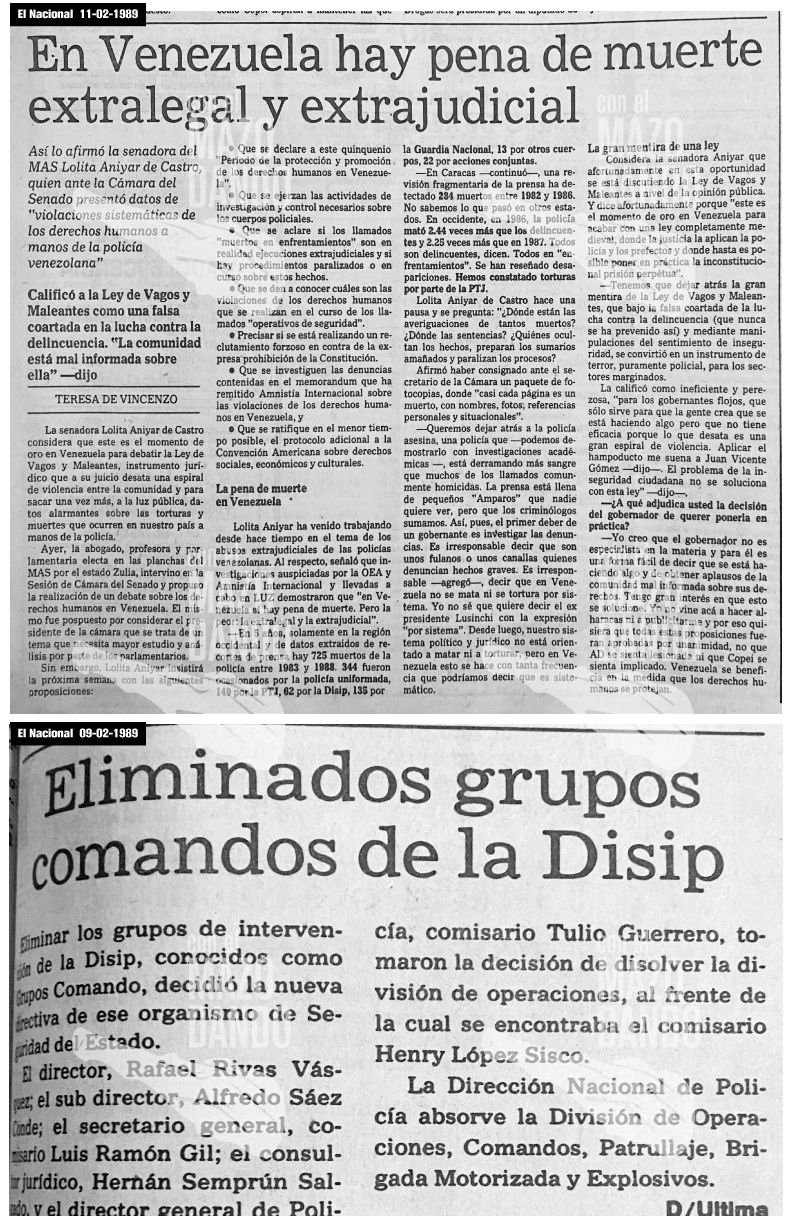
DID THE EXTRAJUDICIAL AND EXTRALEGAL DEATH PENALTY EXIST IN VENEZUELA
725 VICTIMS OF THE REPRESSION BETWEEN 1983-1988 IN ZULIA AND TÁCHIRA
(EL NACIONAL, February 9, 10 and 11, 1989)
- Between the last year of the Government of Luis Herrera and the five years of the Government of Jaime Lusinchi, 725 innocent people were executed by the State security forces.
- This balance only corresponded to police abuses committed in the west of the country and in all cases they were presented as alleged confrontations or false positives.
- The extrajudicial executions of El Vallado and Los Totumitos are among those carried out by commandos of the Intelligence and Prevention Services Directorate (DISIP), led by Henry López Sisco.
- In the false positive of El Vallado, López Sisco, as in El Amparo, planned the death of three young Colombians, to make them look like guerrilla fighters. This time, on a freight trail on the Colombian-Venezuelan border, their names: Fernando Álvarez, William Arévalo and Yesid Beltrán Arévalo.
- Military uniforms, ELN badges and weapons of war were planted in the car where the victims were riding.
- For her part, the criminologist, professor and senator from the edo. Zulia, Lolita Aniyar de Castro, was able to determine that in these commando actions, the DISIP applied the death penalty to 135 people, the uniformed police to 344, the Technical Judicial Police (PTJ) to 149, the National Guard to 135, and other police forces to 13 and 22 fell victim to joint actions.
- The study revealed that in the western region alone the police killed 2.44 times more people, without a police record, than in the rest of Venezuela.
- This is equivalent to saying that throughout the country, the police massacred 1036 innocent people.
- The results of all these investigations were scientifically supported by multilateral entities and were later submitted by Dr. Aniyar de Castro to the Secretary of the Senate House.
- They were supported by photos, names, identification, address, personal references, background, press reviews and circumstantial elements, about each execution carried out by the repressive bodies of those governments, and were described as alleged “confrontations”.
- These investigations were carried out by the School of Criminology of the Faculty of Law of the University of Zulia, under the tutoring of the complainant senator** . **
- The complaints of the parliamentarian and jurist were substantiated on the basis of forensic expertise, press reports, verified statements by the survivors of the massacres, testimonies of family members and eyewitnesses of the bloody events that occurred as a result of the policies of the Adeco-Copeyan governments.
- The only achievement of such complaints was the elimination of the commanding groups of the DISIP and the temporary cessation of office of Henry López Sisco.
SUMMARY:
- As a result of the massacre that occurred in Caño La Colorada, in El Amparo, on October 28, 1988, new complaints appeared in February 1989 about other massacres orchestrated by López Sisco, jointly with military and police groups, under his command.
- In this regard, the deputy for the Movement for Socialism (MAS), Walter Márquez, provided evidentiary reports on the actions of General Camejo Arias and Commissioner López Sisco, in planning the extrajudicial execution of three innocent people in the areas of El Vallado and two in Los Totumitos.
- The DISIP agent and liaison for the massacre**, Carlos Manuel Manrique Cobos**, confessed to the media that that night commissioner López Sisco threatened him, saying: “Look, you're not going to say anything about the people we're looking for to work, if you don't want to die with your family. If he says something, we blow up his house with everything and family.”
- A few days before El Caracazo, Dr. Aniyar de Castro submitted her documented report based on fieldwork carried out through her criminology chair, bringing to the table systematic violations of human rights at the hands of Venezuelan police officers, under the direction of the above-mentioned commissioner and other officials linked to these extermination groups.
Mazo News Team