
1993: Venezuela is experiencing the worst crisis of youth unemployment, school dropout and child malnutrition
Published at: 16/09/2026 02:35 PM
1993: Venezuela is experiencing the worst crisis of youth unemployment, school dropout and child malnutrition
70% of the deserted student population in the Venezuelan education system
(Report of the World Bank, Unicef, FAO, OCEI and Venezuelan Youth Survey — ENJUVE 1993)
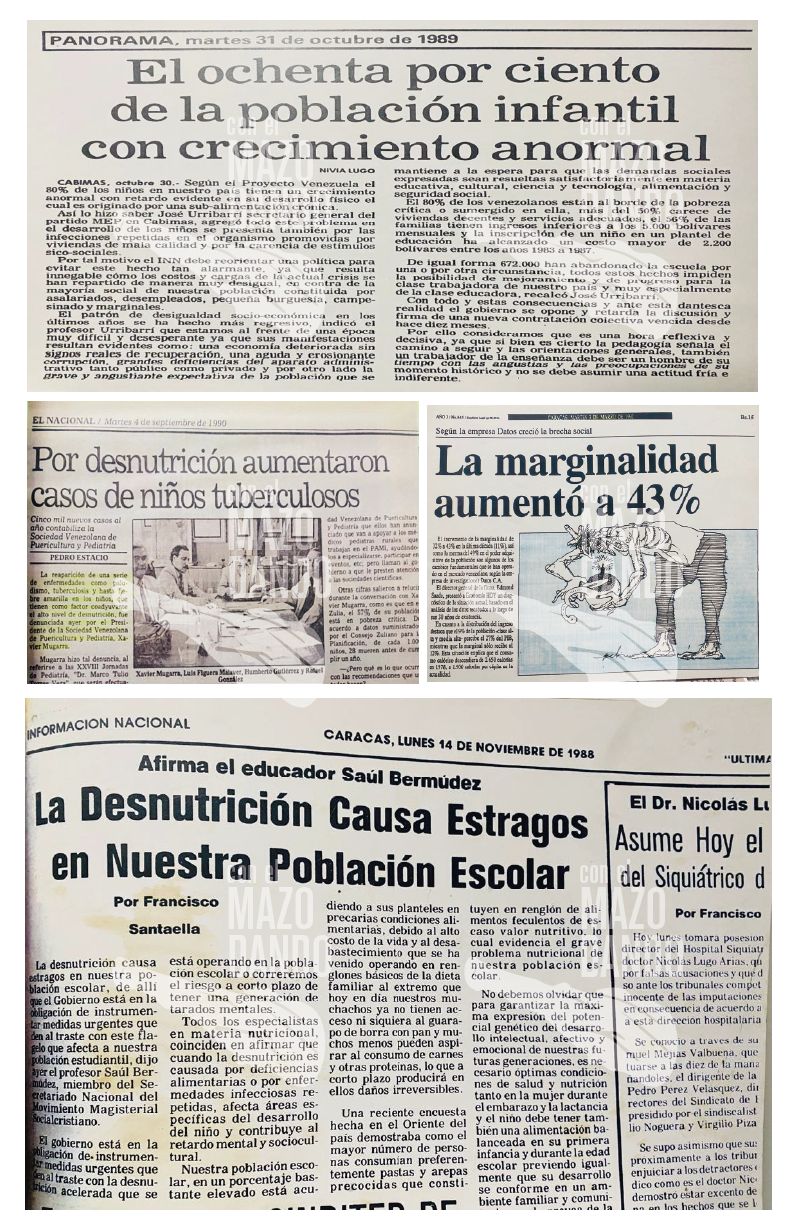
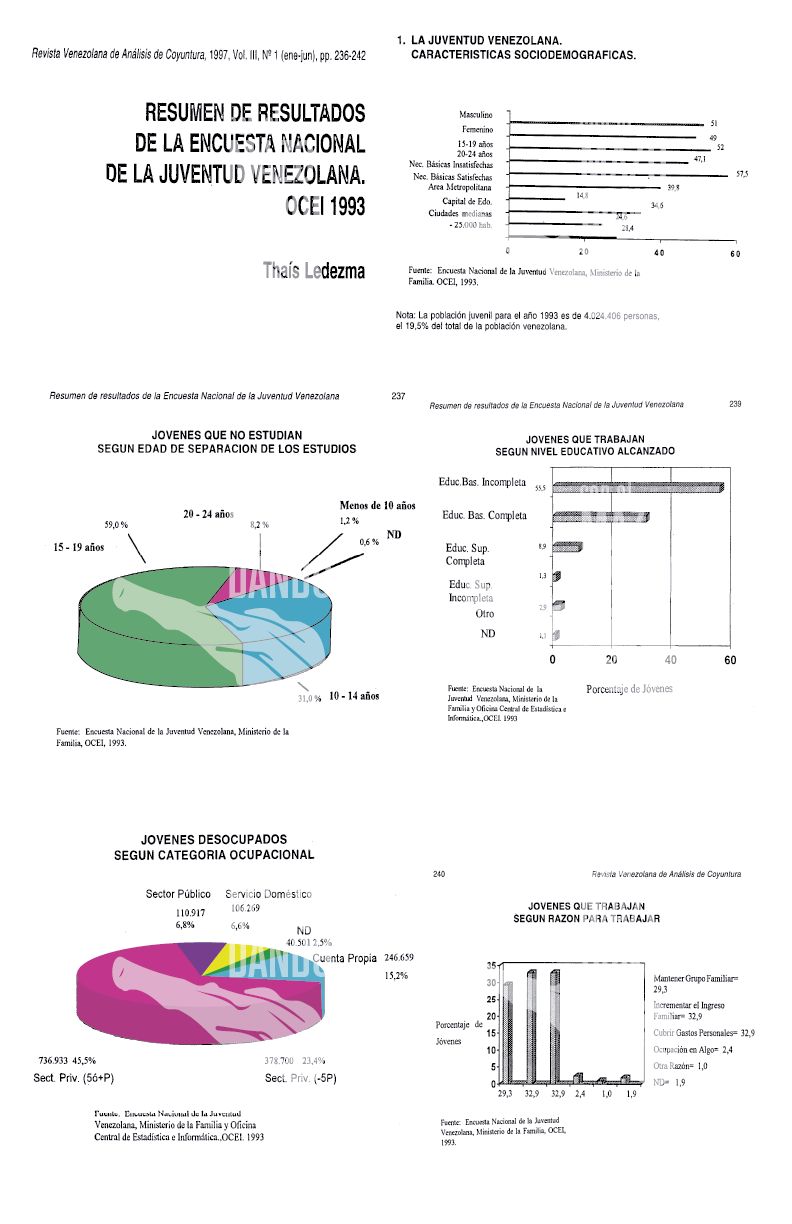
- Those were the years when Hugo Chávez was imprisoned in Yare Prison, when, in 1993, the cumulative school dropout rate for children and young people between 5 and 24 years old reached 70% of the student population, according to a survey carried out by the Ministry of the Family.
- The combination of information from the Venezuelan Youth Survey (ENJUVE) with the data provided by the Human Resources report of the World Bank and UNICEF and FAO indicated that nearly 3 million children and young people deserted classrooms to take to the streets to find a way to survive.
- The school year averaged less than 90 days of classes, ranking Venezuela as one of the countries with the highest educational backwater in the world. The macroeconomic adjustments of the Pérez II and Caldera II governments pulverized the family economy, skyrocketing the indicators of school and university dropout, together with malnutrition at alarming levels.
- Previously, Heriberto González, director of the Venezuelan Federation of Teachers (FEM), confirmed the exclusion of 90% of the child population, from popular urban (“marginal”) areas and rural areas of the Venezuelan countryside, from the preschool system. There were about 2.5 million children, between 3 and 5 years old, without pre-school education, which was compulsory in Venezuela.
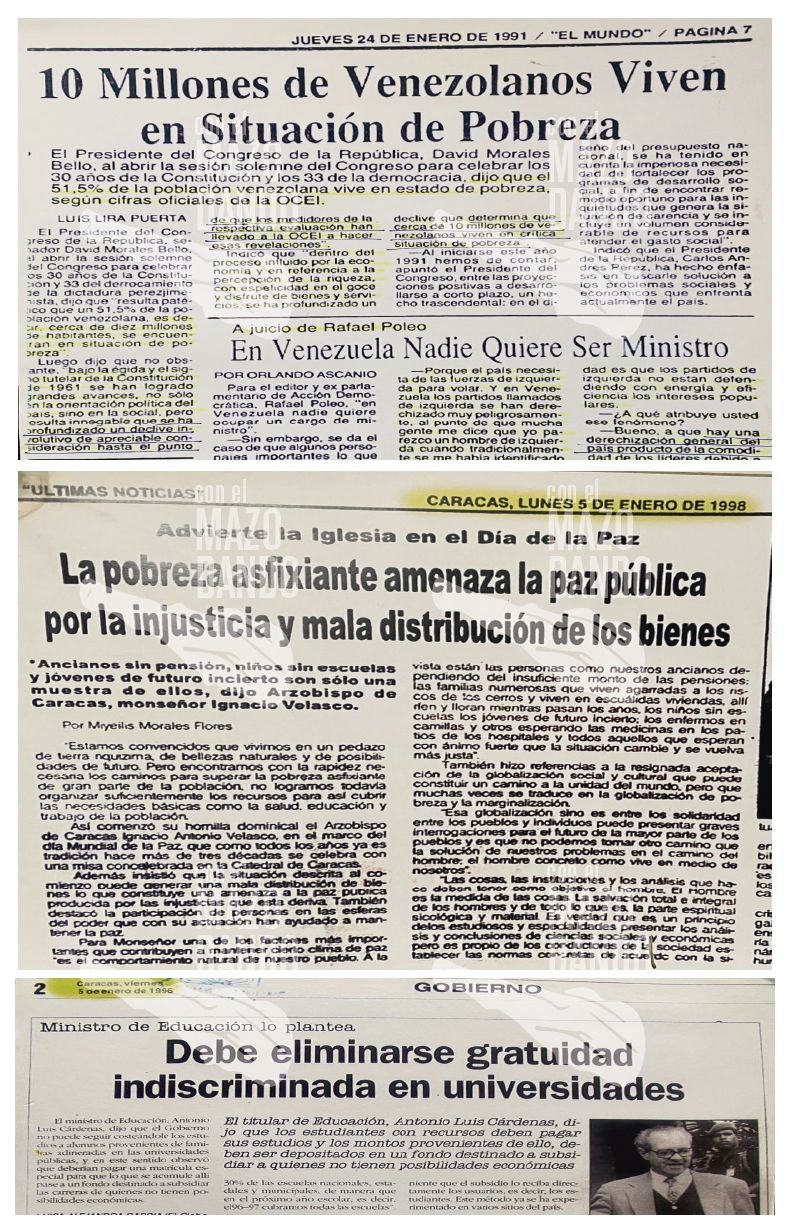
- Suffocating extreme poverty increased to 43%. 19% of the population went to bed with only one plate of food a day. La Perrarina de Protinal, together with the pots of rice water or spaghetti, were the daily menu that the mothers of the neighborhood went to so that their children would not die of hunger. Two million 800 thousand people suffered a silent famine before the indifferent gaze of the Venezuelan State, engaged in the favorite game of the political class at the time: embezzling the national public purse, since the people were worthless to it.
- The deepest misery occurred in Venezuela between 1989 and 1999. A disastrous decade. Three million children and young people could not find schools or medical dispensaries to attend.
- The unemployment rate stood at 44.4%. The labor force was left to rely on the informal economy or underemployment. The youth unemployment rate for children under 25 doubled to 28%.
- The Youth Employment program, implemented by the Ministry of Youth, resulted in the robbery with full hands carried out by foundations, associations and briefcase NGOs founded on the orders of the then minister of that office.
- That acclaimed Youth Employment Plan of the Venezuela Agenda (1994-1999), designed as a system to incorporate millions of young people living in poverty into productive work through the approval of sustainable economic projects, became the great looting orchestrated by that Ministry of Youth; 2.3 billion dollars went to the mysterious pocket of friends, compadres, supporters and collaborators.
- In that decade, 1989-1999, there were numerous press releases reporting people dying from a wreck in hospital corridors, while the Venezuelan Social Security Institute (IVSS) went bankrupt due to lack of budget. Elderly people without pensions, children without schools and young people without a future were the result of the extreme poverty installed in 40 years of Representative Democracy. A factory of economic hardship.
- To confirm everything previously specified by multilateral organizations and the local press, according to official figures from the Central Office of Statistics and Information Technology (OCEI), in January 1991, 51.1% of the Venezuelan population, or about 10 million inhabitants, were living in a situation of critical poverty.
- Paradoxically, these statistical data were revealed by the then president of the Congress, David Morales Bello, on the occasion of the 33rd anniversary of the overthrow of the dictatorship of General Marcos Pérez Jiménez and 30 years after the approval of the Magna Carta of 1961. A confession on the part of a relay of evidence.
- An additional factor, and therefore no less relevant, that contributed to the massive school and university dropout, was the phenomenon of the “vicious circle of fantasy”. Video game addiction or “infophrenia”. Electronic games, with highly violent content, created a fondness for parallel worlds of blood and wars, which contributed to the abandonment of classrooms and caused severe learning deficiencies in the most vulnerable sector of society: children and adolescents. In addition to causing a structural crisis of values and principles.
- The absence of individual morality of presidents Carlos A. Pérez and Jaime Lusinchi, combined with this crisis of extreme poverty and empty classrooms, led to the institutional breakdown of the 1958 political pact or Pact of Fixed Point and were the triggers of El Caracazo and February 4, 1992.
- In contrast, last Monday, September 14, 6,005,254 children started classes, of whom 75,000 have joined classrooms for the first time. It is estimated that this year Venezuela will meet the goal of 200 days of classes, that is, 40 academic weeks, to exceed the 192 national average days and 182 days in Caracas and La Guaira, in the immediately preceding school period, which was affected by the double earthquake of June 24, 2026.
- There are currently only isolated cases of child malnutrition, placing Venezuela, according to recent reports from the World Health Organization, World Bank and UNICEF, as a country with low prevalence. Despite the low incidence, the government of Delcy Rodríguez has ordered an increase in food distribution by 36% to reinforce the intake of proteins, carbohydrates and vegetables in this sector of the population.
- The 86,000 students, whose schools were affected by the double earthquake, have been rezonated to schools close to their homes, enabling double shifts and adjusting the staff of teachers to ensure pedagogical continuity.
- In addition, teachers were provided with tools for the psychoemotional care of children and adolescents who have been rezoned because of the earthquake.
- As a recent measure, it was forbidden to deny enrollment to students who do not have identity documents, ordering the Administrative Service for Identification, Migration and Aliens (SAIME) to update the data of those affected who have lost them, urging parents and representatives to file the respective report in case of difficulties in this regard.
Mazo News Team