Head of State: Venezuela produces biotechnologies for the control of dengue, malaria and other vectors
Presidential Press
Published at: 10/04/2024 08:13 PM
The President of the Republic, Nicolás Maduro, assured that the country produces the biotechnological products necessary for the control of vectors such as dengue and malaria, among others.
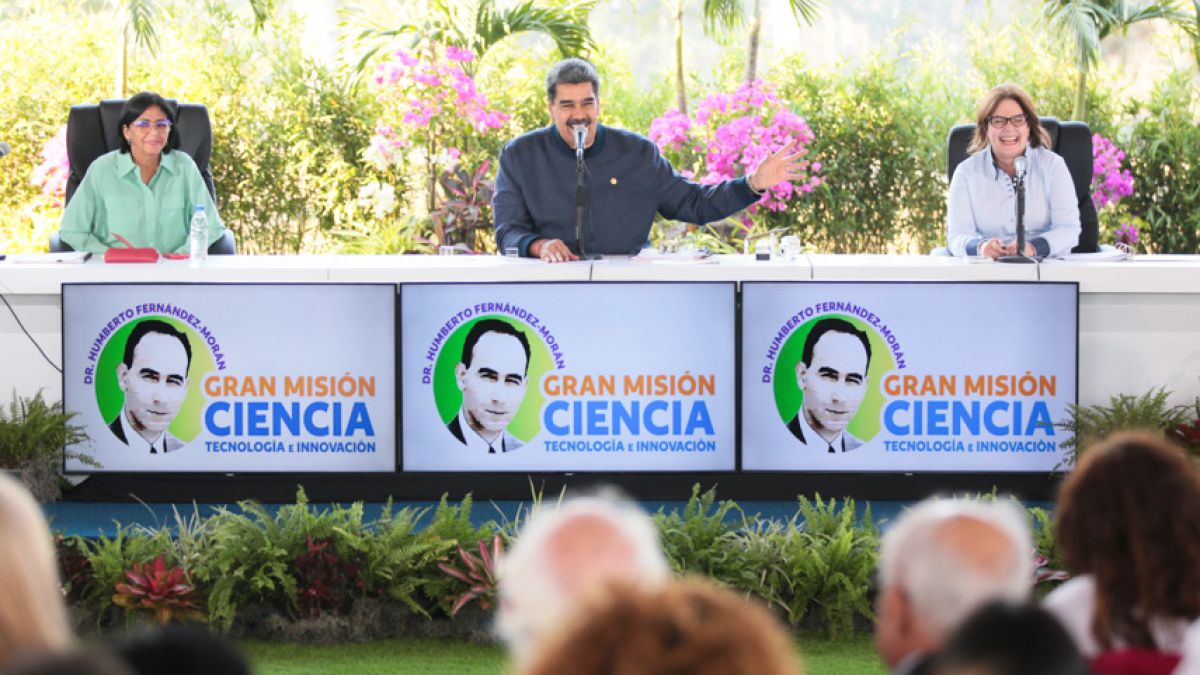
From the Venezuelan Institute for Scientific Research (IVIC), located in San Antonio de los Altos, the President made a contact to learn first-hand about the production of biotechnological products, for the control of the vector population in the country.
“They were already created in Venezuela, they are in full production and they go out to the fields, neighborhoods and streets to protect our people from dengue, malaria and many other vectors,” he stressed.
In this regard, Blas Dorta explained the functioning of a powerful bioinsecticide developed in our country from “entomopathogenic bacteria and fungi, replacing the broad-spectrum chemical insecticides that have traditionally been used for these purposes”.
During his presentation, he showed a graphic in which he explained “the life cycle of a typical mosquito”.
“We have developed in our country with national talent with national resources, we don't have to be importing anything at all,” he reiterated.
“The product developed by us Larvivac is formulated with entomopathogenic bacteria, spherical bacilli and an inert base that is ground corn tusa (...) if one of these bacteria is ingested by the larva, a physiological disorder is automatically generated in the intestinal tract of that larva that leads to death”.
Another biological product developed by the IVIC is X “a spore mixture of three different entomopathogenic fungi (...) that we use in the eastern states of Sucre, Monagas and Alta Amacuro to successfully control hairy popcorn”.
In addition, biotechnology is being produced for the aerial phase of mosquitoes, in their adult phase, which perches on walls and other surfaces.
In this context, the Head of State expressed his faith in these initiatives that arise from Venezuelan laboratories.
“This is admirable, a response from Venezuela for dengue fever, malaria (...) to take it to all fields, to all neighborhoods, to all communities and then to take it to the towns, I tell the Argentinian people, Venezuela is ready to fight dengue, since Milei abandoned them.”
Technological approach in Sucre
From the Yaguaraparo parish, in the Cajigal municipality of the state of Sucre, the President connected with the eastern entity to “consider new levels of development for major transformations based on knowledge precisely what is the protection of Venezuelan cacao against climate change and against the vectors that can limit and attack it”.
This technology developed by Venezuelan scientists, together with the ancient knowledge of peasants and research in the area, makes it possible to develop the innovative technology of the Tricorelum product developed with a fungus that copes with the agent that attacks cocoa crops.
The scientific and technological network for cocoa will begin in 4 states: Miranda, Mérida, Barinas and Sucre, where the approach plan in its first phase will provide care to more than 8,000 cocoa producers in the 4 states. This cooperation includes ongoing training and support to peasant producers by the country's scientists and scientists.
Biomedical Engineering
For its part, the Francisco de Miranda National Experimental University in Falcón state inaugurated the Biomedical Engineering Training Center, during a contact with the Head of State, who referred to the great leap towards progress that Venezuela is taking in this area.
“Now they are creating teams from Venezuela, new equipment and that is going to have a creative explosion at the technological level very soon, for the health of Venezuela and for exports, what is coming is a time of greening the technology of the Miraculous Economy.”
Within the framework of the five vertices that make up the New Great Mission of the New Generation, it became known that the institution trains young people who are specializing in biomedical sciences.
The process is linked to the repair of equipment, components and parts of medical equipment.
A great contribution that is already making progress in the creation of medical prototypes.
The Center has an impact on more than 100,000 students, who now have new spaces, electromedicine, electronics, metalworking and computer laboratories.
Mazo News Team