
OUR DAILY OIL (1908-2026)
Published at: 07/01/2026 09:00 PM
(Summary, September 7, 1975; Now, July 14, 1936; Memories of Venezuela, No. 23, December 2011)
- Since October 12, 1908, 115 years ago, when the company Compañía Nacional Minera Petrolia del Táchira began the first commercial exploitation for industrial purposes in Venezuela, this began to be one of the influential factors that drive the engine of our economy.
- It was six years later, at the end of July 1914, 111 years ago, when the Zumaque I well, located in the Mene Grande field, owned by the Venezuelan State, began producing 39,000 barrels per day, the date on which the nation entered the stage of the world's largest oil producers.
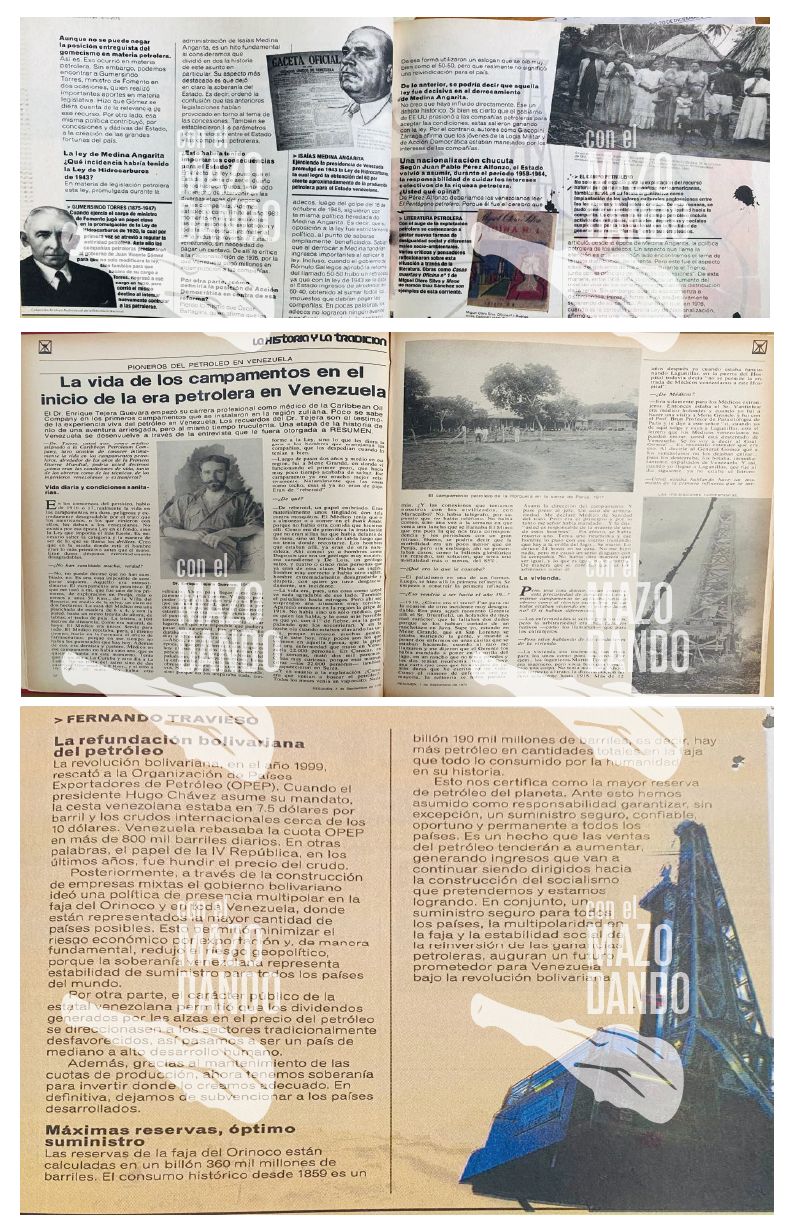
- Later, after two and a half decades after the surrender of Gomecism, on March 13, 1943, General Isaías Medina Angarita enacted The Hydrocarbons Law, through which oil companies began to hand over 50% of their profits to the nation. This was called Fifty-Fifty.
- Within the legal framework of this law, it was established that, by that same date in 1983, all concessions granted up to that time, with their assets, facilities, industrial complexes, goods and the like, would revert to their sole owner and owner: The Venezuelan State.
- This brand new law implied the obligation to refine crude oil in Venezuelan territory and the expiration of these contracts in forty years.
- Moreover, a year earlier, General Isaías Medina Angarita put into effect the first Income Tax Act, which since then obliged oil companies (formerly exempt concession holders) whose production exceeded 2,000,000 b/d to pay 9.5% of their annual profits. This increased the contribution of oil companies to the national treasury by 60%.
- This is how, thanks to General Medina, it was legally established and recognized by all the parties involved that the concessions do not even involve ownership of their facilities and that they would revert to the Venezuelan State in their entirety.
- In the context of the tense negotiations that took place for the consensual enactment of the historic Hydrocarbons Law of March 13, 1943, the concession companies were reluctant to recognize the payment of 50% of their profits, to reverse the industry and refine crude oil in Venezuela within the established deadline.
- It was then that General Medina, aware of the forces that moved geopolitics in the context of World War II, courageously decided to declare an ultimatum to the concession holders. Without Venezuelan oil, the United States did not have enough fuel to mobilize its troops, planes, ships and tanks. The oil companies, after consulting Washington, accepted.
- Thanks to Venezuela, the allies were able to land belatedly in Normandy on June 6, 1944, when the heroic Soviet Army had already won the war well, after the victory of the Battle of Leningrad, on January 27, 1944, and the Battle of Kursk, August 1943.
- It was these same concession companies that, together with the Democratic Action (AD) party, planned the overthrow of General Medina. This gave way to the disastrous Adeco Triennial (1945-1948), in which Venezuela's profits were reduced at the convenience of foreign capital.
- The first major headline that shook national consciousness about the importance of our energy resources was written by a young man named Arturo Uslar Pietri, in a momentous editorial entitled “Sowing Petroleum”, published by the newspaper Ahora, on July 14, 1936, 90 years ago.
- However, due to ignorance of more advanced studies, both Uslar Pietri and other ideologues of oil politics emphasized its meager and transitory nature. They thought the reserves would only last 10 years. The importance of this editorial lay in the emphasis on reinvesting this wealth in far-reaching domestic industries and social welfare programs.
- This led to Uslar Pietri being expelled from the country during the October Coup of 1945 and his property, legitimately acquired, confiscated by the fugitives on duty.
- However, it was the text of General Medina's own law of March 1936 that prevailed and continued to govern with the parliamentary amendments made in subsequent decades.
- 31 years after the 1945 coup d'etat, something unprecedented happened. On January 1, 1976, President Carlos Andrés Pérez needlessly anticipated the process of reversing the oil industry to grant the transnational corporations Shell, Creole Petroleum Corporation, British Petroleum and Texaco, compensation of 5.6 billion dollars that did not belong to them; depending on the date the concessions ceased. Payment made for so-called “Oil Repairs”.
- However, all of them signed a reversion and settlement agreement, transferring all of the concessions and their assets to the newly created Petrleos de Venezuela, S.A. (PDVSA). He paid for every last screw.
- This past January 1st, 2026, marked the 50th anniversary of that event.
- The first thing Commander Hugo Chávez did when he was elected Constitutional President of the Bolivarian Republic of Venezuela was to rescue the Organization of Petroleum Exporting Countries (OPEC), founded on November 6, 1962.
- The Venezuelan national basket was $7.5 and the international basket was $10. Venezuela, like all member countries, exceeded their production quotas. This overproduction flooded the market with cheap oil and practically dismantled the national economy.
- Later, through joint ventures, the Bolivarian Government of Hugo Chávez devised the multipolar project in the Orinoco Oil Belt.
- Likewise, Commander Chávez redirected income to the most disadvantaged sectors of society, through social missions, placing Venezuela as one of the few countries in the world that fully met human development goals.
- During this process of industry recovery, the enormous certified reserves, hitherto unknown, of 360 billion barrels of crude oil were calculated, meaning that there is more oil in the belt than all that humanity has consumed since 1859 (166 years).
- The Orinoco Oil Belt (FPO) is, therefore, the largest natural heavy oil reservoir in the world, with an area of 55,000 square kilometers, divided into the Ayacucho, Boyacá, Carabobo and Junín blocks.
- This geological formation corresponds to the Cretaceous and Tertiary periods that date back 100 million years ago.
- Since April 19, 1811, the date of birth of today's Bolivarian Republic of Venezuela, of its entire, unique, exclusive, inalienable, indisputable and sovereign property. For the benefit of your glorious people.
Mazo News Team