
THE EL LIMÓN RIVER TRAGEDY IN THE STATE OF ARAGUA
Published at: 09/09/2026 09:00 PM
THE TRAGEDY OF THE EL LIMÓN RIVER IN THE STATE OF ARAGUA
(Diario de Caracas, 2001 and El Siglo, September 7-8-9 and 10, 1987)
- 39 years ago, on Sunday, September 6, 1987 at 1:00pm, one of the largest tragedies in Venezuela occurred.
- This was the catastrophe of the El Limón River, in the Edo. Aragua, which left nearly a thousand dead, 17,000 injured and nearly 500 missing. Until today there is no news of them.
- The response capacity of the Government of Jaime Lusinchi to deal with the catastrophe and to rescue hundreds of dead, injured and missing persons, as reflected in the Diario de Caracas, was “slow and painful”.
- Part of the urban areas of Maracay were buried under the mud. Several communities surrounding the capital of Aragüeña were submerged under water.
- A few hours before the overflow, the equivalent of two months' worth of rain fell on the Ocumare de la Costa mountains and the headwaters of the river in less than four hours. What began as a day of rest on the beach ended in a day of national mourning.
- Back home, thousands of people were trapped on the road as victims of the unexpected landslide.
- Eight kilometers of the road were destroyed and 400 vehicles, including buses, vans and cars, were walled up under its rubble. Hundreds of people were trapped inside them. Others, who tried to flee, drowned when they were swept away by the current.
- At 11:00 at night, the waters reached the Caña de Azúcar, Mata Seca and El Progreso neighborhoods, which were completely wiped out. Under the flood of gigantic stones, sand and trees, the communities of La Candelaria, Los Rausseos, Arias Blanco and Valle Verde were sunk.
- La Guamita and Los Apamates Park were completely reduced to rubble.
- In the midst of the tragedy, President Lusinchi never set foot in the disaster zone, he was more aware of his interview with distinguished visitors such as George Shultz and his trip to New York to negotiate the most unfavorable, embarrassing and leonine agreement to refinance foreign debt in our history.
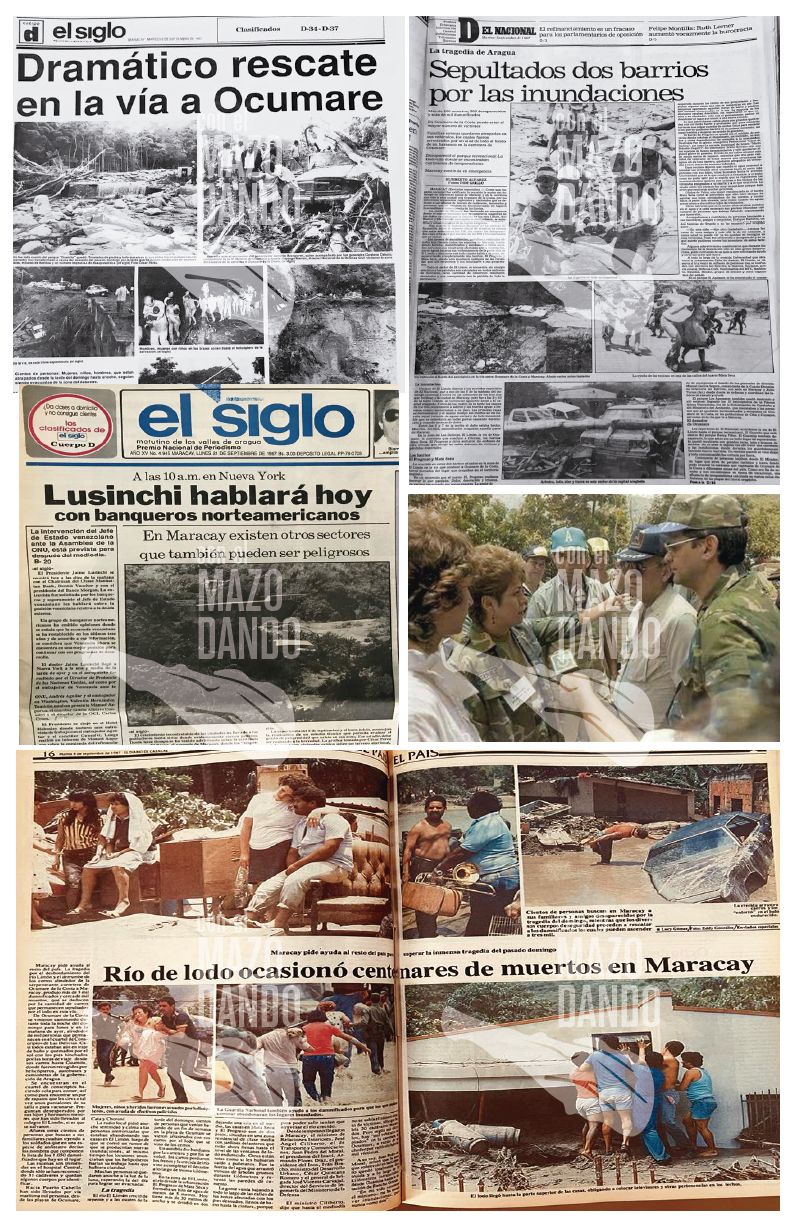
Records of the time
- The memory collected about this catastrophic event, based on the evidence that recorded the tragedy, were:
- Diario de Caracas (09-09-87): Three days after the landslide, people are still on the street without shelter. 17,000 victims and nearly 1,000 deaths are counted, which are deducted from the number of vehicles and buses buried on the Ocumare de la Costa road. The graphic depicts survivors trying to find their missing family members and save their belongings.
- El Siglo (08-09-87): “Along 8 km of road leading to Ocumare de la Costa, more than 400 vehicles are estimated to be covered up by mud... the number of people killed is growing alarmingly... forensic doctors and the Technical Judicial Police (PTJ) are working to identify the bodies rescued... for three days, Venezuelan Air Force pilots evacuated more than 2,500 people in helicopters trapped in the disaster zone.”
- El Siglo (24-09-87): 18 days after the tragedy, she reported: “People live in terror on the banks of rivers and streams.”
- El Nacional (09-09-87): “What happened on Sunday night in different areas of Maracay and on the road that connects this city with Ocumare de la Costa was described as a national tragedy... the official death toll is estimated to exceed 200, not counting the missing whose number is above 500...”.
- September 9: Three days after the incident, the Private Secretary of the President of the Republic, Blanca Ibáñez, appeared at the scene of the tragedy wearing the uniform of General of the Army, with her name stamped on it, receiving military greetings and the honors of that high rank.
- Faced with the usurpation of the uniform and military rank led by the “generala”, her extreme defender, Henry Ramos Allup, Head of the Parliamentary Fraction for Democratic Action (AD), declared loudly: “Nobody touches Blanca!”
- By usurping ranks, including the presidential one, Mrs. Ibáñez decided on military promotions, appointed and removed ministers, and even expelled the First Lady of the Republic, Gladys Castillo de Lusinchi, from the presidential residence “La Casona”. In that same spirit, he intervened so that an interview with Dr. Castillo by journalist Nelson Hippolyte would not be published in El Universal.
- In the midst of this serious situation, which at that time constituted the largest river flood affecting Venezuela, the victims were left living on the banks of rivers and streams, and as handouts from Lusinchi and his Private Secretary they received only government aspirin. The media scoundrel immediately made them invisible.
- For these victims, there was no plan for decent housing or relief to restore their lives and recover part of what was lost in less than four hours of heavy rain in the mountains of Henry Pittier Park.
Mazo News Team