The “Retén de Catia” massacre and other crimes by Antonio Ledezma
Published at: 27/11/2024 10:00 PM
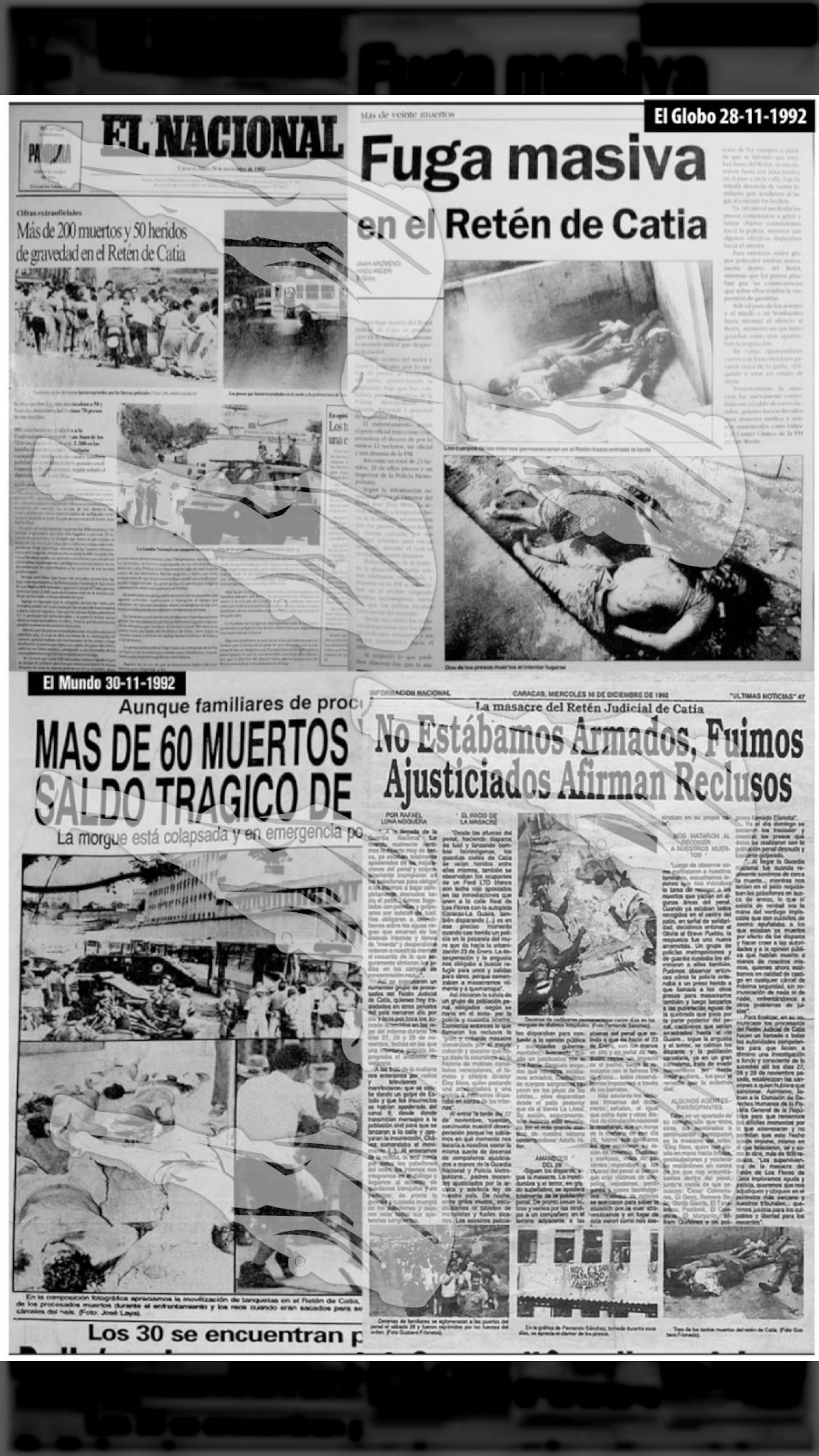
(El Nacional, El Globo and Latest News, November 28-30, 1992)
- On November 27 and 28, 1992, more than 200 inmates were massacred at the Catia Retén, in a stampede provoked by prison authorities.
- The director of the prison, Eloy Mora, announced to the inmates that “the government had fallen” and they opened the doors of the checkpoint so that the prisoners could flee to the streets. That's how the slaughter began.
- Given the overcrowding, those held there did not hesitate to run away. At the time of this massacre, the Catia Retén housed 3,618 inmates, five times its installed capacity (630).
- Within a few hours, the Bello Monte Morgue was crammed with 115 victims of the alleged “prison riot”. The vans had to carry another number equal to the morgues of La Guaira, Los Teques and Guarenas.
- According to the files, which were levied in different national and international bodies, there were crimes against humanity. ANTONIO LEDEZMA was the Governor of the Federal District and, therefore, by all accounts directly responsible for what happened.
- The survivors said that the prison doors were opened to stimulate a collective escape and then send law enforcement to open fire.
- The families of the victims reported that, in the midst of the tension in the city, the Director of the Judicial Detention of Catia, following instructions from Governor Ledezma, ordered the guards to open the prison cells so that the inmates could leave peacefully. So there was no attempt to escape.
- At that moment, Director Mora himself, accompanied by members of the Metropolitan Police (PM) and the National Guard (GN), opened fire, blinding the lives of more than 200 prisoners.
- The Ministry of Justice only admitted the death of 63 inmates; Governor Ledezma himself more than 100, and the national press, based on morgue reports, estimated the number of victims at around 200.
- Antonio Ledezma justified the bloody acts: “... There is no doubt that what was intended was to create chaos in Caracas and for more than 3,000 inmates to take to the streets, and that had to be controlled at the cost of many lives.” **** (El País newspaper, December 1, 1992). A confession on the part...
OTHER LEDEZMA CRIMES: THE MURDER OF JOSÉ GREGORIO ROMERO UZCATEGUI “FLECHA”:
- On July 2, 1992, inside the UCV, the young José Gregorio Romero Uzcategui “Flecha” (14 years old), a third-year high school student, was murdered by PM agents.
- After spending 24 hours in intensive care, José Gregorio died as a result of a projectile fired by the polyledezma, which lodged in his brain.
- José Gregorio was a 5th year high school student at the Liceo Juan Pablo II in Southern California.
- On the same day that Metropolitan Police officers murdered Flecha, three young men were shot down on Baralt Avenue by a Poliledezma commando: Alberto Vivas Pantoja (17 years old), a 4th year high school student (Jehovah's Witness); Ramón Petit (13 years old); and José Luis Rodríguez (24 years old); the latter was serving as a messenger in the Ministry of Defense.
- María Pantoja de Vivas, mother of the young Christian, stated: “My son was murdered viciously, he never ventured into crime.”
- The three young men were shot down by a PM motorized command on the corner of El Truco inside the “Cabildo Segundo” building, and were mistaken as criminals by a motorized command of the PM.
- Antonio Ledezma, in his capacity as Governor of Dtto. Federally, it had implemented a policy of zero tolerance in the neighborhoods and popular sectors of Caracas. This caused real massacres against young students identified as criminals.
- During Ledezma's administration, at least 10 students fell victim to shotguns framed with illegal projectiles, such as sticks, nuts, spark plugs or screws, fired by agents of the extinct PM in popular demonstrations.
- To the legitimate right to Freedom of Expression and Information, Antonio Ledezma responded by savagely repressing several social communicators, including:
- Herminia Serrano (Journalist for the radio station RQ910): Concussion, caused by a blow to the neck, caused by the sabre or comb used by police officers.
- Oswaldo González Moreno (YVKE worldwide): He received brushstrokes and his recorder was destroyed by a PM official.
- Francisco Solorzano “Frasso”: He was arrested by PM officials. He received multiple brushstrokes.
- Verónica Tessari: She suffered a concussion and 15 stitches due to a tear gas bomb thrown by the PM that hit her head. His condition worsened because tear gas managed to penetrate the interior of the cranial structure. At the time, the journalist stated: “Finally, after almost five months in a clinic, with seven surgeries carried out on March 19 at the UCV, due to the police repression against the media. Venezuela continues to experience the same repression. I'm not afraid, I'm going to go back to the street, I need one more intervention, but I know that no one or any of my colleagues can do it with me, so soon we'll see each other on the street, working reporting to provide information to all of you.” Tessari never managed to recover, she suffered months of agony and after 7 surgeries she died on the night of Friday, January 15. No PM official was charged or charged with this crime.
- Others:
- Belinda Álvarez: On April 4, 1991, the 19-year-old student and president of the Center for Students of Social Work was murdered outside the Central University of Venezuela (UCV).
- Older adults and kidney patients: On the morning of February 3, 1992, the elderly and renal patients required medical assistance, in addition to the payment of pensions in front of the Miraflores Palace. The PolileDezma beat them and imprisoned them. The newly imported whale premiered with them. A few hours later, in the early morning of the 4th, the military rebellion led by Commander Hugo Chávez broke out.
- Summary deportations of Colombian and Haitian migrants: Journalist Víctor Hugo Majano also reported that “this short period of government was characterized by executive deportations of Colombian and Haitian citizens, who were arrested in the streets and expelled from the country within hours. Obviously they couldn't make administrative, much less judicial, opposition to the measure.” In the case of Haitians, they were apprehended on the street and in houses where family groups resided and were taken to the Aragua Air Base. There they were boarded in military transport planes and sent, barely wearing the clothes they were wearing, to the Caribbean nation. In the Haitian community, stories abound of children who were left alone in their homes while their parents were forced to fly to the country from which they had fled poverty and military repression.
- Vagos y Maleantes Act: Ledezma used this legal fossil (almost textual plagiarism of a similar law by the dictator Francisco Franco) to banish hundreds of students and detainees in popular demonstrations. These were sent to the El Dorado Penitentiary Colony. A species from Devil's Island, where in many cases it was not possible to survive malaria, dengue and prison abuse.
Mazo News Team