Commander Chávez and his Coup de Timón: Guidelines that govern the management of the Bolivarian Government
Internet
Published at: 20/10/2024 08:00 AM
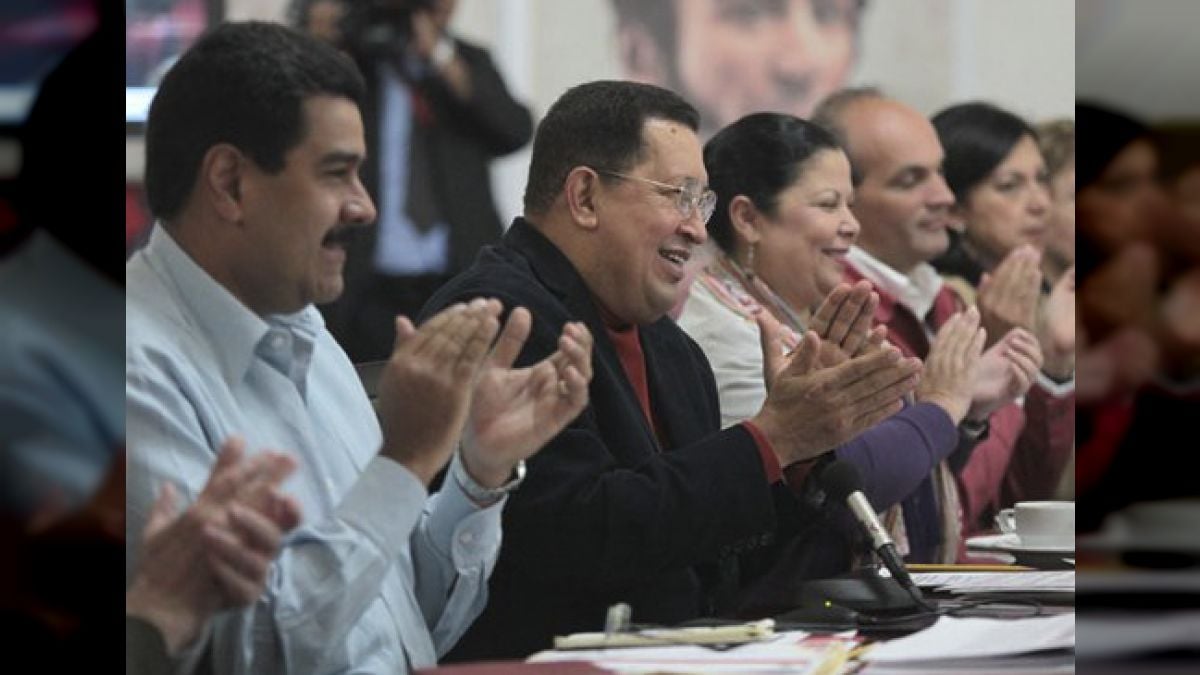
Visionary as usual and with an indisputable clarity of the actions to be taken to consolidate a process at the service of the People, on October 20, 2012, a few days after being re-elected for a third term as President of Venezuela, Commander Hugo Chávez delivered a speech that marked a milestone in the Bolivarian Revolution.
This is the “Timon Coup”, where Commander Chávez drew new lines to further advance the country's social and political transformation, through three main axes, such as the deepening of participatory and proactive democracy; the construction of a socialist economic model; and the defense of national sovereignty.
New cycle
In his speech, the Supreme Leader of the Bolivarian Revolution highlighted the beginning of a new phase of the socialist process in the face of his resounding victory in the elections of October 7 of that year, for which he highlighted the “modification of the country's productive base” for a greater democratization of economic power”, as well as the “change in the role of the State, to ensure that the cumulative process is oriented to satisfaction”.
“These are the steps we have been taking, that's why we talk about the transit, transition, phase. (...) None of this would exist in Venezuela if capitalism were imposed, which would turn us back into the colony that we were. That is why the political revolution predates the economic revolution. It always has to be like this: first political revolution, political liberation, and then comes the economic revolution,” Chávez said then from the Simon Bolivar Hall of the Miraflores Palace, at the first council of ministers.
Socialist democracy
The revival of socialism was a fundamental axis in that historic discourse, a project that urged the patriotic leadership to understand and assume in order to leave behind the model of capitalist exploitation.
In this sense, he called for the creation of a new model: “Venezuelan, Bolivarian socialism of the 21st century”, which “has to be truly new, and one of the essentially new things in our model is its democratic character, a new democratic hegemony, and that forces us not to impose, but to convince”.
Self-criticism and rectification
To advance the transformations for the supreme happiness of the Venezuelan people, the Commander urged the revolutionary forces to carry out self-criticism to rectify errors.
“Self-criticism is to rectify, not to continue doing it in a vacuum, or throwing it away as if in a vacuum. It is to act now, ministers, ladies ministers, the communes, send for the Law of the Communes, read it, study it (...) Popular power is not from Miraflores nor is it from the headquarters of the ministry of this or that that we are going to solve problems (...) Be careful, if we don't realize this we are liquidated and not only are we liquidated, we would be the liquidators of this project,” he said.
Social property
In another line drawn by Commander Invicto, he exalted the importance of social property for the integral and productive development of the country.
In this regard, he indicated that “we have to partner with small producers, but we have to graft social property, the socialist spirit, throughout the entire chain, from the work of the land, where mango, guava and strawberry are produced, to the distribution and consumption system of the producers that come from there.”
Finally, he urged the Government team to act more efficiently to obtain better results in each task and insisted on the need to create a National Public Media System to improve the way of reporting. In conclusion, with his message, Chávez urged a change of course in the revolutionary process, which has deepened in the years since.
Mazo News Team