Schémel: Opposition electoral failure demonstrates the absence of strategy and no connection with the people
Screenshot
Published at: 27/05/2025 09:39 PM
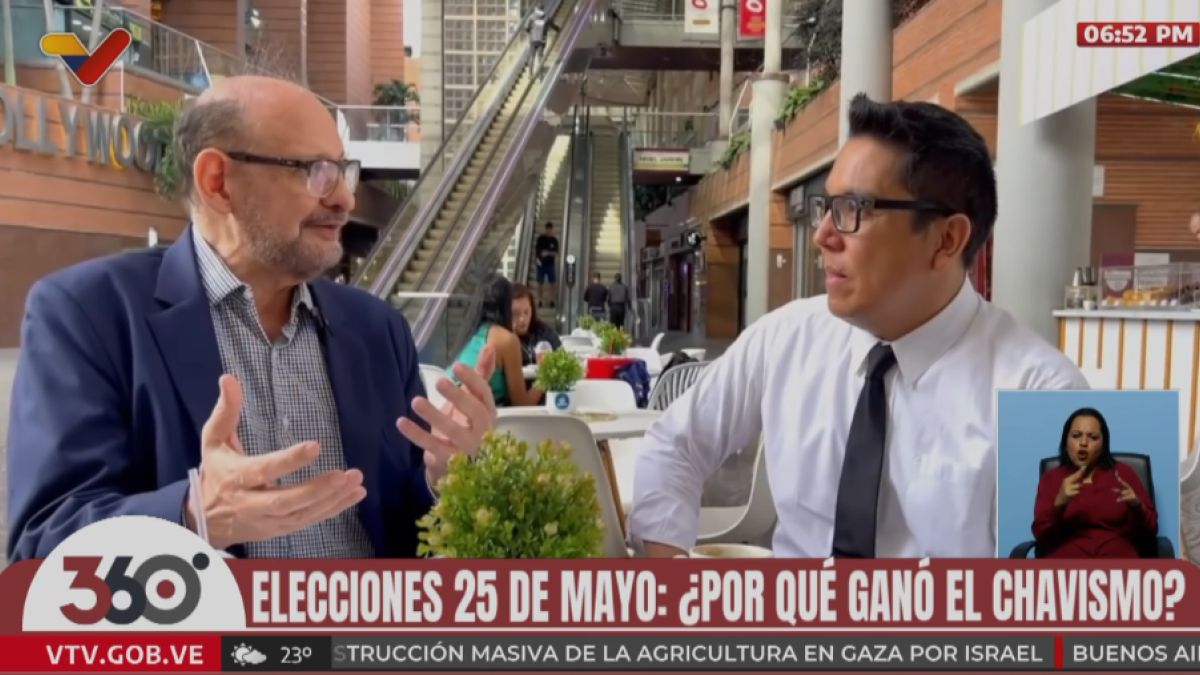
The president of the polling company Hinterlaces, Oscar Schémel, stressed that the electoral failures of the opposition are due to its lack of narrative, lack of strategy and lack of connection with the popular sectors, which has been a key factor in strengthening Chavism,
During an interview on the 360º program, broadcast by Venezolana de Televisión, he pointed out that the opposition has almost always helped a lot to the consolidation, advancement, of Chavism, among others because “he has insisted for these 25 years, on denying the existence of Chavism, on saying that it is a tiny majority, that Maduro has no support, that he was not popular.”
He pointed out that when analyzing the results of the regional and parliamentary elections of May 25, it is evident that the deficiencies in the right have been decisive, in addition to its lack of relations with the popular sectors, its lack of connection with the majorities, the lack of discourse.
He recalled that the opposition, in more than two and a half decades, has always benefited from discontent, but it drew attention that these disgruntled people do not actually vote for the opposition leaders, but rather vote against the Government, to supposedly punish management that they perceive as negative.
“The opposition is profoundly unaware of the existence of an adversary. What does this mean? If you don't know him, you can't compete with him, because he doesn't exist and he goes from ignorance to an attempt at annihilation,” he warned.
He contrasting the speech of María Corina Machado that she repeated about the President of the Republic, Nicolás Maduro, to whom she attributes that “he is weak, that Chavism doesn't exist and people hate them”.
“In other words, not knowing the strength of your opponent is the first step that leads to defeat,” he pointed out categorically.
Regarding the election of Henrique Capriles Radonski to the National Assembly (AN) and the defeat of the governor of Zulia, Manuel Rosales, Schémel specified, first of all, that the opposition voters did not vote for Capriles, but for a national list whose members were unknown.
“You don't have to believe that people voted for Capriles Radonski but for the opposition, and in this case for a party (A New Time) that made it possible for Capriles to be elected to Parliament,” he said.
In the case of former governor Manuel Rosales, he considered that his defeat was due to an exhaustion of his leadership and his lack of alliances.
“I think that people preferred, and this confirms what we observed, a pragmatism of an opposition sector that motivates them to vote for the option that best suits them,” he said.
He considered that this convenience requires a more positive relationship between that Government and the national Executive.
At this point, he took the example of the re-elected governor of Cojedes, the opposition Alberto Galíndez, who has been perceived in that entity as an authority that can achieve alliances with the Bolivarian Government.
“That it helps to build solutions for people (...) voters are positioned in people who provide solutions, as was the Chavism campaign,” he stressed.
Schémel said that the slogan of Chavismo for this electoral campaign, “The People Who Solve”, had a positive impact because it summarizes the guarantees of solutions to everyday problems.
Mazo News Team