
THE HAMPODUCT RETURNS
Published at: 27/05/2026 09:00 PM
(The Caracas Diary, February 8, 1989)
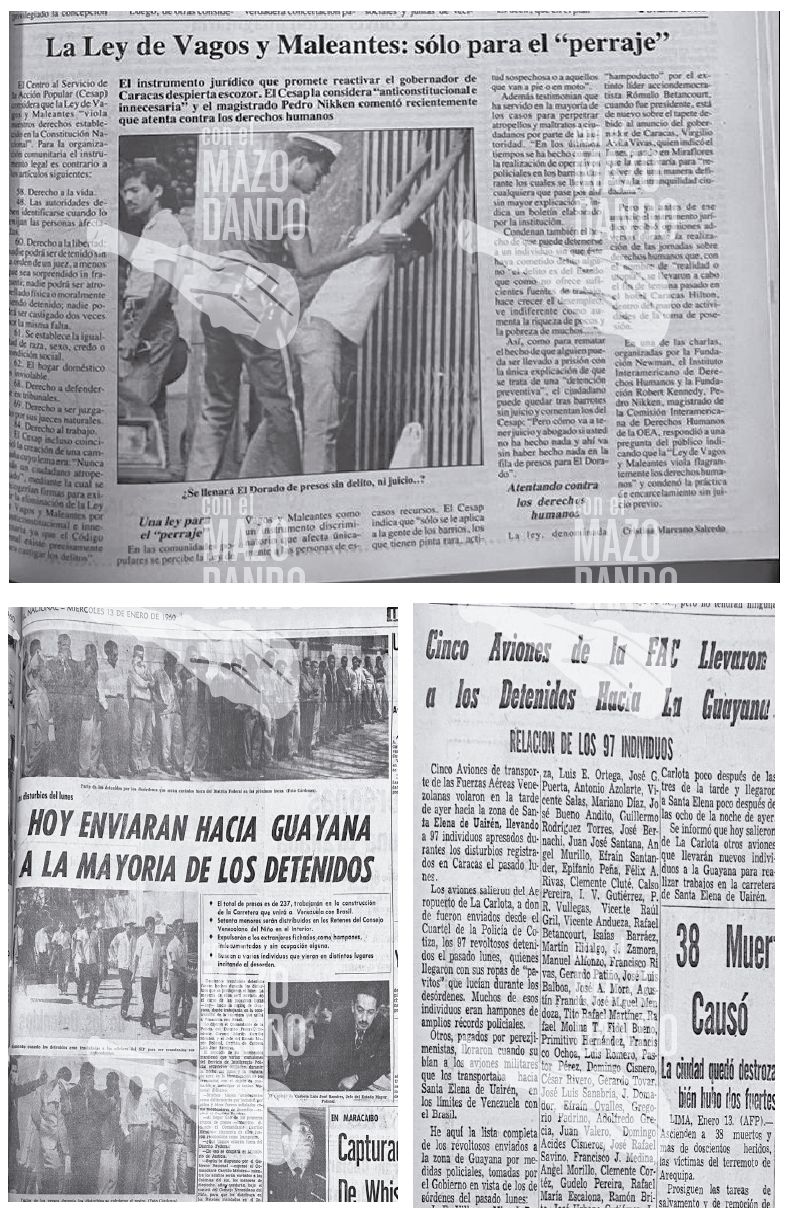
- “El Hampoducto” was created by Rómulo Betancourt to send thousands of high school students, university students, worker-peasant leaders and left-wing leaders to the remote Mobile Colonies of El Dorado, whose mass arrests kept the cells of the General Directorate of Police (DIGEPOL), the Intelligence Service of the Armed Forces (SIFA), the prisons of the Civil Headquarters and the Prefecture of Caracas. For these purposes, Betancourt and his police ministers applied the draconian and unconstitutional Vagos y Malefantes Act.
- Thirty years later, just 19 days after “El Caracazo”, just as the economic electroshock measures were going to take effect, the then governor of Caracas, Virgilio Ávila Vivas, following instructions from the President of the Republic, Carlos Andrés Pérez (CAP), decided to dust off this legal defense to re-establish “El Hampoducto”; direct channel between the crowded prisons in Caracas and the Mobile Colonies of El Dorado.
- The answer was not long in coming, lawyers José Vicente Rangel and Pedro Nikken warned of the inapplicability, as unconstitutional, of this legal fossil, denouncing:
- The illegality of reactivating forced labor eradicated in Venezuela since the death of General Juan Vicente Gómez.
- The unconstitutional increase in police raids and their violent procedures.
- The confinement of young politicians in prisons converted into real universities of crime and schools of organized crime.
- The galloping decay and corruption of police forces and the human degradation of their agents.
- All these factors, repressive procedures, raids, prison overcrowding and express delivery to the colonies of Guiana, were in violation of the essential principles governing human rights.
- The resumption of this repressive practice by Governor Ávila Vivas coincided with the announcement of the set of economic measures designed by the neoliberal brains of the CAP government, whose disastrous socio-economic impact caused more than 5,000 deaths due to a popular uprising against them.
Background:
- The Agricultural Colonies of El Dorado were initially conceived as a social reintegration project to integrate the prison population into productive activities in the countryside, so that they would provide employment opportunities once their sentences have been served. The bill was drafted in 1940 by Alirio Ugarte Pelayo when he was Director General of Policy of the Ministry of Internal Relations, between 1941 and 1945.
- Every time the dictatorship of General Marcos Pérez Jiménez was overthrown, during the governments of Rómulo Betancourt and Raúl Leoni, the colonies ceased to be centers of agricultural training and became camps for torture and forced disappearances.
- Thus, in January 1960, military aircraft were enabled to carry thousands of people who took to the streets to demonstrate against the repressive measures of the government; thus, El Hampoducto Caracas-El Dorado was born, as a repressive measure to silence popular discontent and send innocent people, without any police record, to a center reserved only for convicted or highly dangerous common criminals.
- To justify the violation of due process, the right to defense and to be tried by the natural judges of the republic, the expedited procedure of the Vagos and Maliantes Act was used. This had been applied by Francisco Franco against the republicans in Spain, as an instrument to put students, peasants, workers and left-wing leaders behind bars, under the political pretext of being “undesirable, unofficial, stamp sellers without an church license, anti-social, ruffians, traffickers, criminals, beggars or pimps”.
- Betancourt framed his former party and clandestine resistance colleagues within these same parameters, which are clearly illegal. The members of the Communist Party of Venezuela (PCV), the Revolutionary Left Movement (MIR), student and worker-union leaders, and all dissidents of State policies were catalogued with those same lapidary epithets of the Law of Vagos y Malecantes.
- Under the headstone of the Guiana jungle in El Dorado, hundreds of those confined to that death camp died of abandonment, ill-treatment, malaria, amoebic dysentery and other diseases.
- An episode like this only has a history in the dark concentration camp of Guasina, an uninhabited island in the Orinoco Delta infested with all kinds of diseases, which was closed down by Marcos Pérez Jiménez in 1952.
Mazo News Team