What did Diosdado Cabello say today, Tuesday, March 26, 2024?
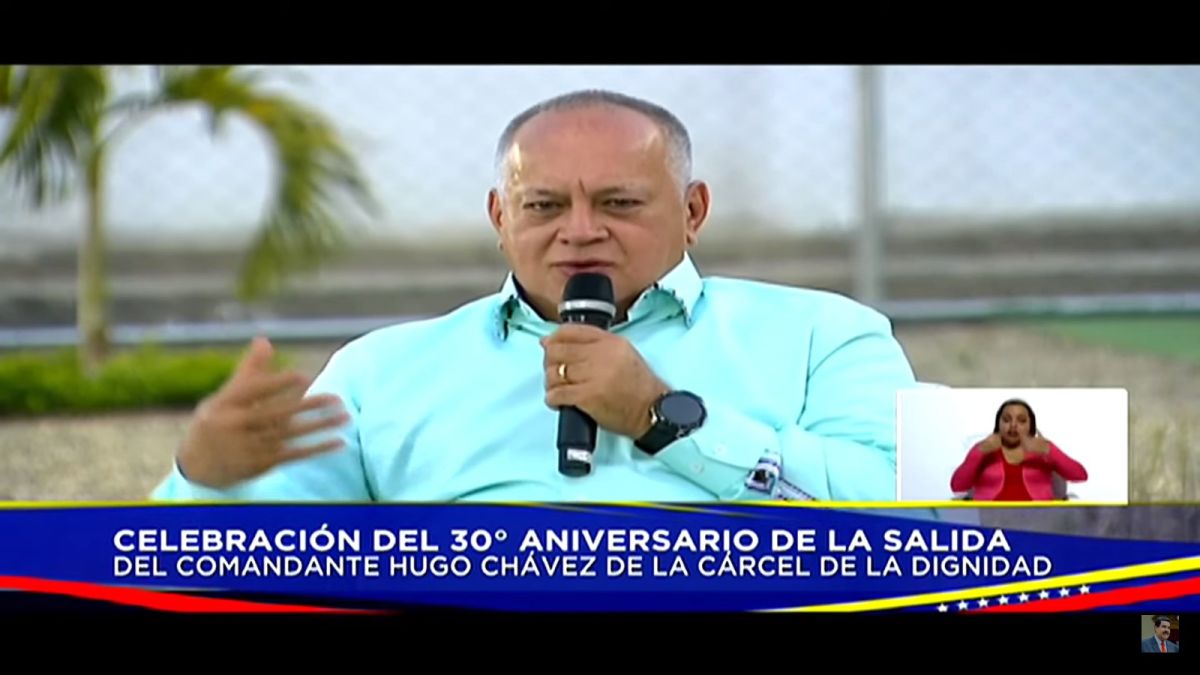
Screenshot
Published at: 26/03/2024 09:29 PM
This Tuesday, March 26, the first vice-president of the United Socialist
Party of Venezuela (PSUV), Diosdado Cabello Rondón, participated
in the events commemorating the 30th anniversary of the departure of Supreme Commander
Hugo Chávez from the Prison of Dignity to embrace himself with the People and
begin the journey towards the seizure of political power to promote a Popular Revolution.
In this regard, Cabello, who was one of the officers who
participated in the February 4, 1992 Rebellion and who was with
Commander Chávez in detention by the security forces of the Fourth Republic, recalled that:
- We were the Lieutenants in Lino de Clemente and
we understood that we were up and, in truth, that prison was an area liberated
by us, then some colleagues arrived on November 27 (92), including
those (Luis) Reyes Reyes and we left some things to those who arrived, but it was because
we had assumed that position and that came from the first day President (Nicolás Maduro).
- On the first day, February 4th, an
Admiral arrived at the San Carlos Barracks to give us a sermon, and Ronald Blanco (La Cruz) stopped and said: 'you
don't understand that this is a military rebellion, we are rising up against you'.
When Ronald said many of those who were there, half crestfallen, they raised their heads.
He also gave an account of the actions taken by repressive
forces in the service of the rulers of the extinct “
Adeco-Copeyan democracy” to cause the division of the Bolivarian Movement among rebel soldiers:
- When do they decide to remove Commander Chávez?
The San Carlos Barracks were becoming a place of constant, permanent popular rebellion and
they were looking for a way to isolate us, to segregate us, and it was well
studied; they brought themselves here (Yare Prison) to another group, they left it in
San Carlos, another group in Lino de Clemente without communication of any
kind, beyond the communication we achieved through the lawyers, which
is not that it was every day because it was a risk that was being taken and we had to take care of the
companions.
- Even when Álvarez Bracamonte deserted,
who left, we used a priest, and the priest went to the DIM (Military Intelligence Directorate
) before delivering the messages and he sold us all, he sold the information, fortunately they couldn't capture or prevent Álvarez Bracamonte's
operation, but the main intention was
to cut us
off so that there would be no command or command over the officers we went out with Commander Chávez, that every
Whoever was on your side, a command here
a command on that side to of course generate anarchy among us and
remember at this moment, I left the day you came here President
(Maduro) on December 16 of the year 93 we were leaving the first group to go free.
We came out like eight people who had to ask for leave to get out.
- We were out there and really the persecution of
us, our families, the permanent raids, the persecution of
what we could do, the comrades who returned to the
Armed Forces were in one place one day and the following week they were being transferred to
another place, until the 26th of March the Commander meets
that town and then what we see there we were lucky to see all over the
country; to see Commander Chávez with the People.
After narrating these events that preceded the departure of the Supreme
Commander, the psuvist leader and protagonist of the 4F Rebellion,
he recalled how the campaign of the young Hugo Chávez began and the hope it generated in the People:
- We arrived at a place without saying anything in the campaign and there were
few people and the Commander said: 'we have to go back', and when
we returned the thing was an avalanche and I saw President (Maduro) adult men,
gentlemen at the marches who handed over their son to Commander Chávez and he
carried him and one had to return the child and, when he handed him his son, one
found a man crying with emotion, shocked because his son was in the arms of Commander Chávez.
- That people felt that a person came out to whom they
could hand over a paper, here they didn't give paper to any politician
because here no politician approached the people.
Highlighting the struggle of these years, and extolling the
prevailing fervor in the streets in the face of what will be a new victory for the
revolutionary forces, he commented on the immense participation of the people in the march to
accompany President Nicolás Maduro to register his candidacy for re-election:
- We had been marching since CANTV, but the people
who met the President (Maduro) on Bolivar Avenue, those people had not been marching
with us, those people left and concentrated early on, those people didn't leave.
People were marching, but they couldn't get in. When we arrived at
Plaza Diego Ibarra it was full of people and we said, where are the people who are marching going to enter?
Because the People had already taken it up with the
popular expression of support.
Finally, calling not to give up, he insisted on
the importance of the unity of the revolutionary forces as the greatest strength to resist and defeat the attacks
of imperialism and its lackeys:
- Here we must vindicate unity, unity as the greatest
strength that the Revolution has at this time.
- They have tried one and a thousand things, and they have always crashed into the hard rock of the unity of the revolutionary forces; that unity that has led us to endure sanctions, blockades, persecution, but not only to resist, but in the midst of resistance, to fight and win.
- The path is the path of the Bolivarian Revolution.
Mazo News Team