Presidential Press
Published at: 24/09/2025 06:17 PM
With regard to the country's remarkable momentum in technological and scientific research, the President of the Republic, Nicolás Maduro Moros, provides an assessment of the advances of the Great Mission Science, Technology and Innovation 2025.
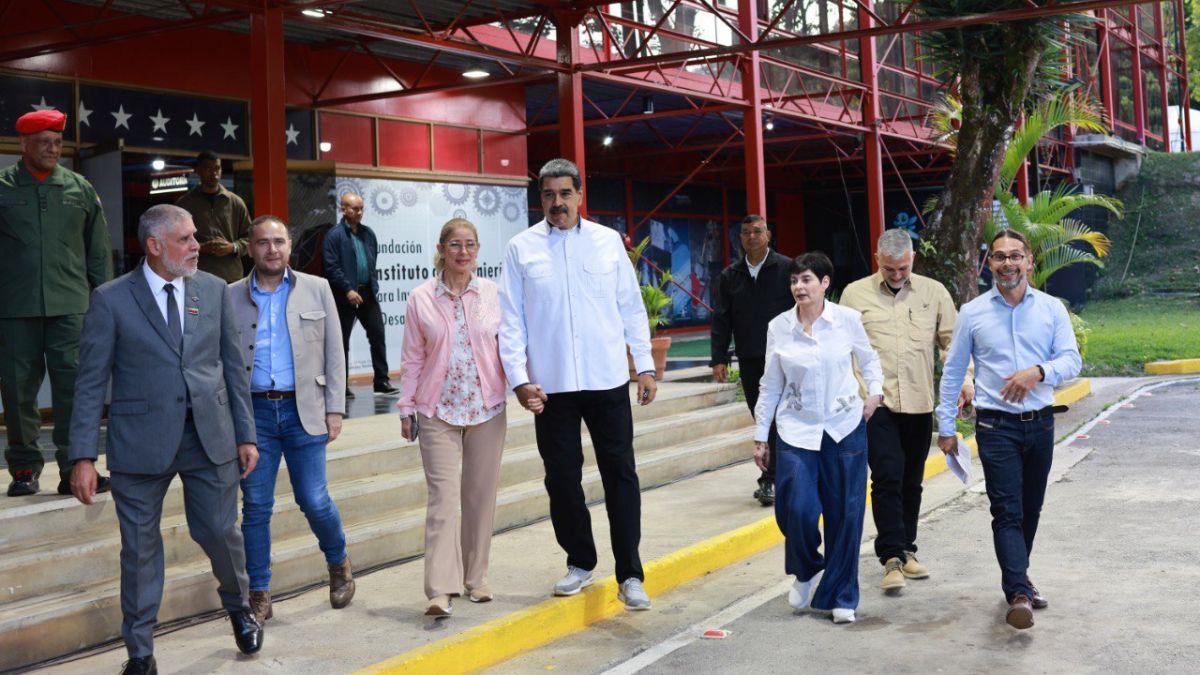
The Head of State was amazed by the advances of the Great Science and Technology Mission Dr. Humberto Fernández-Morán, which seeks to sow knowledge for the country's development.
In this regard, he compared investment in science and technology to a seed that “grows and bears fruit”, and he assured that this is the path to building “Venezuela's power”.
The President emphasized that all research must have as its ultimate goal peace, life and development of both the nation and the peoples of the world.
During the activity, the dignitary toured the facilities of the Venezuelan Scientific and Technological Center, which houses the Engineering Institute Foundation for Research and Technological Development (FIIDT). The objective of the visit was to consolidate this cutting-edge center for national science.
He also visited strategic areas where state-of-the-art electronic microscopes are located, such as the Field Emission Scanning Electron Microscope (FESEM) and the Scanning Electron Microscope (SEM). These tools will strengthen research in key fields such as geochemistry, geology and criminalism, creating an innovative ultramicroscopy ecosystem in the country.
The advances of the Great Mission are focused on the following vertices:
Vertex 1: Planting and preserving national scientific talent.
Vertex 2: Strengthening spaces for research, development and scientific innovation.
Vertex 3: Science, Technology and Innovation for Production.
Vertex 4: Venezuela towards digital transformation.
Vertex 5: International Cooperation and Alliances.
In addition, the scientific complex has a strategically distributed infrastructure:
Miranda Building: A residential area for young people studying at the “Dr. Humberto Fernández Morán” University of Sciences, with capacity for about 60 students.
Ludovico Silva Building: Headquarters of the neonatal research laboratory of the Foundation of the Institute for Advanced Studies (IDEA).
Sucre Building: A housing space for international researchers who visit the country to carry out studies in areas such as environment, agri-food and health.
As part of the National Government's policies for the strengthening of science and technology, all the areas that make up the Scientific Pole have been previously renovated, guaranteeing optimal spaces in line with the needs of the Venezuelan scientific sector.
Mazo News Team